


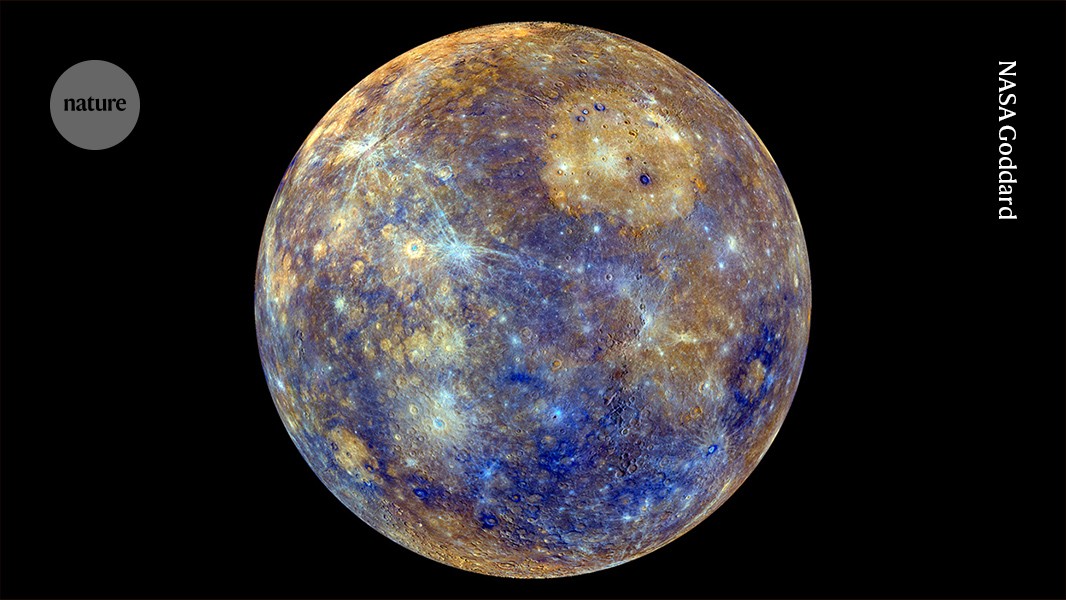
A pseudocolor representation of Mercury generated using data from MESSENGER.Credit: NASA Goddard
After an eight-year journey, the European and Japanese BepiColombo spacecraft has arrived at Mercury. It is only the second mission to enter orbit around the Solar System’s innermost planet, following NASA’s MESSENGER mission, which operated there from 2011 to 2015.
On November 21, the European Space Agency (ESA) announced that a European-built module had been placed into orbit around Mercury. A series of operations will continue over several months. In the coming weeks, the mission’s two science probes—one built by ESA and the other by the Japan Aerospace Exploration Agency (JAXA)—will separate, enabling each to follow its own orbit at a different altitude.
During its journey to Mercury, BepiColombo tested some of its onboard equipment. Mission scientists pointed the Mercury Imaging X-ray Spectrometer (MIXS), an X-ray camera, at the Crab Nebula—the remnant of a supernova observed from Earth in 1054. MIXS is the first X-ray imager sent on an interplanetary mission, said Emma Vance, a plasma physicist at the University of Leicester in the UK and one of BepiColombo’s lead mission scientists.
One mission, two orbiters
For now, the two spacecraft will remain coupled until they reach the orbit designated for the JAXA spacecraft, called MIO, on December 9. MIO will travel in an elliptical orbit ranging from 500 to 11,000 kilometers in altitude, sampling the interaction between Mercury’s magnetic field and the solar wind.
The ESA-built Mercury Planetary Orbiter (MPO), which carries MIXS among other instruments, will then gradually descend into an orbit between 400 and 1,500 kilometers above the planet. It is expected to reach that orbit in March 2027, after which MIXS will continuously study Mercury’s surface.

BepiColombo spacecraft (illustration).Credit: ESA – P. Carril
Traveling to the deepest parts of the Solar System is a “long-term undertaking,” Vance said. “Energetically, it takes more energy to go to Mercury than it does to go outside the solar system,” she said.
BepiColombo launched in October 2018 and had to descend gradually toward the Sun without accelerating so much that it would overshoot Mercury.
Source: www.nature.com