


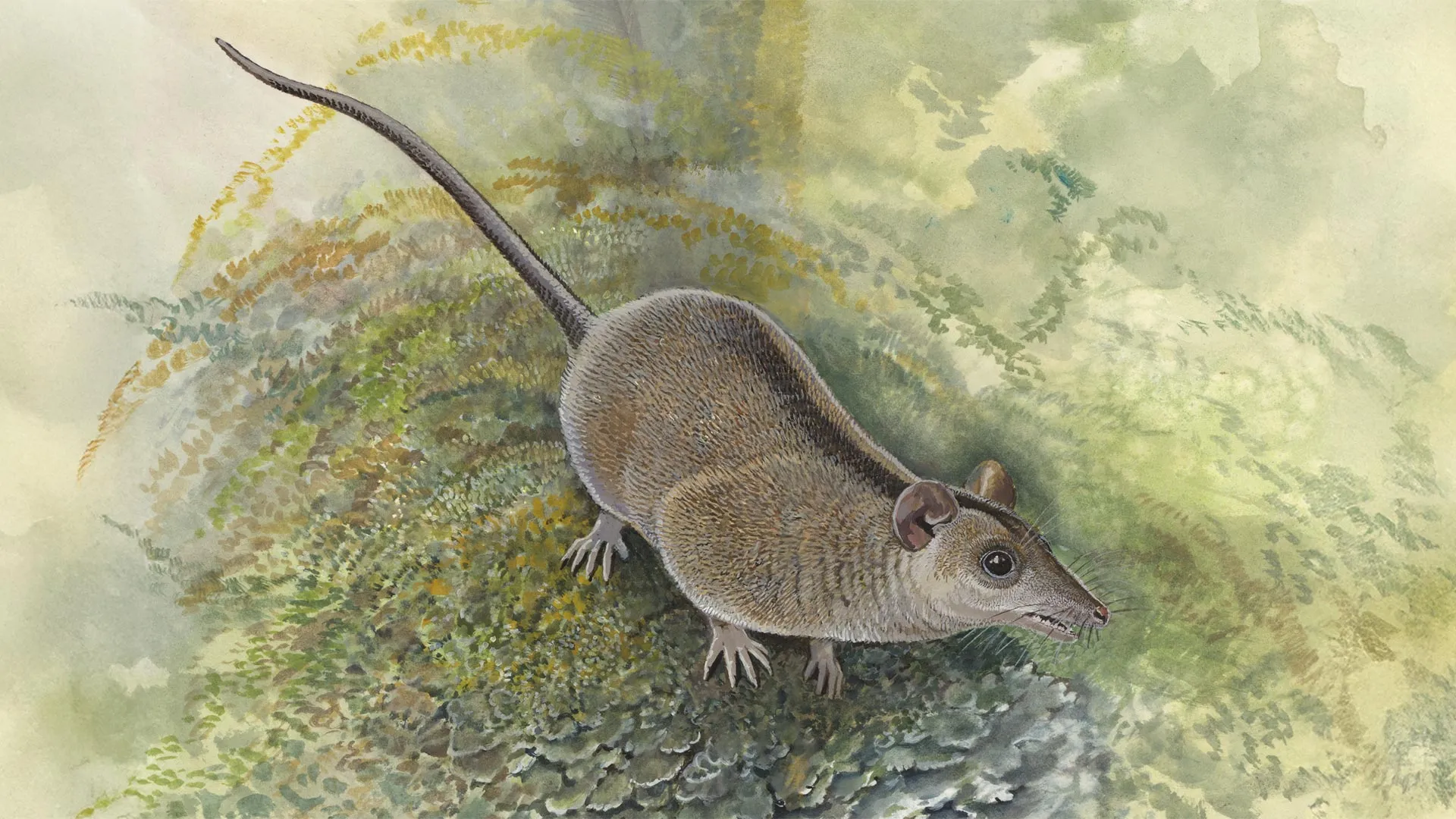
A newly identified branch of the marsupial family tree introduces an intriguing twist to the evolutionary history of Australia’s most unique mammals. This groundbreaking discovery indicates that the evolution of marsupials in Australia is far more intricate and enigmatic than scientists previously thought.
Marsupials first made their appearance in Australia over 55 million years ago. Since this time, they’ve expanded into a stunning variety of habitats and lifestyles. Today, there are approximately 160 species, ranging from highland creatures like tiny possums that hibernate in winter to desert specialists in the Red Center—such as small, pink-furred moles that spend their entire lives underground.
Despite their evolutionary success, many aspects of marsupial diversification in Australia remain a mystery. Significant gaps in the fossil record obscure large portions of their early history.
Recently, in a new paper published in the Paleontology Journal, researchers from UNSW identified three new species that may belong to an ancient and previously unknown class of marsupials. This discovery sheds light on some rare aspects of early marsupial evolution on the continent.
“This isn’t just a new order; it could also represent the oldest lineage of all Australian marsupials,” states UNSW palaeontologist Dr. Tim Churchill.
“It could be an ancestral species of all our marsupial carnivores.”
A New Branch in the Marsupial Family Tree
The prevailing theory suggests that marsupials reached Australia from South America via Antarctica before the fragmentation of the ancient supercontinent Gondwana.
While the broader framework is generally accepted, the finer details remain hazy. Fossils dating back around 55 million years imply that Australian marsupials may have originated from a single, early lineage that later branched out into today’s marsupial groups.
These groups now fall into five orders within the Superorder Australidelphia, encompassing all extant and extinct Australian marsupials (plus one South American marsupial).
Dr. Churchill is currently proposing a Sixth Order called Keenamorphia. His analysis suggests this group may have thrived for approximately 35 million years.
Keenamorphia members were likely small, insectivorous creatures weighing between 25 and 200 grams. They inhabited the forests that are now northern Queensland until their extinction roughly 15 million years ago.
This region, unlike the arid landscapes visible today, was likely a lush, humid rainforest that supported the ancestors of many modern Australian fauna.
“Around 14 million years ago, the climate began to cool,” Dr. Churchill noted.
“Dense forests began to vanish, making way for more open woodlands, lakes, and grasslands.”
Fossils from the Riversleigh World Heritage Site
The three Keenamorphia species described by Dr. Churchill lived approximately 18 million years ago. Following their death, their remains were submerged in shallow cave pools, where their body parts were preserved in what is now the Riversleigh World Heritage Site, one of the world’s most significant fossil sites.
Complete skeletons are a rarity in the fossil record, prompting researchers to rely on smaller indicators like teeth and jaw fragments. Through these clues, they determined the animals’ place within the marsupial family tree.
The research team merged fossil evidence with genetic data from contemporary species, enabling them to construct phylogenetic trees that depict relationships among various species and estimate the timing of their evolutionary divergence.
“Our goal is to create a tree illustrating the connections between all different species while also estimating when those branches diverged,” Dr. Churchill elaborated.
Teeth Unraveling Evolutionary Mysteries
Analysis revealed that these three species coexisted alongside several other familiar marsupials. However, their dental structures were atypical and did not appear closely related to neighboring marsupials.
Interestingly, their teeth bore similarities to those of Jarsia murgonensis, an extinct marsupial from about 35 million years ago, identified as the archetype of Australian marsupials.
Dr. Churchill asserts that this indicates a previously unrecognized and unique line of marsupials that likely diverged early and persisted for millions of years while other lineages evolved around them.
“These creatures seemed quite primitive compared to their contemporaries and exhibited unique behaviors allowing them to thrive alongside them,” Dr. Churchill stated.
While phylogenetic trees typically depict a single original group that subsequently diversified into modern Australian marsupials, the fossil evidence suggests a more complex scenario.
A More Intricate Evolutionary Narrative
Dr. Churchill proposes that the earliest members of Keenamorphia may have emerged shortly after the arrival of the first marsupials in Australia from Antarctica around 55 million years ago.
If this hypothesis holds, Keenamorphia could represent one of the earliest marsupial lineages to separate from the primary evolutionary branch, challenging the simplified narrative of marsupial evolution that posits single ancestral groups leading to the wide variety of Australian marsupials.
Moreover, it raises further questions: If this primitive group diversified so early, how did it endure for so long with little change?
“The evolutionary history of marsupials is far more complicated than merely a single group remaining after the continent’s separation from Antarctica, giving rise to all of Australia’s marsupials,” Dr. Churchill said.
“During Gondwana’s existence, Australia was populated by numerous peculiar, primitive marsupial-like species, some of which likely survived and contributed to our modern lineage.”
Unveiling Hidden Diversity in the Fossil Record
Much of this early diversity may still be absent from scientific record. A nearly 20 million-year gap in the fossil history of Australian marsupials leaves ample opportunities for discovering many yet-unknown lineages.
Some of these ancient organisms might share a common ancestor, while others could have emerged from different lineages left behind in Australia when the continent split.
Scientists may never completely reconstruct the pathways taken by early marsupials during their spread and evolution. Yet, every new tooth fossil unearthed from ancient Australian deposits uncovers additional clues, further complicating and enriching the narrative of marsupial evolution.
Source: www.sciencedaily.com