


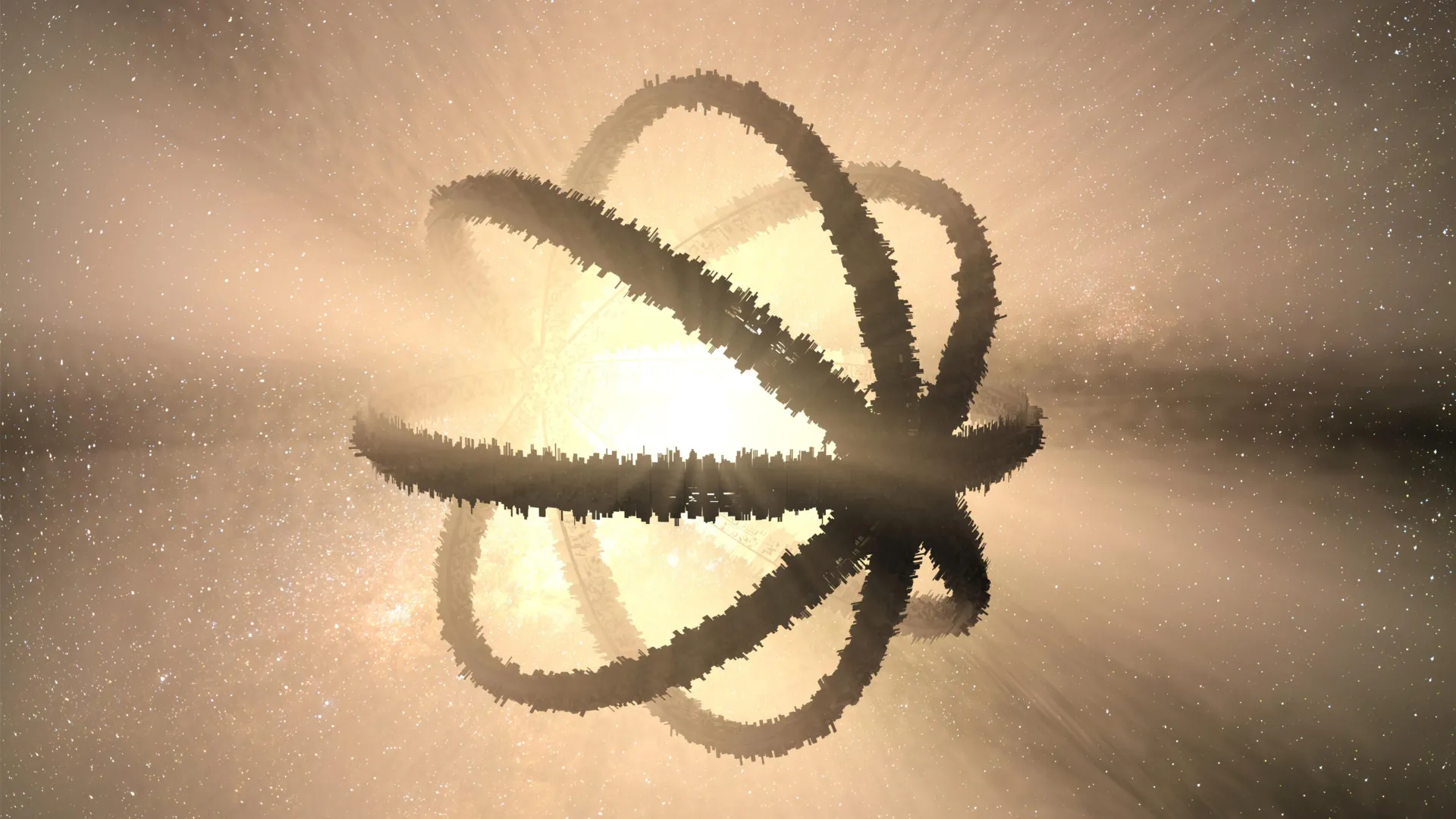
Since physicist Freeman Dyson first introduced the concept of the “Dyson sphere” in 1960, this intriguing theoretical structure has captivated scientists exploring extraterrestrial intelligence. Today, researchers are conceptualizing a more feasible version known as the Dyson “swarm,” which comprises numerous orbiting elements designed to capture nearly all of a star’s energy, rather than a singular solid shell.
Despite extensive theoretical discussions surrounding this concept, many essential questions remain unanswered. What would astronomers observe if a Dyson swarm truly existed? Recent research by Amirnezam Amiri from the University of Arkansas, currently available on arXiv and scheduled for publication in 2016, aims to explore this topic further. Join us as we delve into the potential visuals these colossal structures would present to modern telescopes, along with identifying the types of stars most likely to host them.
Red Dwarfs and White Dwarfs: Prime Targets for Dyson Swarms
Among the most promising candidates are red dwarfs—small, cooler stars that dominate the Milky Way. Due to their slow consumption of nuclear fuel, they can potentially last trillions of years, far outpacing the universe’s current age.
The compact nature of red dwarfs also makes them appealing for engineering purposes. Amiri’s study suggests that a Dyson swarm could orbit a red dwarf at distances ranging from about 0.05 to 0.3 astronomical units, necessitating far less construction material compared to swarms surrounding larger stars like our Sun.
White dwarfs present another attractive option. As the remnants of stars like our Sun that have exhausted their nuclear fuel, these dense objects have collapsed to roughly 1% of their original size.
Due to their compact nature, a Dyson swarm could orbit just a few million kilometers above a white dwarf’s surface, minimizing the size of structures needed. Additionally, white dwarfs emit energy steadily over billions of years, serving as reliable sources of long-term power.
How Dyson Spheres Alter Stellar Appearance
Astronomers classify stars with the Hertzsprung-Russell (HR) diagram, which charts a star’s luminosity against its temperature. The introduction of a Dyson sphere would significantly alter a star’s position on this diagram.
This megastructure would absorb nearly all of a star’s emitted radiation, preventing visible light from escaping. Since energy can’t disappear, an equal amount must be released as heat in the infrared spectrum. Essentially, the Dyson sphere absorbs starlight, utilizing that energy for its intended purpose while radiating excess energy as infrared heat.
While the star’s overall energy output remains stable, its apparent temperature drops significantly. HR diagrams utilize bolometric luminosity, meaning the object’s luminosity stays constant but shifts dramatically cooler on the chart.
Unique Infrared Signature: A Telltale Sign
This temperature shift represents one of the most surprising predictions from the study. A typical red dwarf possesses a surface temperature around 3000K, but the effective temperature of the surrounding Dyson sphere may plunge to approximately 50K—about two orders of magnitude lower.
No known natural stars occupy this segment of the HR diagram, making any findings in this zone compelling candidates for further investigation.
Another potential indicator is the lack of dust. Conventional stars often show silicate emissions due to dusty disks. In contrast, a Dyson swarm consists primarily of radiator panels, giving it a notably “clean” spectrum.
Searching for Unusual Light Curves
Amiri’s study also emphasizes that constructing an entirely solid-state Dyson sphere is nearly impossible. Recent calculations indicate that the required amount of material is impractical, even for smaller stars.
Advanced civilizations might choose to build solar collector swarms with gaps or varied densities throughout the arrangement. As these elements orbit a star, they can create highly unusual brightness fluctuations that deviate from typical stellar patterns.
James Webb: The Quest for Alien Megastructures
The James Webb Space Telescope, with its specialization in infrared observations, is particularly well-suited for investigating these hypothetical structures. Contributions from prior missions like WISE also play an important role in this inquiry.
In May 2024, Project Hephaestus researchers identified seven promising candidates for Dyson spheres, all linked to red dwarfs, after reviewing a catalog of nearly 5 million stars. One candidate was eventually dismissed due to the presence of a perfectly aligned supermassive black hole explaining the anomaly.
Nevertheless, five candidates remain worthy of in-depth study. While not yet confirmed as alien megastructures, Amiri’s research provides astronomers with additional observational clues to differentiate between genuine technosignatures and natural cosmic phenomena. If Dyson swarms exist anywhere in the Milky Way, future infrared observations could eventually uncover their elusive locations.
Source: www.sciencedaily.com