


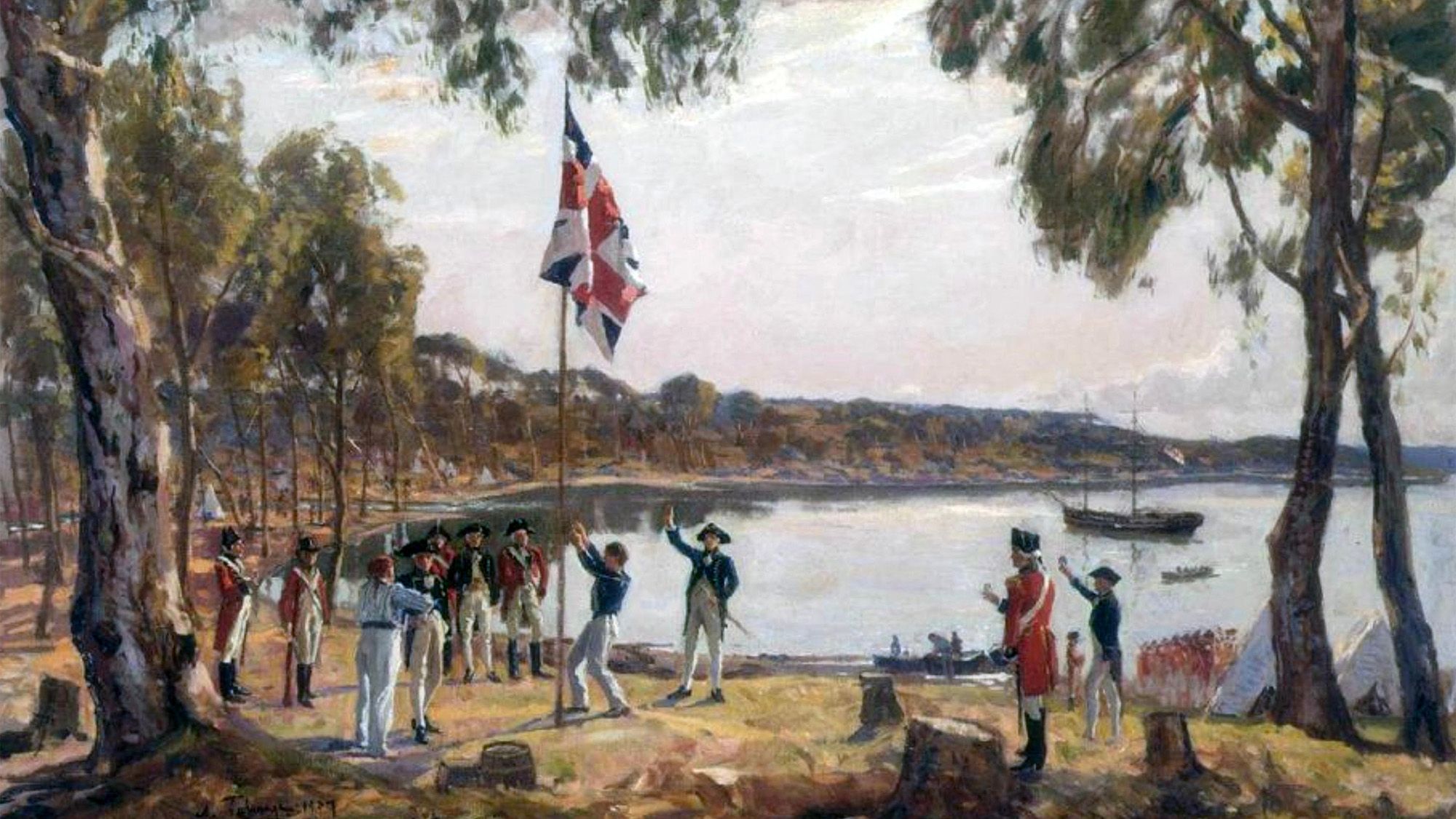
The origins of the 1789 smallpox epidemic that tragically affected Australia’s Indigenous population have been the subject of extensive debate. Recent modeling research has uncovered compelling evidence pointing to its introduction by the ‘First Fleet’ of British ships that arrived in Australia in 1788.
This new finding derives from a sophisticated mathematical model analyzing the disease’s impact on Indigenous Australians, challenging earlier theories suggesting the outbreak resulted from contact with Indonesian fishermen in Australia’s far north.
Alan Williams — an archaeologist at EMM Consulting and co-author of a study published in the journal Nature Human Behavior on July 9 — informed Live Science that the outbreak was likely caused by a vial of dried smallpox scabs that a British doctor had preserved for vaccination purposes (though this was a precursor to the modern smallpox vaccine).

Some historians have contended that no live smallpox virus could have survived the eight-month voyage from Portsmouth, England to Botany Bay, where British ships first landed in Australia.
However, investigations suggest that vials of smallpox scabs may have been replenished during the journey, particularly during stops in Cape Town, South Africa, or Rio de Janeiro, Brazil, as revealed by Williams.
Williams noted that the smallpox epidemic devastated Indigenous communities, leading to a swift decline in Indigenous culture. It is estimated that approximately 220,000 people died from the disease. Early 20th-century Australian authorities lacked accurate data on the Indigenous population while attempting to document historical accounts.
Mystery Outbreak
Decades after British naval officer James Cook mapped Australia, the British sent ships to settle the continent. The First Fleet comprised 11 vessels: two naval ships, six prisoner transports, and three food supply ships. Britain claimed that Australia was unoccupied. Due to limited resources, the fleet quickly departed Botany Bay for Sydney Cove, where they raised the British flag and claimed the territory.
Get the world’s most fascinating discoveries delivered straight to your inbox.
Upon the First Fleet’s arrival, there were no symptoms of smallpox among local Indigenous communities; however, the disease wreaked havoc in the subsequent decades. Initially, it was assumed the virus reached Australia via contact with tropical north coast islanders in Makassar, Indonesia.
Computer modeling of this proposed north coast outbreak suggests it is highly improbable that the disease spread to southeastern Australia due to significant geographical barriers, including vast stretches of uninhabited deserts, according to Williams. Researchers believe that modeling a smallpox outbreak in communities near Port Jackson indicates its true origin.
Matthew Cody Nitschke, a computer modeling expert at Adelaide’s Flinders University, conveyed to Live Science the growing consensus that the outbreak likely did not originate in the north. In contrast, there is robust evidence indicating it was indeed from the First Fleet.
At that time, the theory of viruses was not yet developed. Thus, Williams suggests that the smallpox epidemic’s emergence may have been a tragic coincidence.

An Indigenous Australian man holds a traditional weapon and performs a dance at the Laura Quincan Dance Festival in Cape York, Australia. New estimates suggest Australia’s hypothetical carrying capacity before British arrival was up to 5 million Indigenous people.
(Image credit: Chameleon’s Eye, via Getty Images)
Revising Previous Ideas
The recent study published in Nature Human Behavior is part of an ongoing investigation that suggests there were as many as three million Indigenous Australians when the First Fleet arrived. This figure significantly exceeds the earlier estimates of approximately 300,000.
The follow-up study indicates that Australia’s theoretical population capacity prior to British colonization might have been as high as 5 million, particularly in resource-abundant areas in the north and southeast.
Previous estimates of around 300,000 Indigenous Australians likely originated from 1930s studies that only accounted for reduced populations due to the impacts of disease, violence, and displacement. “It took a century of turmoil before accurate population assessments could be established,” noted Williams.
Henry Reynolds, a historian at the University of Tasmania not directly involved in the study, confirmed to Live Science that the research effectively refutes earlier claims that the smallpox outbreaks started along the north coast. “The notion that the disease traveled from the north and coincided precisely with the First Fleet arrival was always unfounded,” he stated.
Anne McGrath, a historian at the Australian National University in Canberra, who did not participate in the study, concurred. “The interdisciplinary approach of this study convincingly debunks outdated ideas and provides significant insights into the Indigenous population prior to 1788,” she shared in an email.
Nitschke, M., Williams, A., Ingrey, S., Griffiths, B., Pitt, N., Russell, L., Ulm, S., Beller, K., Bird, M., Fatima, S., McNiven, I., Saltre, F., Bashford, A., Wilson, C., & Bradshaw, C. (2026). Stochastic models show rapid spread of smallpox and mass mortality of Indigenous Australians after colonial exposure. Nature Human Behavior.
Source: www.livescience.com