


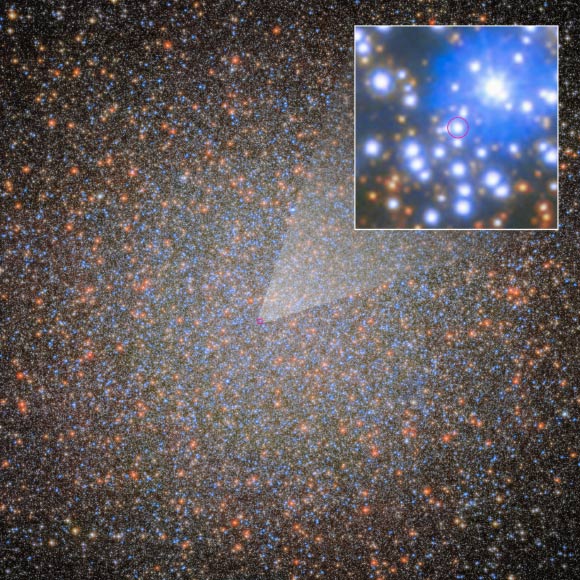
After extensive research spanning decades, astronomers have successfully identified the first of an estimated 10,000 stellar-mass black holes in Omega Centauri, the most massive star system in the Milky Way, boasting a mass of 3.6 million solar masses.
Whitaker et al. have discovered the first stellar-mass black hole in Omega Centauri, which features a visible stellar companion. Image credits: ESA / NASA / Maximilian Häberle, MPIA / Joseph DePasquale, STScI.
Omega Centauri, located approximately 18,000 light-years away in the constellation Centauri, is also known as NGC 5139. This massive globular cluster spans about 150 light-years in diameter and is around 12 billion years old.
Among the approximately 200 globular clusters orbiting the Milky Way, Omega Centauri stands out as the largest, harboring over 10 million gravitationally bound stars.
It is recognized as the brightest globular cluster in our galaxy, boasting an apparent magnitude of 3.9, making it visible to the naked eye for observers in the southern hemisphere.
Previously, the astronomical community had observed intermediate-mass black holes at the centers of star clusters through NASA/ESA’s Hubble Space Telescope; however, models indicate that Omega Centauri may contain around 10,000 smaller stellar-mass black holes.
This remarkable population of black holes had evaded detection in prior observational studies that utilized radial velocity methods or analyzed radio and X-ray emissions from matter spiraling into the black holes.
The new discovery employs a unique approach, measuring the subtle movements of stars over time in this stellar environment.
Using over two decades of archived data from Hubble and recent inputs from the NASA/ESA/CSA James Webb Space Telescope, University of Utah astronomer Matthew Whitaker and his team uncovered a star orbiting an unseen object so massive that it must be a black hole.
Designated oMEGACat BH-2, this black hole is the first stellar-mass black hole detected in Omega Centauri and exhibits some unexpected characteristics.
This compact object has a lower mass than anticipated, and along with its visible companion star, oMEGACat BH-2 has the longest orbital period of any known black hole binary system.
“With data from Hubble and Webb, we observed the motion of visible main-sequence stars within this binary system, located approximately 18,000 light-years away in the dense environment of Omega Centauri,” Dr. Whitaker commented.
“The precision of these measurements is remarkable, reaching a fraction of a pixel using Hubble and Webb’s detectors.”
“Without these space telescopes, locating this black hole would have been impossible.”
An analysis of precise measurements from Hubble and Webb allowed astronomers to map the star’s orbit over more than 20 years, particularly during its closest approach to the black hole’s companion star, which moves rapidly across the sky.
The team determined that the visible star orbits oMEGACat BH-2 every 94 years, making it the longest-period black hole binary known to date.
This system likely formed dynamically, indicating that the star and black hole did not originate together, but rather came together within this globular cluster.
Researchers estimate that a system like oMEGACat BH-2 will survive for less than a billion years before it is disrupted by a collision with a neighboring star, significantly shorter than the age of the cluster itself.
“Understanding black hole populations in globular clusters is crucial due to uncertainties surrounding their physics and formation,” stated Dr. Anil Seth, also from the University of Utah.
“Specifically, grasping how black holes form and subsequently give rise to binary star systems is vital, as it affects our understanding of gravitational wave phenomena.”
“Globular clusters like Omega Centauri are thought to be primary sites for binary mergers, leading to gravitational waves.”
For more details on this breakthrough, check out the research paper published in Astrophysics Journal Letter.
_____
Whitaker et al. 2026. ω Centauri’s long-period stellar mass black hole binary. APJL 1006, L1; doi: 10.3847/2041-8213/ae7a5c
Source: www.sci.news