


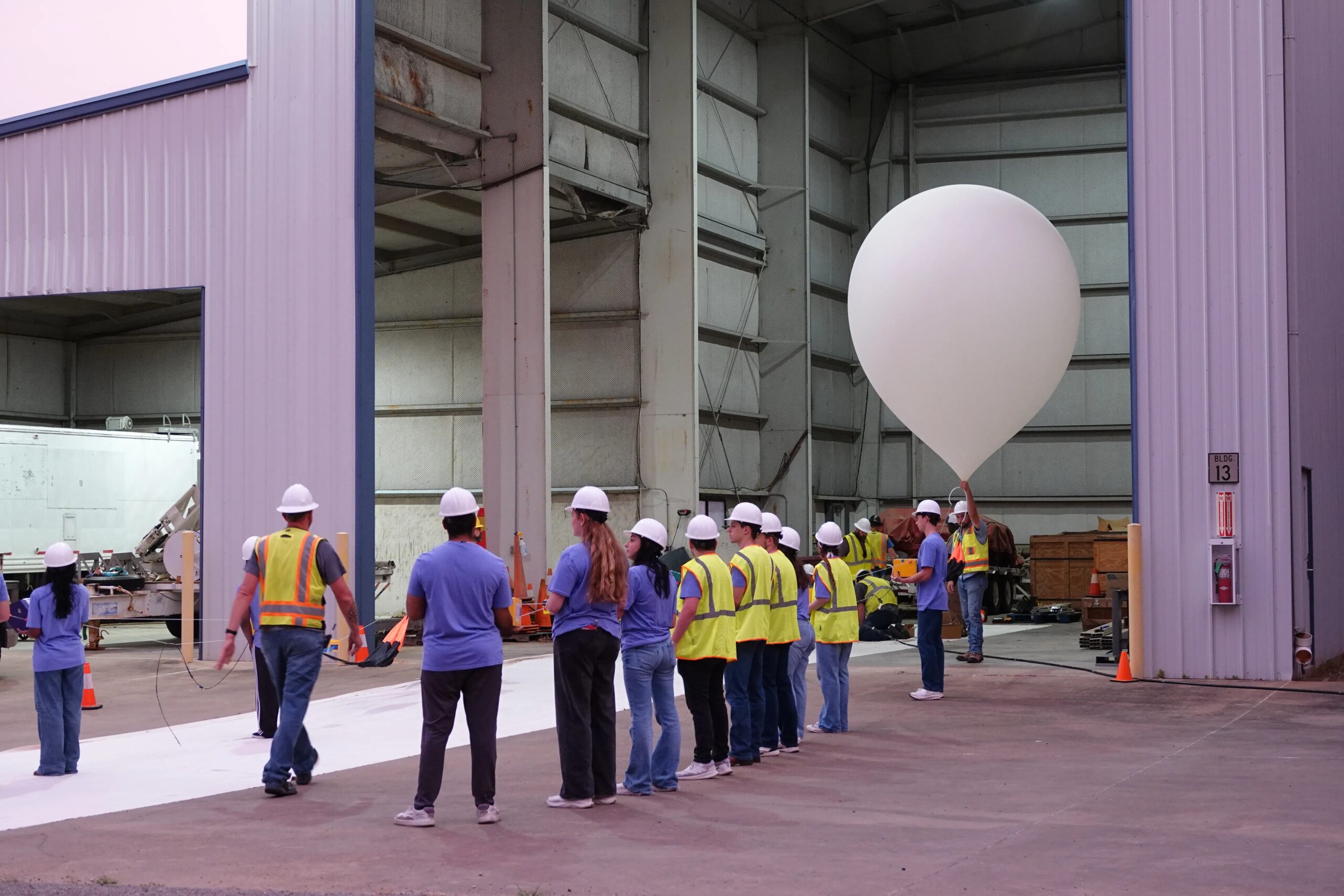
Each spring, the fields surrounding NASA’s Columbia Scientific Balloon Facility in Palestine, Texas, become a launch site for student innovation. Students and faculty from across Louisiana arrive with sensors, laptops, and payloads they have spent months designing and building. Their mission is to send scientific experiments to the edge of space, collect valuable data, and gain hands-on experience that supports NASA’s goal of preparing the next generation of scientists and engineers.
NASA student programs provide an important pathway to hands-on exploration, connecting students with agency missions and real-world aerospace operations. One of these initiatives, the Louisiana Aerospace Catalyst Experiences for Students, or LaACES, gives undergraduate students an introduction to scientific ballooning, aerospace engineering, and experimental research.
Just after dawn on May 19, student-built instruments lifted off successfully from the flight line, marking the 74th and 75th launches in the long-running partnership between the balloon facility and the Louisiana Space Grant Consortium. The 2026 LaACES campaign featured 11 payloads designed and built by nine Louisiana university teams representing Louisiana State University, Northwestern State University, Southeastern Louisiana University, McNeese State University, Loyola University, and Southern University. One high school team from St. Joseph’s Academy also participated in the weeklong campaign.
The student research projects covered a broad range of scientific topics, including atmospheric science, cosmic-ray detection, thermal management, ultraviolet characterization, stratospheric wind analysis, and solar-cell performance.
Before traveling to Texas, the teams developed their mission concepts through a series of design reviews modeled on NASA’s engineering lifecycle. From preliminary design through flight readiness, students defended their technical decisions, improved their payloads, addressed engineering challenges, and demonstrated that their experiments were ready for launch.
After receiving approval from LaACES program directors Doug Granger and Aaron Ryan, the teams moved their operations to Palestine, Texas. NASA’s Columbia Scientific Balloon Facility supported the 2026 LaACES campaign by providing daily weather briefings, filling both latex balloons with helium, and offering launch-line guidance to promote safe and successful operations.
“We enjoy being able to support the students’ launches here and hope to help them cultivate a love for ballooning,” said Hugo Franco, operations manager at the balloon facility.
The two student flight trains, designated LACES-74 and LACES-75, launched May 19 at the beginning of the program’s first launch window. The balloons were designed to carry payloads weighing approximately 7 to 9 pounds. They ascended to near-space altitudes while teams monitored the missions through multiple communication and tracking systems. Both flights were completed successfully, and the payloads were recovered approximately 60 miles north of the launch site near Ben Wheeler, Texas.
“My most memorable experience during the course of this year was seeing the plots for the first time post flight,” said Savannah Matlock, a Louisiana State University student. “When we saw the data behave in the way we’d expected it to, and saw the science we were able to demonstrate, it makes it all worth it. It’s a great feeling to see all of your hard work pay off.”
After recovery, the student teams analyzed sensor readings and environmental measurements before presenting their results to balloon facility engineers and technicians, faculty mentors, and fellow students.
Programs such as LaACES reflect the real-world operations of NASA’s Scientific Balloon Program. NASA scientific balloons are far more advanced than conventional weather balloons. The Columbia Scientific Balloon Facility supports the launch, tracking, and recovery of large scientific balloons carrying sophisticated research instruments to the edge of space. These missions enable research in astrophysics, atmospheric science, planetary science, technology demonstrations, and other fields.
By placing students within this professional research environment, LaACES bridges academic learning and national scientific operations. Participants experience every stage of a mission, including experiment preparation, payload integration, launch, tracking, data collection, and recovery. These experiences can influence career decisions and create opportunities in NASA, aerospace, higher education, and the broader space industry.
Funded by NASA’s National Space Grant College and Fellowship program, LaACES is a statewide initiative of the Louisiana Space Grant Consortium. Since its creation, the program has supported more than 500 students at 13 higher-education institutions, launched more than 60 balloon flights, and flown approximately 135 unique payloads. As NASA continues advancing scientific discovery, programs like LaACES help build a strong pipeline of future innovators. For participating Louisiana students, watching a carefully engineered payload rise into the sky is more than a technical achievement—it is a defining moment that transforms curiosity into possibility.
Source: www.nasa.gov