


This article is fully accessible via your institution.
Hello Nature Readers! Want to receive daily briefings like this one for free? Sign up here!
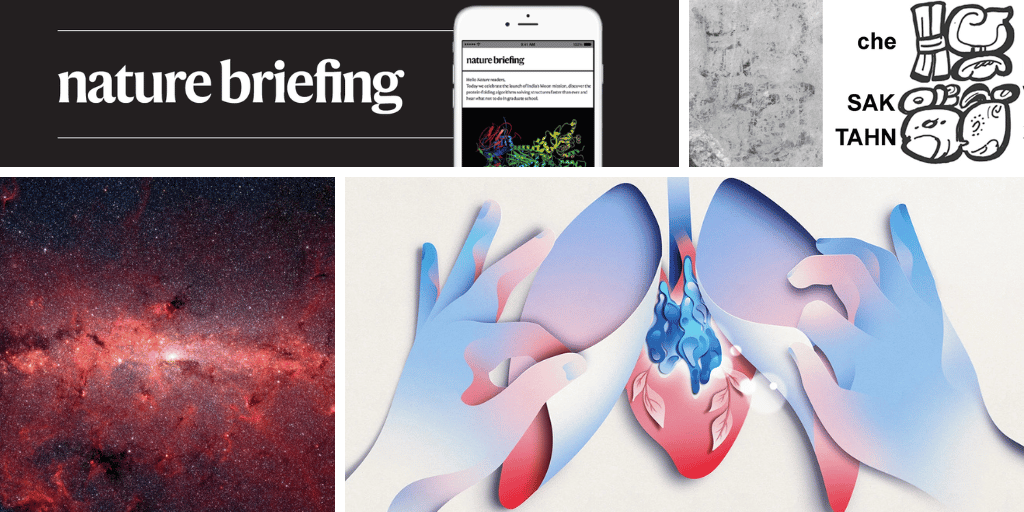
Researchers have identified a four-carbon sugar called erythroulose in a cloud of gas and dust at the Milky Way’s center (as shown by the Spitzer Space Telescope).
Credit: NASA, California Institute of Technology, Susan Stolovy (SSC, California Institute of Technology)
Astronomers have discovered erythroulose, a complex four-carbon sugar, in molecular clouds near the Milky Way’s core, marking a significant finding outside our solar system. This discovery suggests that sugars essential for the development of early DNA and RNA could be transported to asteroids or comets during the formation of star systems. According to Izasquun Jiménez Serra, an astronomer and co-author of the study, these celestial bodies may have brought these crucial organic materials to Earth approximately 4 billion years ago during intense asteroid impacts.
Nature | 5-minute read
Reference: Natural Astronomy paper
In a fascinating study, researchers trained participants to write with their elbows, revealing that handedness isn’t solely an innate preference. An article on Science Alert highlights that individuals who taped a pen to their arm showed no difference in performance whether using their dominant or non-dominant hand. The key insight from neurologist and co-author Ahmet Arak is that one hemisphere of the brain excels at controlling movements, shaped by years of practice. “The dominant arm isn’t inherently better,” he explains.
Reference: Proceedings of the National Academy of Sciences paper
A newly deciphered mathematical formula from a Mayan ruin in Xultun, Guatemala, sheds light on the contributions of a renowned Maya mathematician and astronomer named Sak Tarn Wax, whose work reflects advanced mathematical concepts previously unseen in Maya texts. Archaeologist Heather Hurst noted that the playful expression of various calendar systems reveals a notable degree of mathematical flexibility.
Nature | 5-minute read
Reference: Ancient paper

The final hieroglyph translates to “say so,” concluding with the name Sak Tahn Waax, indicating the authorship or credit of the calculations—implying mathematicians were recognized in Maya society. (Franco D. Rossi) Other/Ancient (CC-BY-NC)
Recent Features and Insights
In the last three years, thymus research has surged. Once deemed unimportant, studies suggest the thymus gland’s health significantly indicates overall well-being. This breakthrough has sparked interest in therapies aimed at regenerating the thymus, potentially slowing aging and combating cancer.
Nature | 8-minute read
Regardless of where you live, summer is an ideal time for books. We invited contributors to share their must-read titles. Notably, environmental activist Moriba Jah highlighted a work on water that fueled his mission, while AI researcher Blaise Aguera y Arcas praised Jean-Baptiste Lamarck for his “quietly radical” insights about life’s ongoing self-organization.
Nature | 13-minute read
Researchers are increasingly focusing on specific epigenetic markers—chemical tags on DNA that influence gene expression—to advance treatment methods. Biomedical engineer Charles Gersbach emphasizes the sophistication of epigenome editing, which allows for more nuanced manipulation compared to traditional gene editing.
Nature | 16-minute read
Today, I’m learning from a master. Each day, Jan shares a video of himself striving to cut the perfect slice of bread. His best effort reached a mere 0.08 mm of precision, proving the value of a determined, enjoyable endeavor over perfection.
Reflecting on the nine years since I’ve penned this briefing, the countless emails exchanged have made every moment worthwhile. My aim isn’t flawless uniformity but to enhance each edition progressively. Your feedback—whether positive or critical—enriches this journey. Though responding to every message is challenging, both Jacob and I read all correspondence; feel free to reach us at [email protected].
Thank you for reading,
Flora Graham, Editor-in-Chief, Nature Briefing
Contributed by Jacob Smith, Associate Editor, Nature Briefing
• Nature Briefing: Careers — Insightful advice and award-winning journalism to optimize your professional life.
• Nature Briefing: Microbiology — Explore microorganisms, the most numerous life forms on Earth, and their roles in health and the environment.
• Nature Briefing: The Anthropocene — Examine the impact of climate change, biodiversity, sustainability, and geoengineering.
• Nature Briefing: AI and Robotics — Insightful content, 100% written by humans.
• Nature Briefing: Cancer — A weekly newsletter tailored for cancer researchers.
• Nature Briefing: Translational Research — Covering biotechnology, drug discovery, and pharmaceuticals.
Source: www.nature.com