


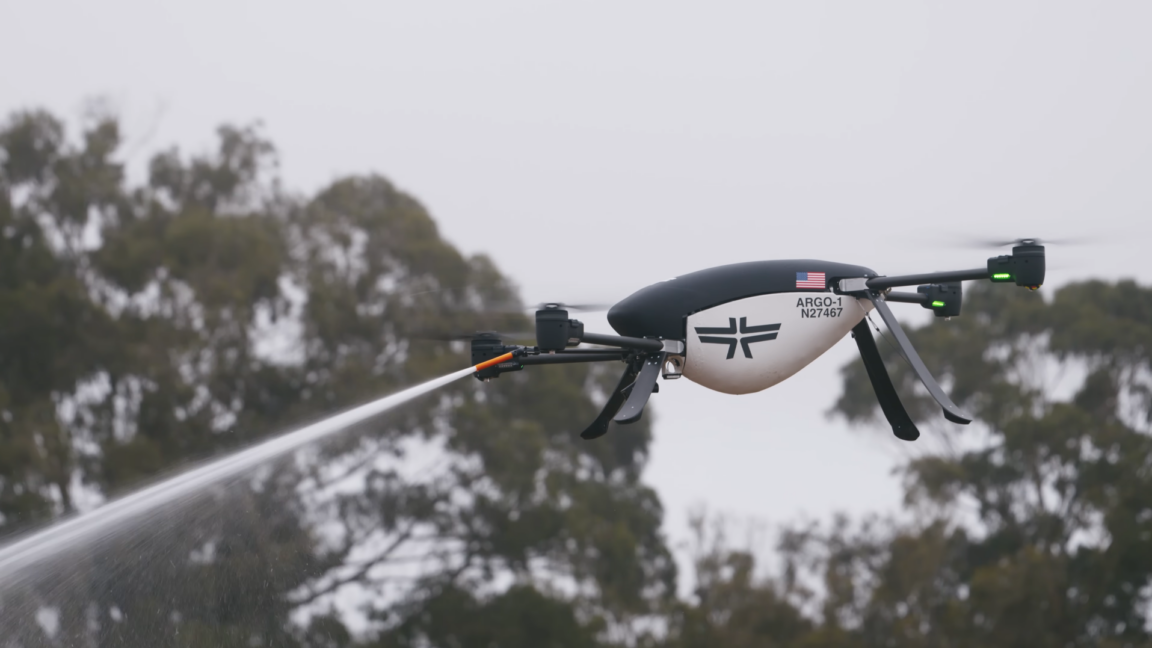
Drones equipped for spraying water and fire retardants are honing their skills to combat early-stage wildfires in California and Alaska this summer. These innovations demonstrate their potential as an essential rapid response tool amidst increasingly dangerous wildfire seasons driven by climate change across the United States.
Although most drones are smaller and have a limited range compared to manned aircraft, they play a crucial role in supporting firefighting efforts rather than replacing large air tankers. Businesses and fire agencies, alongside organizers of the $11 million XPRIZE competition, are investigating how drones can assist firefighters to swiftly respond to and extinguish minor fires before they escalate.
On July 15, the California Department of Forestry and Fire Protection, known as CAL FIRE, conducted an innovative field test featuring five autonomous drones. These drones collaborated to deploy between 500 to 1,000 gallons of firefighting foam to douse flames, as reported by KPMH. This demonstration was a partnership between the nonprofit FireWERX and the California-based Seneca Company, which plans to commercialize its drones starting in 2026.
Each Argo-1 drone from Seneca can carry around 100 pounds of water or flame retardant, working in swarms of four to six drones. A human operator inputs a GPS waypoint, and the autonomous drone navigates to the target, utilizing onboard sensors to detect heat signatures. According to HeliOps Magazine, the drones optimize their hovering altitude before launching their payloads sequentially.
While fully loaded, drones are limited to a 16-mile round trip at an average speed of about 30 miles per hour. Therefore, strategically positioning them in fire-prone areas or transporting them via ground vehicles is advisable. Notably, each drone can fit in the back of a pickup truck, and an empty unit can be manually carried by two individuals.
Source: arstechnica.com