


Enterprise AI is currently facing a significant ROI paradox. While increasing computational resources for powerful underlying models aids in product experimentation, the costs soar once those products transition to production environments, making them unsustainable.
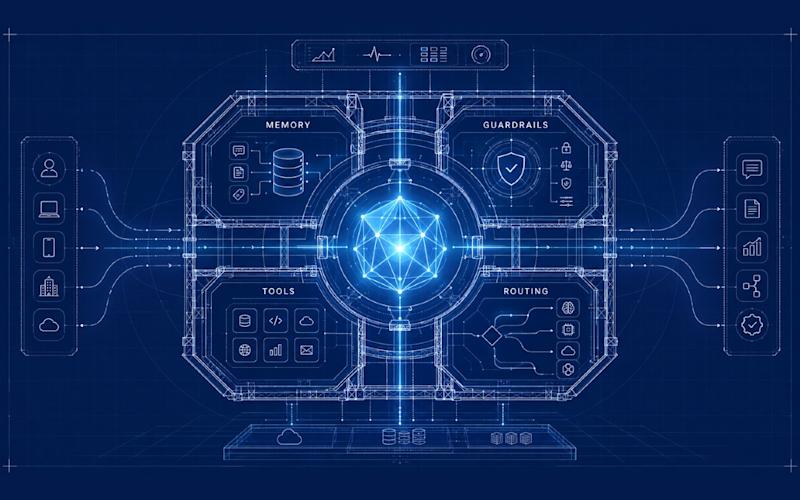
A recent study by Writer researchers presents actionable solutions for engineering teams. This research systematically addresses the optimization of the orchestration layer surrounding AI models—referred to as the AI harness.
The findings indicate that optimizing the AI harness, without altering the core model, reduces the number of tokens required per task significantly, resulting in up to a 61% reduction in costs per successful task, all while maintaining quality standards.
Since the harness falls entirely under developer control and requires no model adjustments, engineering teams can leverage these insights to create cost-efficient AI applications.
Token Maxing and the ROI Crisis
The current landscape of AI engineering is troubled by a trend known as token maxing. This approach sees developers relying excessively on large context windows and brute-force token consumption instead of implementing sound system design principles.
Instead of evolving their workflows, developers often reflect traditional software development practices, leading to ineffective cycles of spawning, running, and failing tasks while continuously stuffing their context windows with errors.
“Tokenmaxxing is currently viewed as the most cost-effective fix, as it aligns with how most engineers work today,” explains Waseem AlShikh, CTO and co-founder of Writer. This cycle often works for coding tasks, leading to its adoption as the default method across various workloads. The danger here lies in the declining token costs masking deeper inefficiencies.
“The cost equation involves tokens per task times the price per token, but most teams only scrutinize the latter,” adds AlShikh. “With agent workloads, token consumption compounds rapidly, exacerbating expenses faster than prices can depreciate. This price drop serves as a numbing agent and obscures the fact that the loops are fundamentally flawed.”
Tokenmaxxing leads to several operational pitfalls. Teams might default to using premium models for simple tasks while exploiting LLMs as lazy search indices, resulting in cluttered context windows. The worst-case scenario involves creating unbounded agent loops that spiral out of control upon encountering errors. For leading model providers, the cost of output tokens generally exceeds that of input tokens, making inefficient task execution a silent budget drain.
Although the industry offers various methods to enhance efficiency, many are insufficient as they treat models in isolation.
-
Instant Compression: Compresses input text for space-saving but neglects the systematic organization of these inputs across intricate workflows.
-
Budget-based Reasoning: Imposes upper limits on computational steps, often leading to reduced output quality when workflows aren’t intelligently routed.
-
Concise Coding: Forces the model to generate minimal code to conserve output tokens but does not resolve inefficient tool calls.
-
Speculative Decoding: Utilizes smaller draft models to expedite text generation for larger models but falls short in addressing bloated agent architectures.
These methods falter as they prioritize engine optimization while disregarding the orchestration layer, leaving core architectural inefficiencies unaddressed.
Leveraging the Harness: A Key to Enhanced Efficiency
The harness functions as the orchestration layer that routes, formats, and operationalizes the underlying LLM into a coherent system.
Core harness optimization techniques include system prompt caching, interaction history compression, effective tool management, retrieval strategies, and robust error management. These are the most straightforward intervention points for engineering teams aiming to enhance AI performance.
As highlighted by the Writer research team, “The harness efficiently organizes model calls and directly influences pricing for model tasks.”
Historically, developers viewed harnesses merely as temporary connectors linking APIs to user interfaces. However, this research emphasizes that harnesses should be regarded as critical software components requiring thorough testing, version control, and strategic design.
This new perspective will fundamentally reshape the “own vs. rent” debate for enterprises.
“Organizations often spend months analyzing models, only to rely on readily available orchestration solutions, optimizing minor aspects rather than addressing the substantial levers,” stated AlShikh. “Ownership of the harness directly correlates to control over unit economics. An out-of-the-box orchestration framework isn’t optimized for core business needs.”
Experimental Insights
To evaluate the orchestration layer’s impact, researchers conducted experiments using six underlying models from various vendors: Claude Sonnet 4.6, Gemini 3.1, Gemini Flash 3.5, Qwen 3.6, GLM 5.1, and Writer’s Palmyra X6.
These experiments compared a traditional static production model loop to a complete Writer Agent Harness for 22 predetermined enterprise tasks, covering grounding and retrieval, multi-step workflows, tool usage, and content creation. By maintaining a consistent model and task, the study isolated the orchestration layer’s influence.

The optimized harness achieved a significant cost reduction, with per-task costs decreasing by 41%, from 21 to 12 cents. This reduction was primarily achieved by lowering token consumption, which dropped from 14.2k to 8.8k tokens per task.
This harness efficiently delegates tasks such as searching to dedicated subagents, ensuring that the subagent receives only the necessary tools and precise queries. It retrieves accurate data and returns a clean, summarized response to the main agent, preventing the primary context window from being cluttered with irrelevant results.
Moreover, the task success rate remained consistent, improving from 78% to 81%—a statistically non-significant yet directional increase, affirming that costs can decrease without compromising quality.
End-to-end task latency was notably improved as well, with a 44% reduction in median real-time from 48 seconds to 27 seconds, largely due to enhanced caching and the elimination of ineffective inference loops.

However, the researchers discovered limitations in multi-agent orchestration. Smaller models like Gemini Flash 3.5 and Qwen 3.6 achieved reliability scores below the thresholds necessary for subagent delegation (0.45 and 0.42, respectively). Therefore, subagent orchestration reached reliability benchmarks only in the two most advanced models examined: Palmyra X6 (0.86) and Claude Sonnet 4.6 (0.85).
Developer Takeaways: Strategic Implementations and Tradeoffs
The findings translate into actionable playbooks for enterprise developers scaling agent workflows. The initial focus should be on implementing strategies termed by AlShikh as “two-zone prompting” and “context offloading.”
Designing the System Prompt Cache (Two-Zone Prompts): Modern LLM APIs support prompt caching, but developers must structure the input correctly. By separating “stable zones” (unchanging elements) and “instability zones” (dynamic elements such as user queries), developers can enhance prompt caching efficiency. By reordering these elements, the harness can reuse cached information across numerous calls. “This separation optimizes prompt caching and avoids redundant costs for repeated instructions,” noted AlShikh.

Manage Contexts with Context Offloading: To avoid context stuffing, which involves accumulating previous responses into a bloated prompt, transfer history and intermediary artifacts to retrievable storage for current tasks. When feasible, delegate to single-purpose subagents to minimize context overload. AlShikh notes, “The primary expense in an agent’s cycle is not inference but the retransmission of previously encountered data.”
Create Resilient Loops and Redefine KPIs: Unsupervised agent loops can deplete your API budget rapidly. Teams should begin monitoring completions per million (CPM) to gauge the true costs of tasks, while the harness should include physical restraints. “It’s crucial that a model is never tasked with monitoring its own expenditure,” AlShikh cautioned. This necessitates three explicit checks:
-
Enforce a Hard Token Budget: Once the budget is reached, the task conclude without exception.
-
Implement Generation Fencing: Stop lapsing agents by limiting recursion depth, step counts, and tool calls.
-
Govern Spending in Failure Cases: Limit expenses incurred after initial validation failures to prevent costly errors.
Avoid Complacent Complexity: Optimizing the orchestration layer brings engineering overhead. During the prototyping phase, this complexity is unwarranted. Rapid iterations with robust models and lightweight harnesses are essential. However, as task volumes escalate into millions per day, the benefits of harness optimization become increasingly pronounced.
Yet, teams must remain mindful of “leverage.” Introducing structural elements requires models to retain context. If the model is insufficiently powerful, it may allocate its limited resources to navigating the scaffolding rather than executing tasks, subsequently compromising accuracy and inflating token use. The principles surrounding added orchestration capabilities are mathematical: “If you introduce more coordination tokens than you can remove task tokens for a particular model, it’s time to scale back,” warned AlShikh. “There are no free additions in the harness.”
The Future of Enterprise Harnesses
The era of reckless tokenmaxxing and treating context windows as unlimited resources is over. For businesses striving to validate their AI investments, infusing more computational power into poorly structured systems is no longer a feasible approach.
As underlying models progress towards integrating planning, tool selection, and multi-step inference more naturally, the harness’s role will transition from addressing model deficiencies to enforcing corporate governance.
“Models cannot inherently incorporate permissions like budgets, access boundaries, or audit trails,” said AlShikh. “In five years, the harness will become streamlined yet pivotal. There will be fewer redundancies and more governance. Irrespective of how advanced the models become, the responsibility for defining expenditures, accessible data, and operational touchpoints will always lie with the company—this layer must be owned, not rented.”
Source: venturebeat.com