


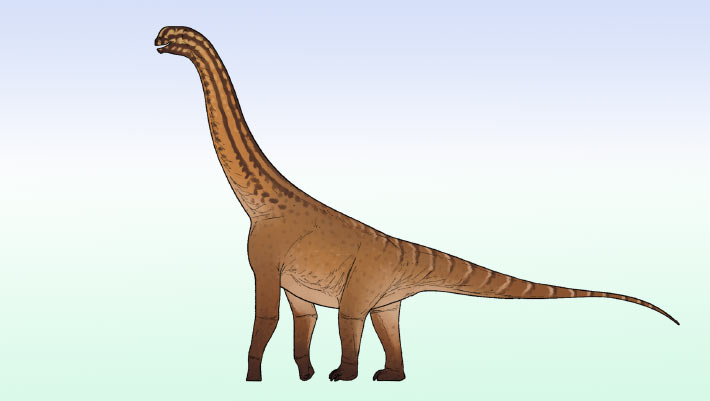
Paleontologists in India have made a groundbreaking discovery with the partial skeleton of a previously unidentified small neosauropod dinosaur, found in Middle Jurassic rocks situated in Gujarat’s Kutch Valley. This remarkable find pushes back the known global spread of major dinosaur lineages by tens of millions of years.
A reconstruction of Ceratocaudia Antiqua, the oldest known large neosauropod species from India. Image credit: Connor Ashbridge / CC BY 4.0.
Ceratocaudia Antiqua belongs to the neosauropod group, which gave rise to colossal dinosaurs like diplodocus, Brachiosaurus, and Argentinosaurus.
In stark contrast to these giants, the newly discovered species measures roughly 7 meters (23 feet) in length.
Dr. Abhishek Natarajan from the Indian Institute of Technology Bombay noted, “Neosauropods represent one of the most successful clades of saurischian dinosaurs, exhibiting significant diversity from the late Jurassic through the end of the Cretaceous period.”
The origins and early diversification of neosauropods (encompassing Diplodocoidea and Macronaria) remain contentious due to factors like limited fossil outcrops, unclear dating of Lower Middle Jurassic deposits, inadequate sampling rates, and incomplete fossil records.
Recent studies aim to address these challenges, suggesting that both diplodocoids and macronarians had extensive geographic ranges and substantial diversity during the Middle Jurassic, indicating a global neosauropod presence in this era.
The Ceratocaudia Antiqua skeleton was discovered in the Kaladongal Formation in western India’s Kutch Valley.
Researchers unearthed a total of 181 bone fragments, including vertebrae, ribs, and limb elements, believed to belong to a single individual.
The region’s fossil-bearing rock formations date back to the Pliensbachian of the Early Jurassic through the Bajocian of the Middle Jurassic, making precise dating a challenge. Ceratocaudia Antiqua could be around 190 million years old.
The fossils are housed at the Vertebrate Paleontology Laboratory, Department of Earth Sciences, Indian Institute of Technology Bombay, Mumbai, Maharashtra.
Researchers utilized digital reconstruction techniques to analyze the musculature of Ceratocaudia Antiqua, drawing comparisons with modern crocodiles and lizards.
Their models indicate that this species could maintain a horizontal tail, swinging it vigorously side to side—an action possibly employed as a defense mechanism against predators.
“The proposed model of Ceratocaudia Antiqua suggests that sauropod tails might have acted as a moderate deterrent against predators, even without specialized adaptations like flagellated tails,” the research team noted.
Phylogenetic analysis positions Ceratocaudia Antiqua as an early branch of the Macronaria, marking it as one of the earliest identifiable neosauropod specimens discovered worldwide.
Alongside two Chinese species, Dachampsaurus dongi and Prunus crenensis, these findings imply that neosauropods had already achieved a global distribution prior to the Bajosian period of the Jurassic.
As the researchers concluded, “Kutchi sauropods represent some of the earliest neosauropods, contributing to the limited global record of Early/Middle Jurassic neosauropods.”
For further details, refer to their publication in the Journal of Vertebrate Paleontology.
_____
Abhishek Natarajan et al. A new small Jurassic neosauropod excavated from the Kaladongal Formation (Kadir Uplift) in the Kachhi Basin of western India. Journal of Vertebrate Paleontology, published online July 16, 2026. doi: 10.1080/02724634.2026.2677749
Source: www.sci.news