


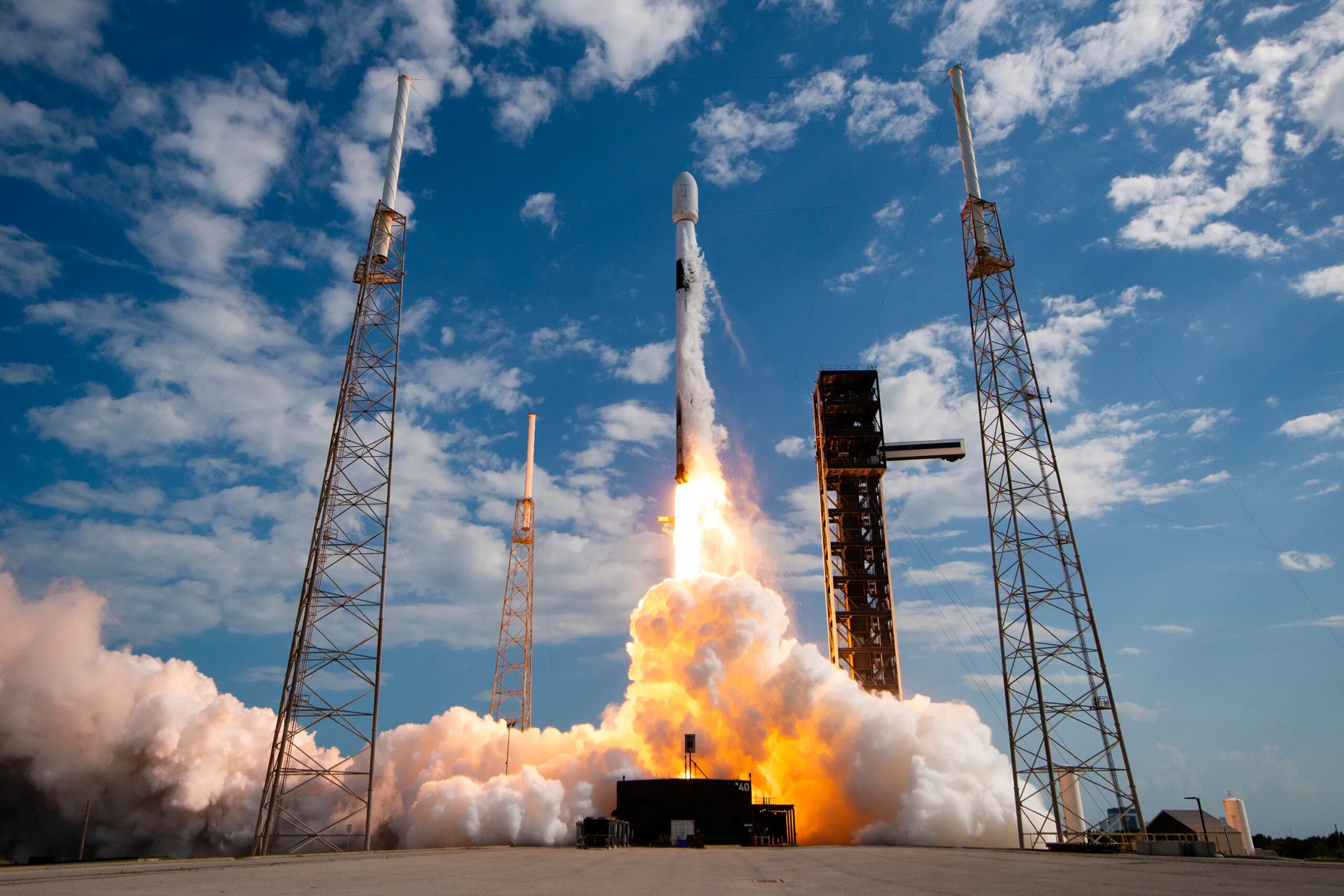
Launched from Cape Canaveral on July 21 aboard a SpaceX Falcon 9 rocket, the Mission Robotic Vehicle (MRV) is now en route to a geosynchronous orbit. Equipped with the NASA-backed Robotic Servicing of Geostationary Satellites (RSGS) payload, this mission aims to utilize cutting-edge robotics for satellite servicing in orbit.
The RSGS program aligns with NASA’s overarching goal of utilizing advanced space robotics to enhance the U.S. capabilities in in-space servicing, assembly, and manufacturing, which can be pivotal for both space commerce and exploration.
Funded by the Defense Advanced Research Projects Agency (DARPA), the RSGS initiative incorporates two highly dexterous robotic arms, created by the U.S. Naval Research Laboratory. DARPA also contributed a robotic arm assembly that integrates into Northrop Grumman’s MRV, the country’s first contractor for multi-mission robotic space services. This spacecraft will focus on inspecting and upgrading satellites in orbit, employing small propulsion modules known as mission expansion pods, significantly extending the operational lifespan of existing satellites.
RSGS fosters collaboration between government agencies and industry to evaluate advanced robotic systems in space. NASA’s Goddard Space Flight Center in Greenbelt, Maryland, commenced support for RSGS missions in 2024 through an interagency agreement with DARPA.
NASA’s contributions to the RSGS mission leverage the experience gained from previous servicing missions, including the renowned Hubble Space Telescope servicing and the International Space Station’s robotic refueling mission. Support for RSGS encompasses the development of dynamic simulations and analysis tools, performance validation through software analysis, and a dedicated team of robotic operators to facilitate advanced technical procedures in orbit. Given the hundreds of satellites in geostationary orbit, many of which are retired prematurely due to fuel depletion or aging technology, RSGS promises to establish a critical U.S. capability for extending spacecraft longevity, enabling innovative and cost-effective mission designs.
Written by Colleen Wooters
NASA’s Goddard Space Flight Center, Greenbelt, Maryland
Source: www.nasa.gov