


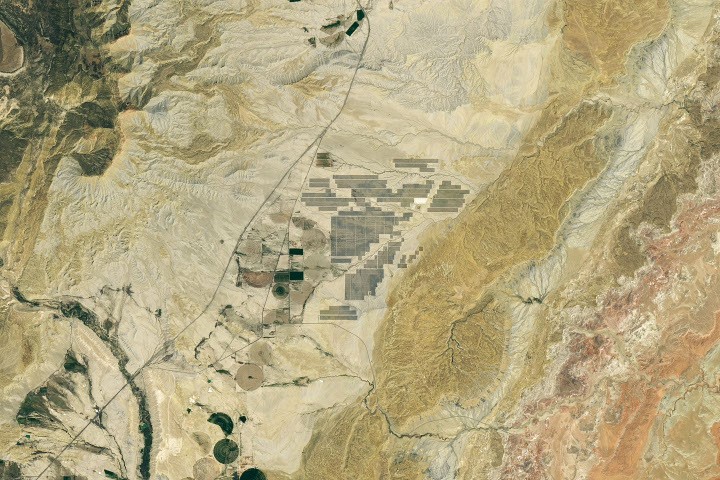
Castle Valley, located in central Utah, has a rich history as a coal mining hub since the late 1800s, situated on the scenic Wasatch Plateau. However, June 2026 marked the arrival of a transformative energy development with the launch of a large-scale solar and battery storage power plant in this sun-drenched valley, approximately 130 miles (210 kilometers) southeast of Salt Lake City.
The newly established Green River Energy Center, as depicted in the Landsat 8 image above (right), boasts state-of-the-art features including 1 million solar panels and about 500 batteries, spanning several square miles of previously undeveloped land. This facility has an impressive solar power generation capacity of 400 megawatts, accompanied by an equal capacity in battery storage, situating it amongst the leading utility-scale solar and battery storage projects in the country, as noted by the U.S. Energy Information Administration. The plant is scheduled for connection to the national power grid in 2026.
According to the company, this Utah facility is set to supply power to Salt Lake City and surrounding areas, potentially producing enough electricity to power over 100,000 homes, as reported in recent news coverage. The integrated battery storage system enables the plant to generate power anytime, even during non-sunny hours, thus enhancing the region’s energy security. The Green River Energy Center will build on Castle Valley’s long-standing energy legacy, utilizing existing power lines originally developed for coal-fired plants.
Although Utah has traditionally depended on coal as its primary energy source, with plans for coal to supply about half of the state’s fuel by 2025, renewable energy sources like solar and geothermal are gaining traction. Projections show that solar energy generation could represent approximately 14% of Utah’s electricity generation by 2025, up from nearly zero a decade ago, as illustrated by satellite data that aids stakeholders in assessing and tracking renewable energy system performance during this transition.
NASA Earth Observatory image by Lauren Dauphin, using Landsat data from United States Geological Survey. Story by Lindsay Dorman.

- Deseret News (June 23, 2026) Utah’s Largest Solar Power Plant Begins Operation. Accessed July 23, 2026.
- Edwards MR, et al. (2022) Application of Satellite Data for Sustainable Energy Transition. Frontiers of Sustainability 3, 910924.
- Quell (June 23, 2026) Utah Just Installed a Huge Solar and Battery Power Plant in Emery County. Accessed July 23, 2026.
- NASA (2021) ARSET – NASA Earth Observation for Energy Management. Accessed July 23, 2026.
- U.S. Energy Information Administration (February 20, 2026) US New Power Generation Capacity Expected to Reach Record High in 2026. Accessed July 23, 2026.
- U.S. Energy Information Administration; Utah Overview. Accessed July 23, 2026.
Source: science.nasa.gov