


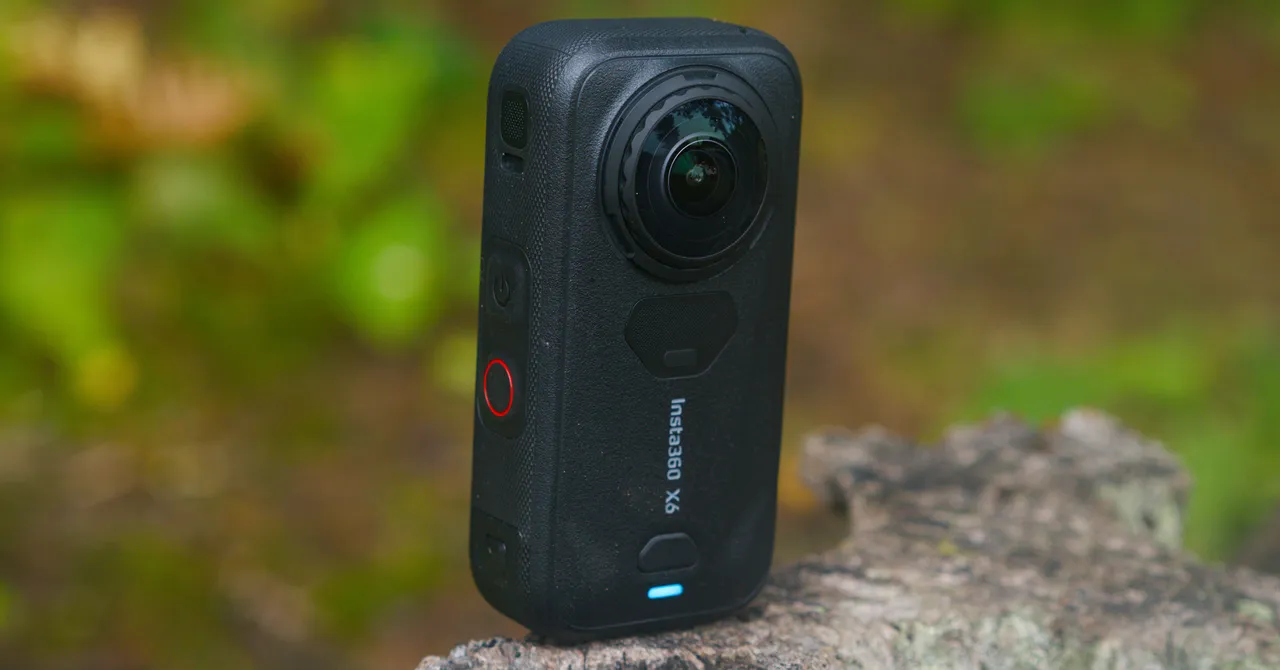
For nighttime shooting, the Insta360 X6 is the clear winner. It delivers significantly brighter low-light footage than the X5 and GoPro, although its color accuracy is not perfect—blues may appear slightly green, while yellows can lean toward orange. Even so, the X6 produces some of the best 360-degree low-light video I’ve captured. The DJI Osmo 360 comes close, but it can introduce noticeable blur-like artifacts in dark scenes.
Another major upgrade is the X6’s single-lens mode, which makes this 360 camera a more convincing action camera alternative. While it may not completely replace a dedicated action camera, the X6 comes closer than any other 360-degree camera to serving as an all-in-one recording solution.
The Insta360 X6 can record up to 5K video in single-lens mode, improving on the X5’s 4K limit. It also introduces InstaFrame 2.0, a feature that records traditional single-lens video and 360-degree footage simultaneously. This makes editing much easier: you get a ready-to-use flat video file, while the 360-degree recording provides a backup if you miss an important angle. Although the feature was also available on the X5, its non-360 video was limited to 1080p, which reduced its usefulness. With the X6, single-lens footage is recorded in 4K, while simultaneous 360-degree recording can reach 8K at 30 frames per second. The feature is simple to use and has become my preferred way to shoot.
As I’ve mentioned before, most viewers do not want to watch unedited 360-degree footage. Although virtual reality may eventually change that, InstaFrame 2.0 currently offers one of the easiest ways to create conventional, linear videos from 360-degree recordings. The editing process is still not completely effortless, however. Advanced users may also be disappointed that InstaFrame 2.0 does not support Insta360’s I-Log format. This log profile is designed to preserve more dynamic range for post-production, while the camera’s preset color modes are a better choice for everyday recording.
When shooting in 360 mode with I-Log, the Insta360 X6 supports 10-bit video recording. Single-lens mode is limited to 8-bit I-Log. In practical terms, 10-bit video stores more color information—up to 1,024 shades per channel compared with 256 shades in 8-bit footage—giving editors greater flexibility when color grading. Unfortunately, this limitation keeps the X6 from fully replacing a dedicated action camera for my professional workflow. It may be addressed in a future Insta360 X7, although most casual users are unlikely to consider it a major issue.
Photo: Scott Gilbertson
Source: www.wired.com