


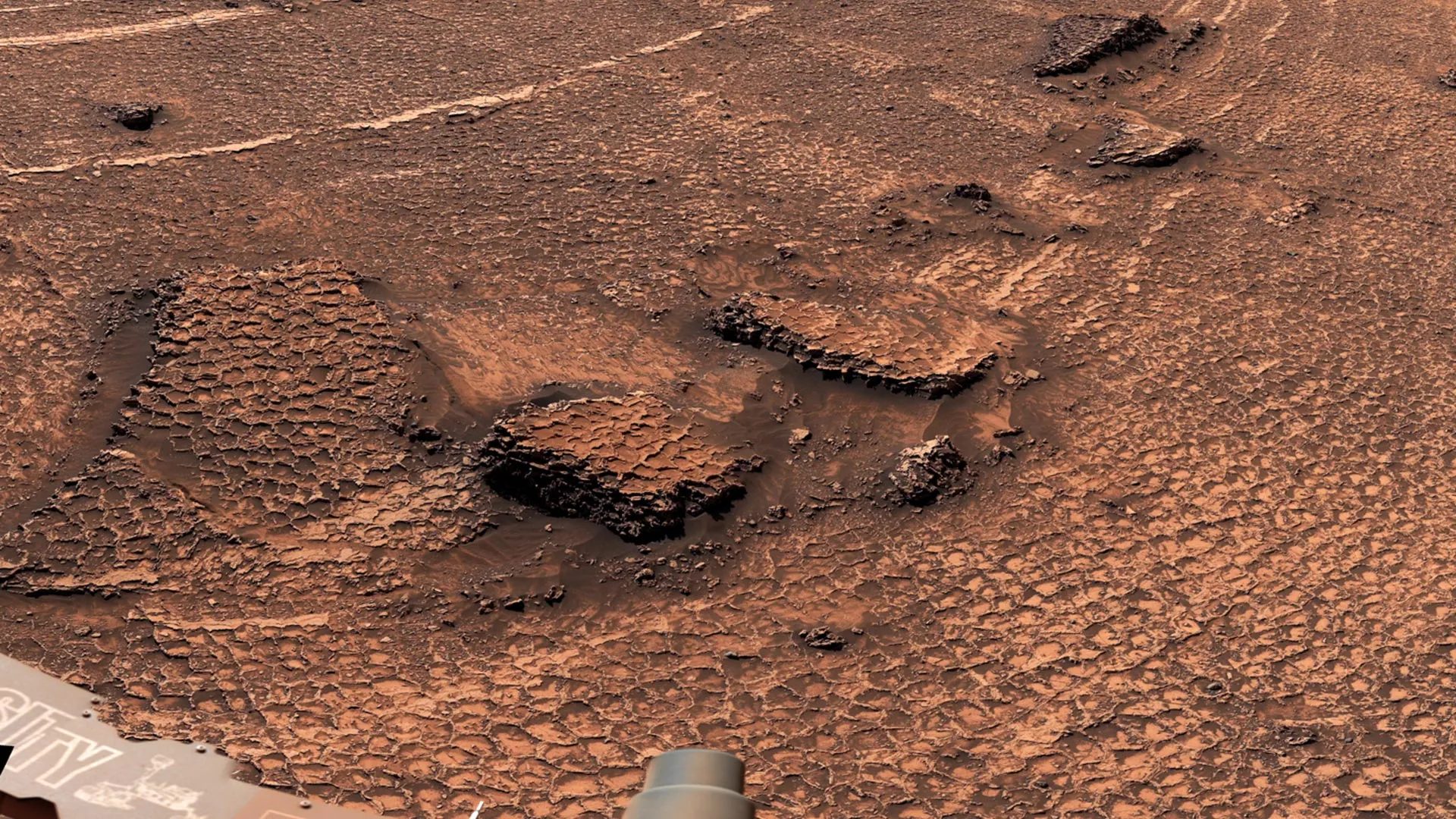
NASA’s Curiosity rover has discovered a remarkable Martian landscape while climbing through a valley nicknamed “Valle Grande.” New images reveal a vast field of honeycomb-like patterns called polygonal fractures, with individual shapes measuring approximately 1.5 to 3 inches (4 to 8 centimeters) across.
Curiosity has previously observed small groups of similar geometric formations on Mars, but never a polygon field on this enormous scale. The discovery may provide new clues about the planet’s ancient climate and geological history.
A Vast Sea of Martian Polygons
The formations are visible across a 360-degree panorama captured June 19 and 20, during Curiosity’s 4,930th and 4,931st Martian days, known as sols. The polygonal fractures extend in every direction across Valle Grande, continuing beyond the rover’s visible range.
The geometric patterns also cover the slopes of a nearby butte called “Miraflores.” Rising about 20 feet (6 meters) above the surrounding terrain, the butte is topped with a thick layer of sand.
“We’ve seen a lot of fascinating landscapes through Curiosity’s eyes, but this sea of polygons took our breath away,” said Ashwin Vasavada, Curiosity’s project scientist at NASA’s Jet Propulsion Laboratory in Southern California. “We measured their shapes and chemistry carefully and are hopeful there are clues in the data as to how these features formed.”
How Did the Honeycomb Patterns Form?
Some polygonal formations previously studied by Curiosity began as cracks in drying mud, offering evidence that liquid water once existed on Mars. However, scientists say multiple geological processes can create similar honeycomb-like patterns.
Repeated cycles of heating and cooling can fracture the Martian surface into geometric shapes. Compression may also produce polygonal cracks by forcing water from sediment after it becomes buried beneath layers of material.
Researchers are analyzing the newly discovered formations to determine whether drying mud, temperature changes, compression, or a combination of these processes created the polygon field in Valle Grande.
Fourteen Years of Martian Discoveries
The enormous polygon field is the latest in a long list of unexpected discoveries made by NASA’s Curiosity rover since it landed on Mars on Aug. 5, 2012.
During its exploration of the Red Planet, Curiosity has encountered sulfur crystals, reflective meteorites, and numerous other unusual geological features. More importantly, the rover has reshaped scientists’ understanding of ancient Mars by showing that the planet once had liquid water, favorable chemistry, and nutrients capable of supporting microbial life.
Curiosity Reveals Mars’ Watery Past
Billions of years ago, lakes and streams covered parts of the lower foothills of Mount Sharp, a 3-mile-tall (5-kilometer-tall) mountain that Curiosity has been climbing since 2014.
The rover has detected chemical traces from this wetter era, including carbon-based molecules considered possible precursors to RNA and DNA—the nucleic acids that store and transmit genetic information.
Scientists still cannot determine whether these organic molecules formed through biological activity or geological processes, and both possibilities remain open. Nevertheless, the discovery provides further evidence that ancient Mars contained many of the chemical ingredients necessary for life.
Managed by Caltech in Pasadena, JPL built Curiosity and leads the mission on behalf of NASA’s Science Mission Directorate in Washington as part of the agency’s Mars Exploration Program portfolio.
Source: www.sciencedaily.com