


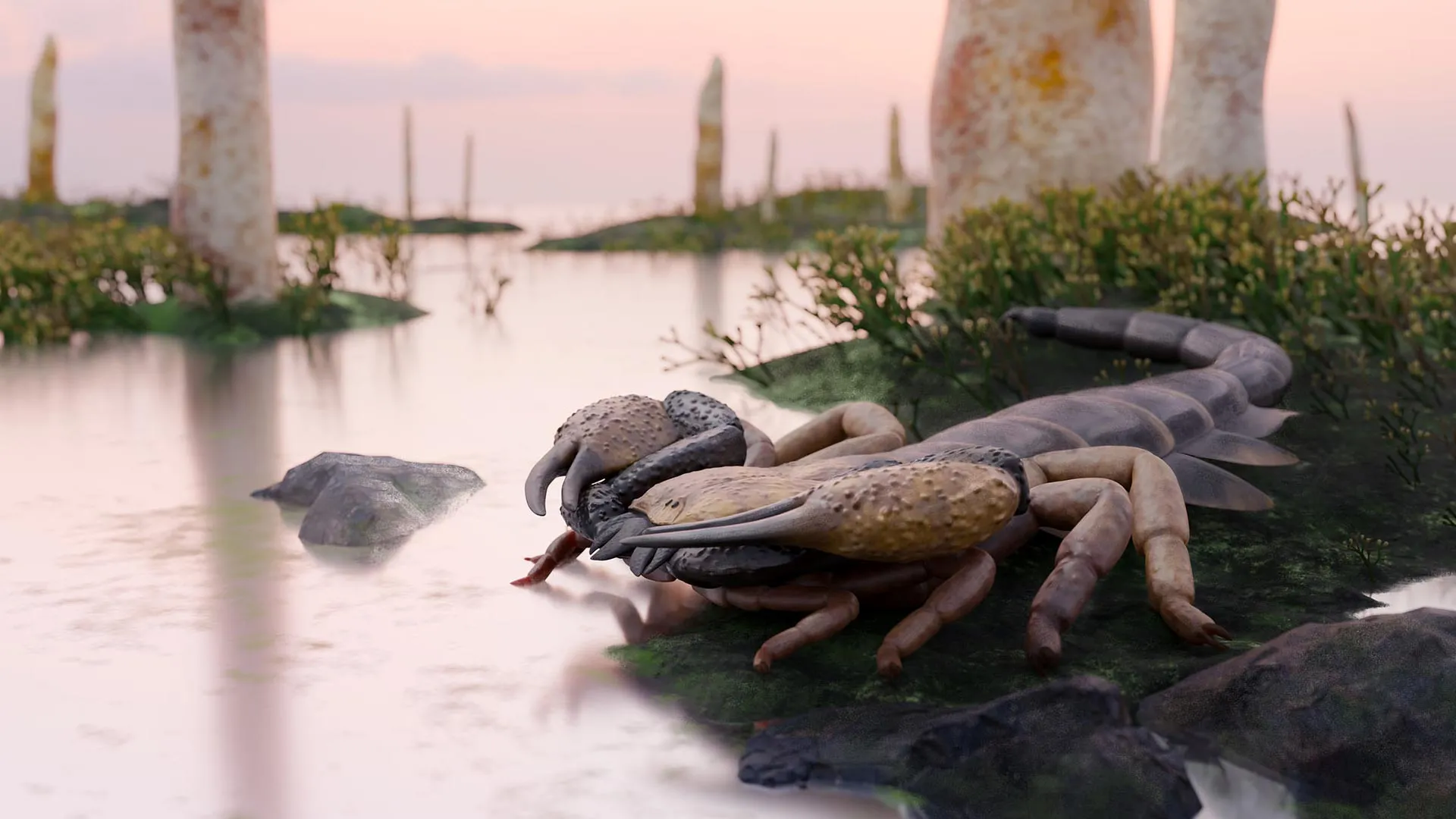
A new analysis of fossilized predator remains discovered in modern-day England and Wales has identified the largest scorpion ever known to science. Researchers from the University of Manchester and the Natural History Museum reached this conclusion after reexamining fossils that had remained in museum collections for more than 150 years.
The species, Praearcturus gigas, measured approximately 1 meter (3.3 feet) in length and had pincers more than 16 centimeters long. Scientists believe it was a powerful predator that lived in floodplain environments during the Early Devonian Period, around 415 million years ago.
Research published in Palaeontology used modern analytical techniques and comparisons with recently described fossil species to confirm that Praearcturus was a scorpion and represented a previously distinct species.
Giant scorpion existed before the age of trees
Dr. Richard J. Howard, curator of fossil arthropods at the Natural History Museum in London and lead author of the study, said: “When people think of giant arthropods, they often imagine the Carboniferous rainforests, which were home to enormous millipedes and dragonflies much later in Earth’s history. Praearcturus lived at least 50 million years earlier, long before trees evolved and when life on land was only beginning to establish itself.”
“Confirming that this animal was a scorpion fundamentally changes our understanding of when and how these creatures evolved such extraordinary body sizes.”
The discovery pushes the history of giant arthropods far beyond the period traditionally associated with enormous insects and other invertebrates.
Dr. Russell Garwood, a paleontologist at the University of Manchester, added: “Praearcturus has puzzled paleontologists for more than a century. By combining specimens from several collections and applying advanced imaging techniques, we were able to reconstruct a clearer picture of the animal than ever before. It is a remarkable discovery.”
“What makes Praearcturus especially interesting is that it reached enormous proportions at a time when most life on land was still very small. However, the surrounding environment may have supported giant predators. To understand this ancient ecosystem, we compared the size of the scorpion fossils with other animals that lived during the same period. Its unusual size suggests that it may have lived in water, where animals generally grew larger.”
Why did this ancient scorpion grow so large?
Praearcturus gigas lived during the Early Devonian Period, when terrestrial ecosystems were still in their infancy. Small plants and fungi had only recently begun spreading across the landscape, while forests and complex land-based food webs had yet to develop.
The timing is significant because Praearcturus lived before the expansion of forests caused atmospheric oxygen levels to rise. High oxygen concentrations are often linked to the gigantic size of some later arthropods, including the enormous insects and millipedes of the Carboniferous Period.
Instead, the researchers suggest that ecological opportunity may explain the scorpion’s extraordinary size. With few other large predators competing for resources, Praearcturus may have been able to dominate its environment. Such opportunities would have become less common as terrestrial ecosystems grew more crowded and complex.
Giant scorpions may have lived in water
The fossils also provide clues that Praearcturus may have spent at least part of its life in aquatic environments. Some specimens preserve flap-like structures on the abdomen that resemble features found in modern crustaceans, including lobsters. These anatomical traits raise the possibility that giant scorpions could move between aquatic and terrestrial habitats.
An analysis of the extensive arachnid fossil record led by Garwood and his team found that scorpions are unusually abundant in rocks from this period compared with other arachnids. This pattern supports the idea that some of the earliest scorpions lived in freshwater environments, where their remains were more likely to be preserved as fossils.
Praearcturus lived during a crucial stage in Earth’s history, when animals were beginning to explore habitats beyond the oceans.
Dr. Greg Edgecombe, a distinguished research fellow at the Natural History Museum in London and co-author of the study, said: “At that time, the boundaries between land and water were much less distinct. Praearcturus offers an important glimpse into how early animals adapted to these changing environments.”
“It may even represent a lineage that returned to the water after its ancestors had already begun adapting to life on land.”
150 years of fossil mystery
Scientists first described Praearcturus gigas after its discovery in 1871. At the time, however, it was interpreted as a giant crustacean similar to a woodlouse. The fossil was incomplete and lacked key anatomical features, including a tail, making its true identity difficult to determine for more than a century.
A new interpretation became possible when researchers compared the historical specimens with recently discovered, well-preserved fossils. These newer fossils revealed anatomical characteristics unique to scorpions, providing the evidence needed to reassess Praearcturus.
The discovery demonstrates how historic museum collections can continue to produce important scientific findings long after specimens are first collected.
Dr. Howard added: “Specimens collected more than a century ago may still contain completely new insights. Reexamining them with modern technology can lead to discoveries that transform our understanding of life on Earth.”
Rethinking the evolution of giant prehistoric arthropods
The discovery of such a large scorpion so early in the history of terrestrial life challenges traditional explanations for why prehistoric arthropods evolved enormous body sizes.
The findings suggest that high oxygen levels and other environmental conditions may not have been the only factors involved. Ecological opportunity—particularly the absence of competing large predators—may also have allowed animals such as Praearcturus to reach extraordinary sizes.
Source: www.sciencedaily.com