


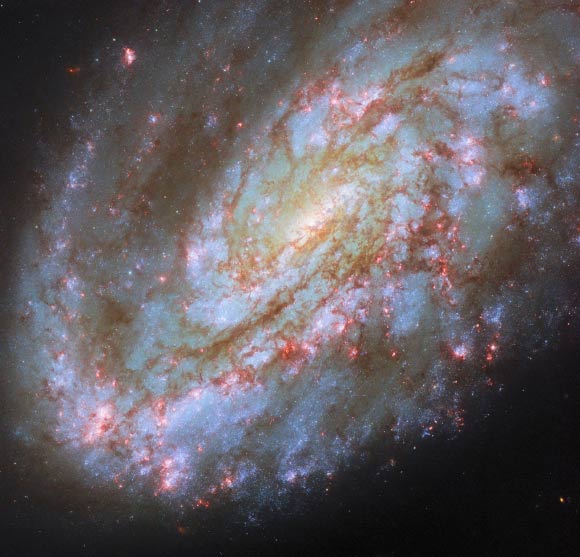
A new NASA/ESA Hubble Space Telescope image reveals the strikingly asymmetrical shape of NGC 4654, an intermediate spiral galaxy located about 55 million light-years away in the constellation Virgo. Its unusual appearance was shaped by both a past gravitational encounter with another galaxy and ram-pressure stripping as it moves through the hot gas of the Virgo Cluster.
This Hubble image shows NGC 4654, an intermediate spiral galaxy about 55 million light-years away in the constellation Virgo. Image credit: NASA / ESA / Hubble / D. Thilker / J. Lee / PHANGS-HST Team.
NGC 4654, also known as IC 3708 and LEDA 42857, lies approximately 55 million light-years from Earth in the constellation Virgo.
The galaxy spans roughly 70,000 light-years and was discovered by German-British astronomer William Herschel on April 12, 1784.
NGC 4654 is part of the Virgo Cluster, a massive collection containing as many as 2,000 galaxies.
“NGC 4654 is classified as an intermediate spiral galaxy because its structure falls between spiral galaxies with a central bar and those without one,” Hubble astronomers said in a statement.
However, the galaxy is notably lopsided. One side has a rounded, sharply defined edge, while the opposite side features a long stream of gas that extends beyond the field of view in the Hubble image.
That extended gaseous feature was created by ram-pressure stripping, a process that occurs when a galaxy travels rapidly through the thin, hot gas between galaxies in a cluster.
“NGC 4654 moves at such a high velocity that it sweeps through the hot, rarefied gas filling the Virgo Cluster,” the astronomers explained.
As the galaxy passes through this intracluster medium, the resulting pressure compresses its leading edge and pulls gas behind it. Over time, this process forms the galaxy’s elongated gas tail.
NGC 4654’s asymmetry is not limited to its gas. Its stars are also unevenly distributed, an unusual feature for a spiral galaxy.
One leading spiral arm contains abundant stars and gas, while the opposite arm is noticeably depleted of stars. This imbalance contributes to the galaxy’s distinctive lopsided appearance.
According to astronomers, ram-pressure stripping alone probably cannot explain the full extent of NGC 4654’s unusual structure.
“NGC 4654 was also affected by the gravitational pull of the nearby Virgo Cluster galaxy NGC 4639,” the researchers said.
Although the two galaxies are currently separated, astronomers believe they passed close to each other approximately 500 million years ago. That encounter may have removed gas from one side of NGC 4654, reducing star formation there and intensifying the galaxy’s asymmetrical shape.
Ram-pressure stripping often suppresses star formation because cold gas—the material needed to create new stars—is stripped from a galaxy and carried away.
NGC 4654, however, continues to form stars at a rate of nearly two solar masses per year, comparable to other spiral galaxies of a similar size.
The galaxy’s ongoing star formation is visible in the latest Hubble observations used to create this image.
These observations detect red light emitted by energized gas clouds surrounding newborn stars. The bright pink regions scattered across NGC 4654—from its leading spiral arm and central bar to the outer edge of its disk—mark active star-forming regions.
Source: www.sci.news