


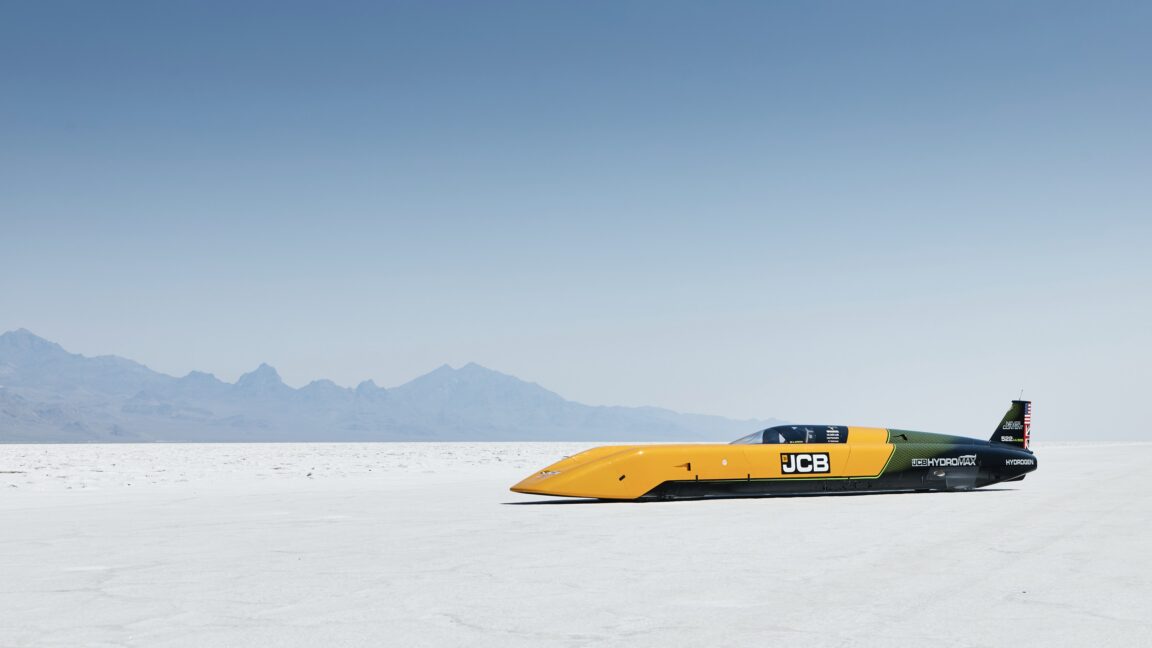
Although its performance is comparable to a JCB diesel engine, 74 horsepower (55 kW) would not be enough to achieve a record-breaking speed on the Bonneville Salt Flats. To create the JCB Hydromax land-speed record car, JCB transformed two hydrogen internal-combustion engines into high-performance powerplants producing 800 horsepower (597 kW) each. The extensive upgrades included doubling engine speed to 3,800 rpm, replacing pushrod valves with dual overhead camshafts for more precise valve timing, and adding direct fuel injection operating at significantly higher pressures than production engines.
JCB also fitted the engines with dry-sump lubrication systems to reduce weight and improve cooling. The JCB Hydromax uses two intercoolers to cool air exiting the turbochargers from 392°F (200°C) to below 50°F (10°C), helping the hydrogen-powered engines deliver maximum performance.
JCB Hydromax reaches 406.320 mph
RAF Wing Commander Andy Green was behind the wheel for the record attempt. Green is no stranger to the land-speed record books: In 1997, he became the first driver to break the sound barrier on land with the Thrust SSC. In 2006, he also drove JCB’s Dieselmax to a diesel-powered land-speed record of 350 mph (563 km/h). Green later took part in the Bloodhound land-speed record project.
With a combined output of 1,600 horsepower (1,193 kW), 2,600 pound-feet (3,525 Nm) of torque, and all-wheel drive, the hydrogen-powered JCB Hydromax recorded 400.623 mph (644.74 km/h) in one direction. On its return run, it reached 412.135 mph (663.27 km/h), producing a two-way average speed of 406.320 mph (653.91 km/h).
The JCB team celebrates the new hydrogen-powered land-speed record.
Credit: JCB
The JCB Hydromax’s result is more than twice the previous hydrogen internal-combustion land-speed record of 185.5 mph (298.53 km/h), set by the BMW H2R in 2004 with its power-limited V12 engine. It also surpasses the hydrogen fuel-cell land-speed record of 303 mph (488 km/h), achieved by the Venturi Buckeye Bullet 2 in 2009.
The hydrogen-powered JCB also exceeded the electric-vehicle land-speed record of 341 mph (549 km/h), set by the VBB3 in 2016. However, the overall wheel-driven land-speed record remains with Challenger II. Powered by a nitromethane-fueled V8, Challenger II reached 449 mph (722 km/h) in 2018.
“Bonneville is the spiritual home of the World Land Speed Record, and the JCB Hydromax has made history,” Green said. “This car was smooth, stable, strong, and fast. After 20 years since Dieselmax, it is a great honor to set the world land-speed record for hydrogen power. This achievement reflects the work of a world-class team and the potential of hydrogen engine technology.”
Source: arstechnica.com