


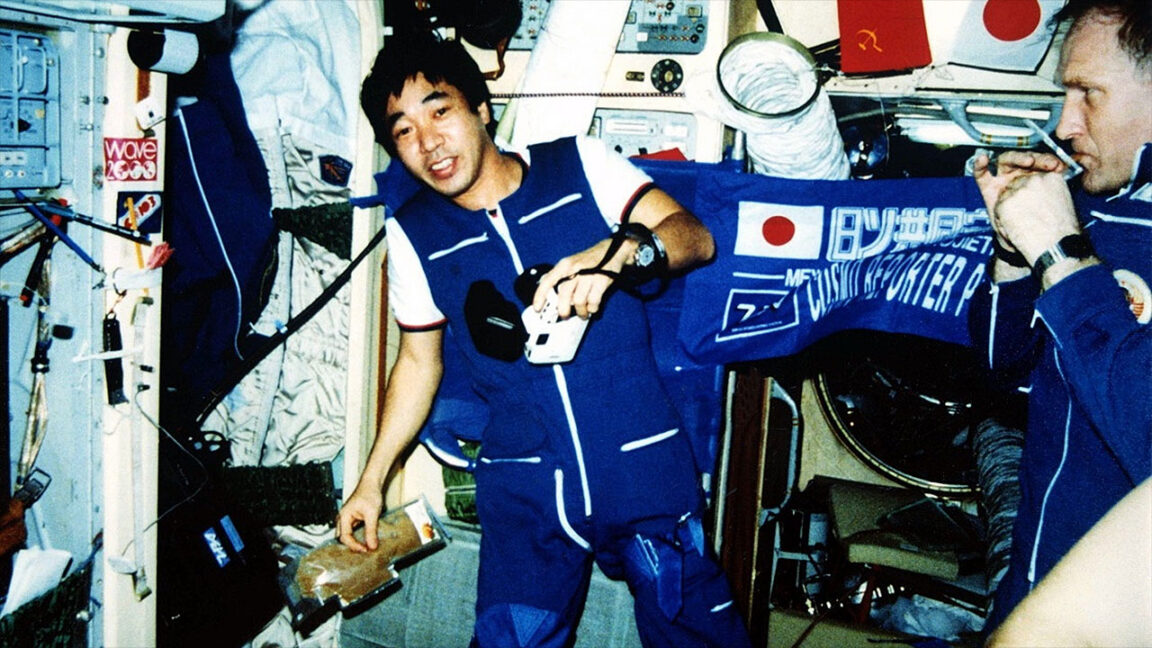
Japanese audiences initially tuned in to Toyohiro Akiyama’s space mission every day, but public interest declined as the weeks passed. TBS had reportedly invested between $12 million and $37 million in the mission, hoping it would strengthen the broadcaster’s international profile. However, aside from a temporary ratings increase, the plan produced limited long-term results.
Toyohiro Akiyama returned to Earth on December 10, 1990, landing in the grasslands of Kazakhstan aboard the Soyuz TM-10 with cosmonauts Gennady Manakov and Gennady Strekalov. His first and only spaceflight lasted 7 days, 21 hours, and 54 minutes.
From Space Correspondent to Mushroom Farmer
Toyohiro Akiyama was born in Tokyo on July 22, 1942. After earning a bachelor’s degree from International Christian University in Mitaka, Tokyo, he joined TBS. From 1967 to 1971, Akiyama worked for the BBC World Service before becoming an overseas news correspondent for TBS.
Before his historic spaceflight, Akiyama served as TBS’s chief correspondent in Washington, D.C., for four years.
According to the Space Traveler Registry, Akiyama became the 239th person to orbit Earth and the 246th person to cross the recognized boundary of space, including suborbital astronauts. He was also recognized by the Association of Space Explorers.
Akiyama was the first Japanese citizen to travel into space and orbit Earth. Japan’s first professional astronaut, Mamoru Mohri, followed two years later. Mohri had originally been expected to fly first, but the Challenger disaster in 1986 delayed NASA’s Space Shuttle missions.
Toyohiro Akiyama, Soyuz TM-11 crew member.
Credit: Roscosmos
After returning from space, Akiyama became deputy director of TBS’s news department. He left the broadcaster in 1995, citing the increasing commercialization of television. He later worked with fellow journalists on a documentary about the environmental crisis affecting the Aral Sea before becoming a mushroom grower and organic rice farmer.
Following the Great East Japan Earthquake and Fukushima nuclear disaster in 2011, Akiyama was forced to evacuate his home and farm. He later moved into education, taking a teaching position at Kyoto University of Art and Design, now known as Kyoto University of the Arts. He remained a professor until 2023.
Akiyama has written several books about spaceflight, farming, and his experiences as an evacuee from Fukushima Prefecture. His works include Space Correspondent: Nine Days—The Complete Record of the First Japanese Astronaut’s Experience and This Is a Space Correspondent! I Went to Space!, both published in 1991, as well as Nuclear Refugee Diary: From the Land of Anger, published in 2011.
For his 1990 spaceflight, Akiyama received the Soviet Order of People’s Friendship. In 2011, he was awarded Russia’s Order of Merit in Space Exploration. He also received the Tokyo Cultural Honor Award in 1991.
Akiyama married Kyoko Akiyama in 1970, and they had two children, Ken and Naoko. The couple divorced in 1995.
Source: arstechnica.com