


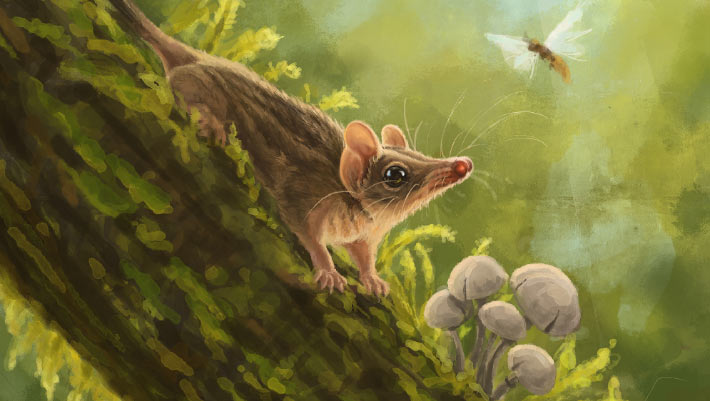
Paleontologists from the University of New South Wales have identified a new genus and species of dasyurid marsupial from Australia’s Early Miocene fossil record. The discovery of Miyumba chrisdickmani provides the earliest reliable evidence that the family Dasyuridae — which includes quolls, Tasmanian devils and antechinuses — was already established millions of years ago.
An artist’s reconstruction of Miyumba chrisdickmani in the Early Miocene rainforests of northern Australia. Image credit: Nellie Pease.
Named Miyumba chrisdickmani, the newly described marsupial lived approximately 18 million years ago in the lush rainforests of what is now northwestern Queensland.
The tiny animal is estimated to have weighed between 23 and 33 grams, making it similar in size to modern antechinuses and dunnarts.
“Dasyurids are the most speciose family in the marsupial order Dasyuromorphia and the second-most species-diverse family of Australian marsupials, with 67 living species in 21 genera,” said lead author Dr. Timothy Churchill and his colleagues from the University of New South Wales.
“The fossil record contains 20 dasyurid species in eight genera that include living species, as well as two genera represented only by living species known from Australian Plio-Pleistocene deposits.”
The researchers recovered several partial lower jaws of Miyumba chrisdickmani from fossil sites in the Riversleigh World Heritage Area, a world-renowned fossil locality in Queensland.
Using micro-computed tomography, or micro-CT scanning, the paleontologists examined the animal’s teeth in detail and compared the fossils with dozens of living and extinct marsupial relatives.
The analysis revealed a previously unrecognized dental feature that appears to be shared by all dasyurids. This characteristic provides what the researchers describe as the first reliable anatomical trait linking the entire family.
Before this discovery, no dental feature had definitively separated dasyurids from their close relatives. That gap made it difficult for scientists to determine when the group first evolved and how its early members were related.
Comparisons of the fossil anatomy with genetic data from living species indicate that Miyumba chrisdickmani branched off before all other known dasyurids. It is therefore the oldest and most evolutionarily early member of the family identified so far.
The researchers estimate that the broader dasyurid lineage originated approximately 25.6 million years ago — about three million years earlier than previous estimates.
The fossil species also shares important dental similarities with modern rainforest-dwelling marsupials from New Guinea, including species of Murexia.
Based on these similarities, the scientists suggest that Miyumba chrisdickmani may represent an early branch of a rainforest-adapted lineage that later survived in New Guinea as Australia’s forests contracted and became drier.
“New Guinea has retained extensive rainforest cover since the Miocene, preserving a faunal assemblage that likely reflects the ecological structure of Sahul’s former lowland rainforests,” the scientists said.
“This includes a diverse radiation of rainforest-adapted dasyurids, some of which may share a close relationship with Miyumba chrisdickmani.”
“Several marsupial lineages that were once more widespread across Sahul are now restricted to New Guinea.”
“Miyumba chrisdickmani appears to represent a comparable case — a Miocene rainforest-adapted dasyurid lineage whose descendants may have persisted in New Guinea following the collapse of closed forests on the Australian mainland.”
The discovery of the Early Miocene dasyurid marsupial Miyumba chrisdickmani is reported in a paper published July 17 in the journal Australian Zoologist.
_____
Timothy J. Churchill et al. 2026. A new genus of dasyurid Miyumba chrisdickmani (Marsupialia, Dasyuridae) from the Early Miocene deposits of the Riversleigh World Heritage Area, north-western Queensland. Australian Zoologist 45 (2): AZ26024; doi: 10.1071/AZ26024
Source: www.sci.news