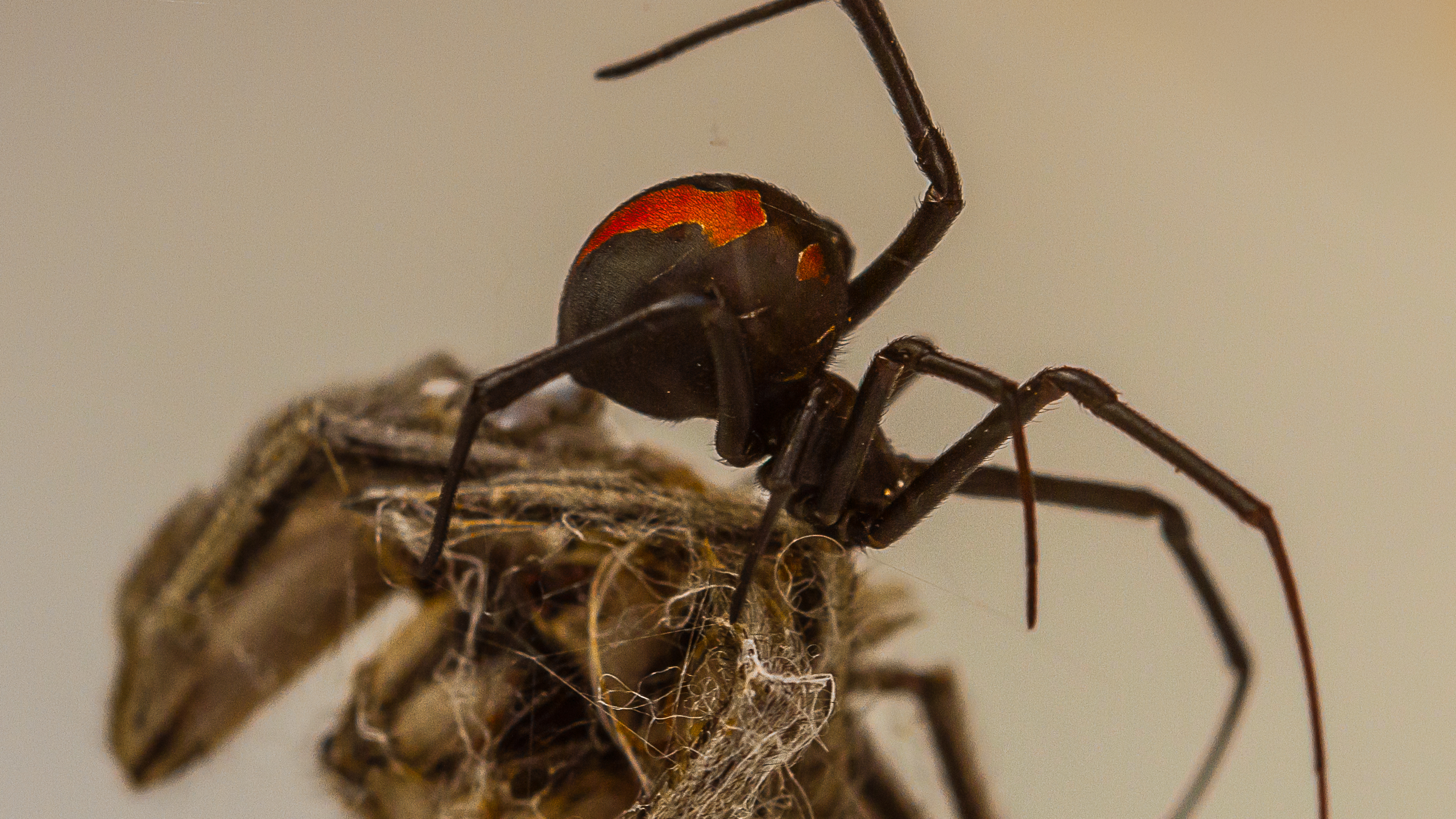
Redback Spiders’ Deadly Mating Backflip Has a Simple Genetic Basis
A dramatic mating behavior in male redback spiders — including a backflip into the female’s fangs — may be controlled by a surprisingly simple genetic mechanism, new research suggests.
Male redback spiders (Latrodectus hasselti), Australia’s relatives of black widows, perform a remarkable somersault during mating. The males flip their abdomens toward the female’s fangs, apparently encouraging her to bite and eat them while mating continues.
Although this behavior appears suicidal, it may help the male transfer more sperm. Redback males also contract their abdomens, a behavior that can prolong mating and give them enough time to complete sperm transfer even while being consumed. They then leave behind their sperm-transferring organs, called pedipalps, which can act like a plug and make it more difficult for another male to inseminate the female.
However, the katipō spider (Latrodectus katipo), a close relative from New Zealand, does not perform the same deadly mating routine. Katipō spiders do not backflip into their partners’ jaws and are not typically cannibalistic during mating. Instead, they engage in courtship behavior and separate afterward. The sharp contrast between these closely related species gave scientists a way to investigate the genetic basis of redback spider mating behavior.
Latest Videos FromLive Science
“What makes this system so intriguing is the fact that we are dealing with two species here, which are very closely related,” Kardelen Özgün Uludağ, a doctoral student in behavioral biology at the University of Hamburg in Germany, told Live Science in an email. The two species may have diverged less than 100,000 years ago, yet they display very different mating behaviors and physical traits. “This is very uncommon in animals,” she said.
To investigate the genetics of redback spider mating, Uludağ and her colleagues first paired katipō females with redback males. Because the two species are closely related, they were able to produce hybrid offspring. The researchers then bred hybrid females with either redback or katipō males, creating male spiders with mixed genetic backgrounds.
The scientists could not begin with katipō males and redback females because redback females generally attack and eat katipō males rather than mating with them. This limited the possible breeding combinations, but the resulting hybrids still allowed the researchers to examine how the mating behaviors were inherited.
The researchers paired the hybrid males with katipō females, allowing them to observe mating behavior without the males being immediately eaten. They recorded how often the hybrid males performed the characteristic backflip and how often they constricted their abdomens during mating.
The results were unexpected. The backflip and abdominal constriction behaviors were not closely linked genetically. Hybrid males displayed both traits only about half the time, while others showed just one behavior. This suggests that the two components of the redback spider’s deadly mating strategy evolved independently.
The researchers also found evidence that the backflip is associated with the spiders’ sex chromosome, the X chromosome. Male and female spiders have different genetic arrangements involving their sex chromosomes, which may help explain how this trait is inherited. The backflip also appeared to follow a relatively simple dominant-recessive inheritance pattern.
Abdominal constriction, by contrast, appears to be a more complex genetic trait, according to the researchers’ findings, reported Wednesday (Aug. 12) in the journal Biology Letters. Multiple genes may influence the behavior, or it may be strongly affected by the female’s behavior during mating.
Widow spiders are widely known for sexual cannibalism, but only a small number of species regularly eat their mates. The Australian redback spider is one example. Another is the southern black widow (Latrodectus mactans), which is found in the United States.
The researchers hope to learn more about why some widow spiders evolved such extreme mating strategies while closely related species did not. “It would be nice to investigate more species of the genus Latrodectus to allow comparative studies,” Uludağ said.
Özgün Uludag, K., Ivanov, V., Krehenwinkel, H., & M. Schneider, J. Crossing experiments suggest a simple genetic basis of complex male self-sacrifice phenotypes in widow spiders. Biology Letters, 22:20260211.
How much do you know about spiders? Test your knowledge with our spider quiz!