


Ancient Roman Sling Bullets Reveal Evidence of the Ceretani Revolt in Spain
Ancient lead sling bullets discovered in northeastern Spain may provide new evidence of a local uprising against Roman rule in the first century B.C. The finds suggest that Roman troops fought to suppress a revolt by the Indigenous Ceretani, also spelled Cerretani, in the Pyrenean region of Cerdanya.
Archaeologists believe the lead projectiles were fired by Roman soldiers after an ambush organized by the Ceretani. By that time, the people of the region had resisted Roman expansion in Iberia for nearly 200 years.
The discoveries reinforce the view that “the Roman conquest of the Iberian Peninsula was neither a brief nor a peaceful process,” researchers explained in a statement from the Autonomous University of Barcelona.
Latest Videos FromLive Science
The Ceretani Revolt of 39 B.C.
The ancient Roman historian Cassius Dio, who lived from around A.D. 150 to 235, wrote that the Ceretani revolt occurred in 39 B.C. Historians previously believed the conflict took place farther west. However, the newly identified Roman military camp at Collet de Jovell places the battle in what is now Cerdanya, a region of the eastern Pyrenees on the Spanish side of the modern border with France.
During the first century B.C., the area was part of Ceretani territory. The archaeological evidence indicates that Roman forces established a camp at the alpine pass before facing an attack from local fighters.
Roman Sling Bullets Found at Collet de Jovell
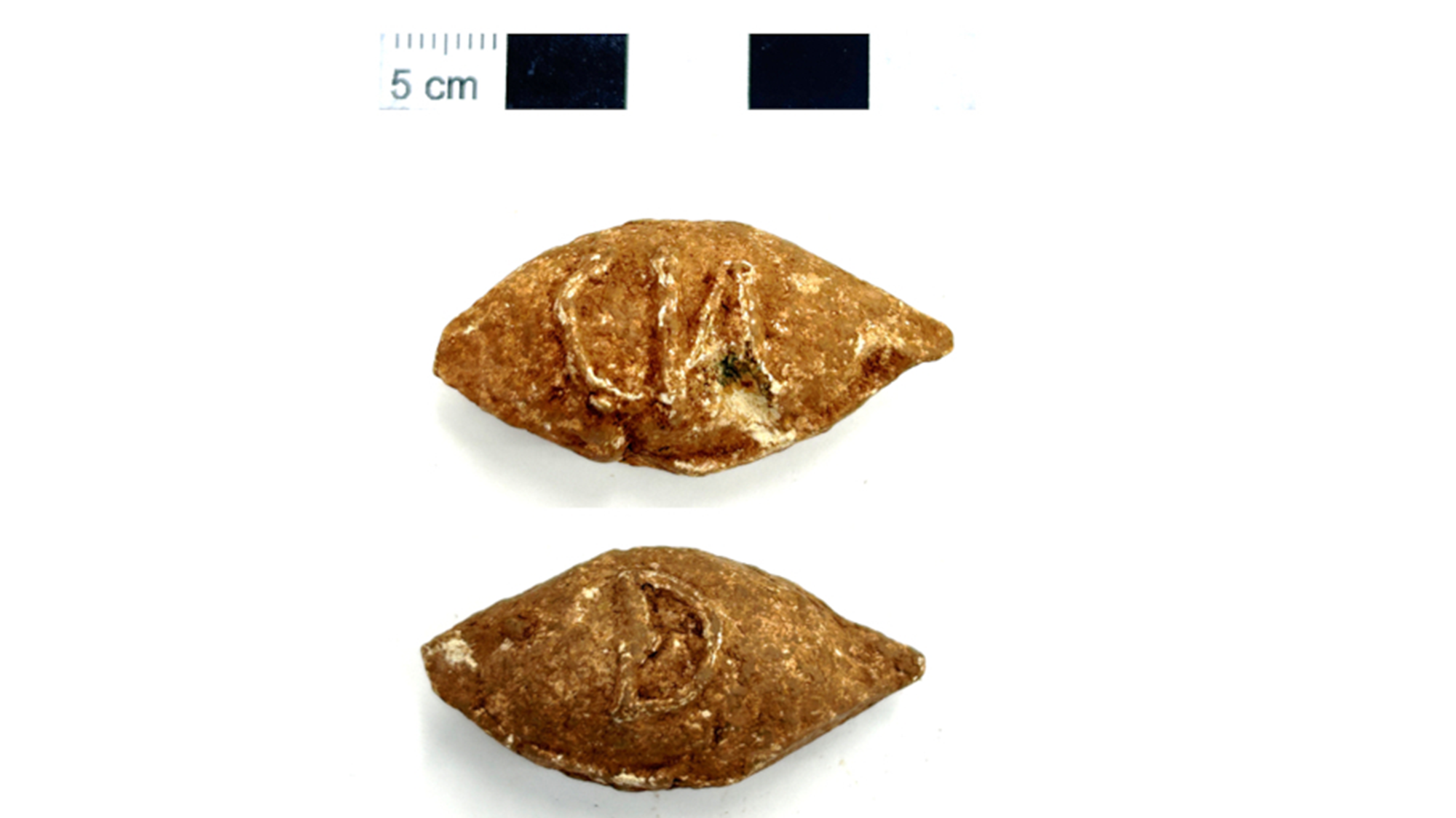
The archaeological team discovered the lead sling bullets among the remains of the ancient camp. Lead was commonly used for Roman sling ammunition because it was easier to produce in large quantities than carefully selected stones.
Two of the sling bullets bear the letters “CND.” Researchers interpret the inscription as an abbreviation for Gnaeus Domitius Calvinus, the Roman governor of Hispania at the time. Because Calvinus held office in 39 B.C., the markings help date the military confrontation with unusual precision.
In addition to the sling ammunition, archaeologists uncovered the distinctive iron studs worn on Roman legionaries’ sandals, known as caligae. Roman fibulae, or clothing brooches, and several Roman coins were also found. Together, these artifacts support the identification of the site as a Roman military camp and strengthen the dating of the conflict.
Roman Expansion into Hispania
Rome began expanding into Iberia, which it called Hispania, after landing on the Mediterranean coast in 218 B.C. during the Second Punic War with Carthage. Although Carthage was eventually defeated, Rome continued its campaign to conquer and control the peninsula.
The expansion brought Roman armies into conflict with the Ceretani and other Indigenous communities. Resistance continued for generations, making the conquest of Hispania one of Rome’s longest and most difficult military campaigns.
Roman Repression After the Uprising
The Ceretani revolt ultimately failed to remove Roman forces from the region. According to the researchers, the unsuccessful uprising was followed by severe Roman repression of the local population.
The Romans also suffered losses during the attack. Cassius Dio reported that the Roman governor ordered some soldiers to be punished after they fled when the Ceretani ambushed the camp. This detail suggests that the confrontation was a serious setback for the Roman troops, even though the revolt was eventually defeated.
The artifacts at Collet de Jovell offer a rare archaeological record of the conflict and highlight the violence and complexity of Rome’s expansion across the Iberian Peninsula.
From Augustus to Nero, see how much you know about ancient Rome’s famous leaders with our Roman emperor quiz!
Source: www.livescience.com