Neanderthals May Have Reached Saudi Arabia’s Arabian Desert 55,000 Years Ago
Neanderthals may have traveled deep into the Arabian Peninsula approximately 55,000 years ago, according to a new study of Stone Age tools discovered in Saudi Arabia.
The research, published August 12 in Quaternary Science Reviews, suggests that Neanderthals lived farther south and in more open environments than previously known. However, researchers say additional archaeological and fossil evidence is needed to confirm their presence in northern Arabia.
“Our findings extend the known range of Neanderthals farther south, into more open environments in Arabia,” study co-lead author Hugh Groucutt, an archaeologist at the University of Malta, told Live Science via email.
Latest videos fromLive Science
Stone tools found in Saudi Arabia
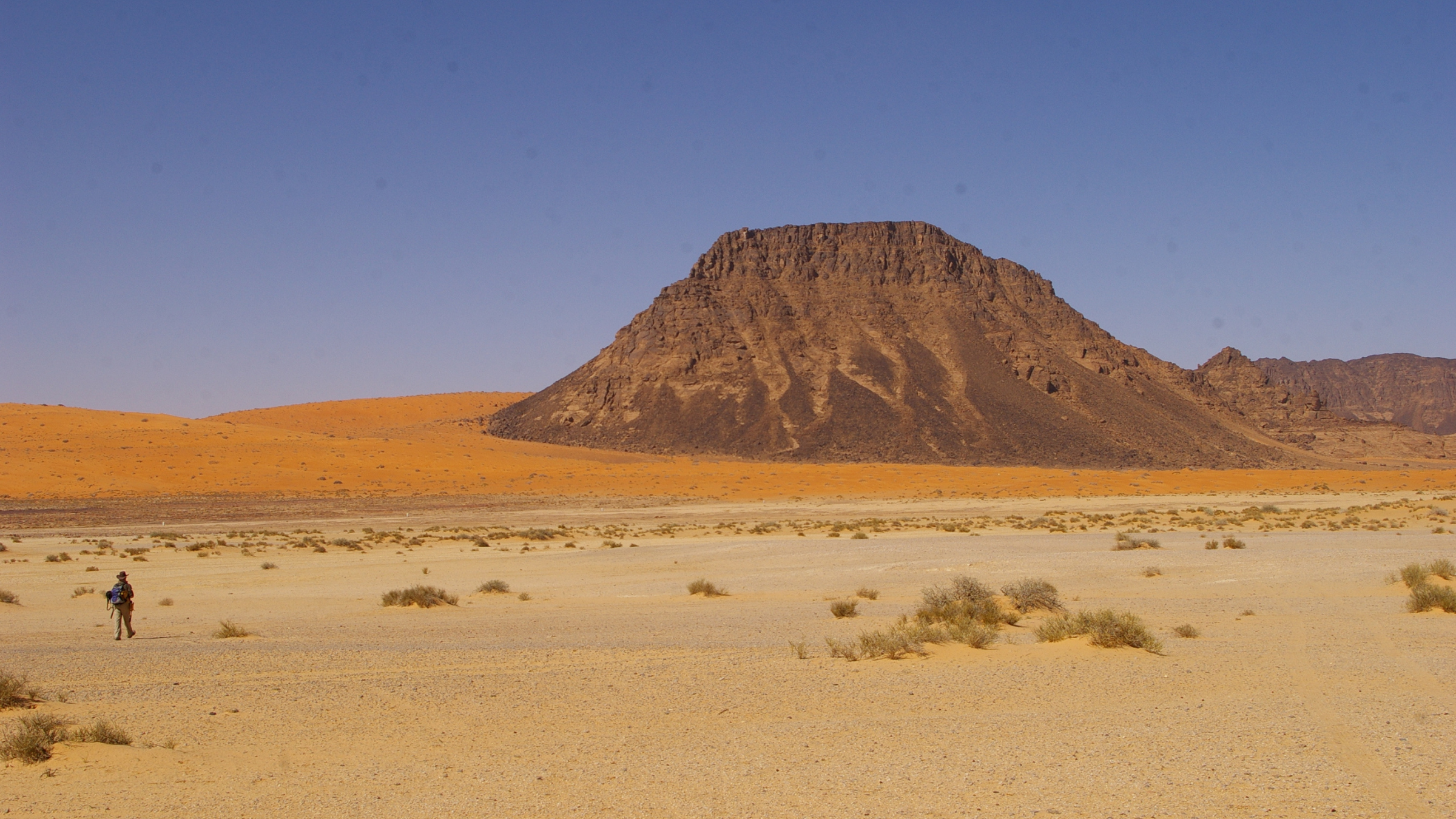
The study examined stone tools from the archaeological site Jebel Katefeh-1, or JKF-1. The site sits beside the remains of an ancient lake near the city of Jubar in Saudi Arabia’s Nefud Desert, also spelled Nafud or An-Nafud.
No Neanderthal fossils have been discovered in Arabia, leaving archaeologists uncertain about who made the tools found at the site. To investigate, the researchers compared the tools with artifacts made by Neanderthals and Homo sapiens at other archaeological sites.
Neanderthals were once viewed primarily as cold-adapted Europeans. Archaeological discoveries have since expanded their known range, placing them across parts of the Middle East and as far east as Siberia.
Because the tools were made without human or Neanderthal bones nearby, the researchers analyzed the distinctive shapes of hundreds of stone flakes. These fragments were struck from carefully prepared stone cores at JKF-1 and at other sites in Arabia, the Levant and northeastern Africa.
How researchers identified the Neanderthal tools
The researchers used statistical analysis to compare stone-flake shapes from different periods and regions. Their computer model was trained on tools from sites where archaeologists have stronger evidence about the identity of the toolmakers.
When the model was applied to artifacts from JKF-1 and a nearby site called ALM-3, the tools were statistically more similar to Neanderthal technology than to tools made by Homo sapiens.
The team also excavated new trenches at JKF-1 and used a dating technique called optically stimulated luminescence. This method determines when sand grains were last exposed to sunlight, helping researchers estimate when the sediments—and the tools within them—were deposited.
Specialized stone tools from the Nefud Desert may have been made by Neanderthals rather than modern humans.
Image courtesy of the Palaeodeserts Project.
Neanderthals may have followed animals into a greener desert
Earlier research dated similar tools to between 90,000 and 50,000 years ago. The new study narrows the age of the JKF-1 artifacts. They were found in a sediment layer where older desert sands were replaced by younger lake deposits, indicating that people were present at the site approximately 55,000 years ago.
At that time, the Nefud Desert was becoming wetter. Lakes expanded, vegetation spread and grazing animals may have moved deeper into the Arabian Peninsula. Neanderthals could have followed these herds in search of food and water.
Archaeologist Knut Bretzke of the University of Tübingen, who was not involved in the research, said the evidence for Neanderthals in northern Arabia was convincing, although some of the study’s assumptions require further examination.
Bretzke noted that some comparison sites used in the statistical model are surface sites where artifacts may have accumulated over long periods. That makes them less directly comparable with sites where tools were discarded during a relatively short period. Nevertheless, he described the study’s conclusions as plausible.
More evidence is needed
The researchers emphasize that the evidence remains circumstantial. Stone tools can reveal how ancient people worked, but they cannot identify their makers with absolute certainty.
“Do you think there were Neanderthals in northern Saudi Arabia? Yes,” Bretzke said. “Do you think there is hard evidence to prove that belief? No.”
Human remains or ancient DNA could provide more definitive evidence. However, bones and genetic material are poorly preserved in Arabia’s hot, dry climate. For now, stone tools provide one of the best ways to investigate Neanderthal migration and human activity in the region.
Brinkhorn, J., Groucutt, H. S., Carleton, W. C., Andrew, E., Armitage, S. J., Shipton, C., Brees, P. S., Drake, N., Al-Omari, A., Al-Jibreen, F., Al-Sharekh, A. M., Sheri, E. M., Brockley, S., and Petralia, M. D. (2026). Neanderthals in the desert? Population history best explains the technological heterogeneity of Arabia’s Middle Paleolithic.Quaternary Science Reviews, 390, 110196.
How much do you know about our closest human relatives? Test your knowledge with our Neanderthal quiz!