


NASA Studies Rare Supercooled Large Droplet Icing Threat to Aircraft
NASA is using its aviation expertise and advanced test facilities to help the aerospace industry address a rare but persistent flight hazard: supercooled large droplet icing. The phenomenon occurs when aircraft fly through clouds containing unusually large water droplets that remain liquid despite temperatures below freezing.
What Is Supercooled Large Droplet Icing?
Supercooled large droplet icing occurs when very cold, liquid water droplets strike an aircraft. Surfaces without ice-protection systems can freeze rapidly as the droplets hit the airplane.
Supercooled water is common in clouds. Droplets can reach temperatures below 32 degrees Fahrenheit without freezing unless they encounter dust or other small particles that trigger crystallization.
Aircraft are designed to operate in typical icing conditions, where water droplets generally range from 2 to 100 microns in diameter. For comparison, a human hair is approximately 70 microns wide. In rare conditions, however, clouds can contain droplets as large as 2,000 microns. These droplets are similar to those encountered in freezing rain.
Because of their size, large supercooled droplets can strike and splash across the rear portions of an aircraft, including areas behind traditional anti-icing systems. This makes the hazard difficult to model and address with existing aircraft designs.
NASA Tests Large Water Droplets in the Icing Research Tunnel
NASA researchers are helping U.S. industry better understand this complex icing phenomenon through a series of experiments in the Icing Research Tunnel at NASA’s Glenn Research Center in Cleveland.
The aviation industry uses engineering tools to design and evaluate aircraft. These tools perform well for common icing conditions, but engineers continue to investigate how accurately they represent the physics of unusually large, supercooled water droplets.
To support that work, NASA is improving the instruments used to generate and measure experimental clouds inside the tunnel. More accurate measurements can help researchers determine how large droplets behave when they encounter aircraft surfaces and ice-protection systems.
New Probe Measures Droplet Sizes in Real Time
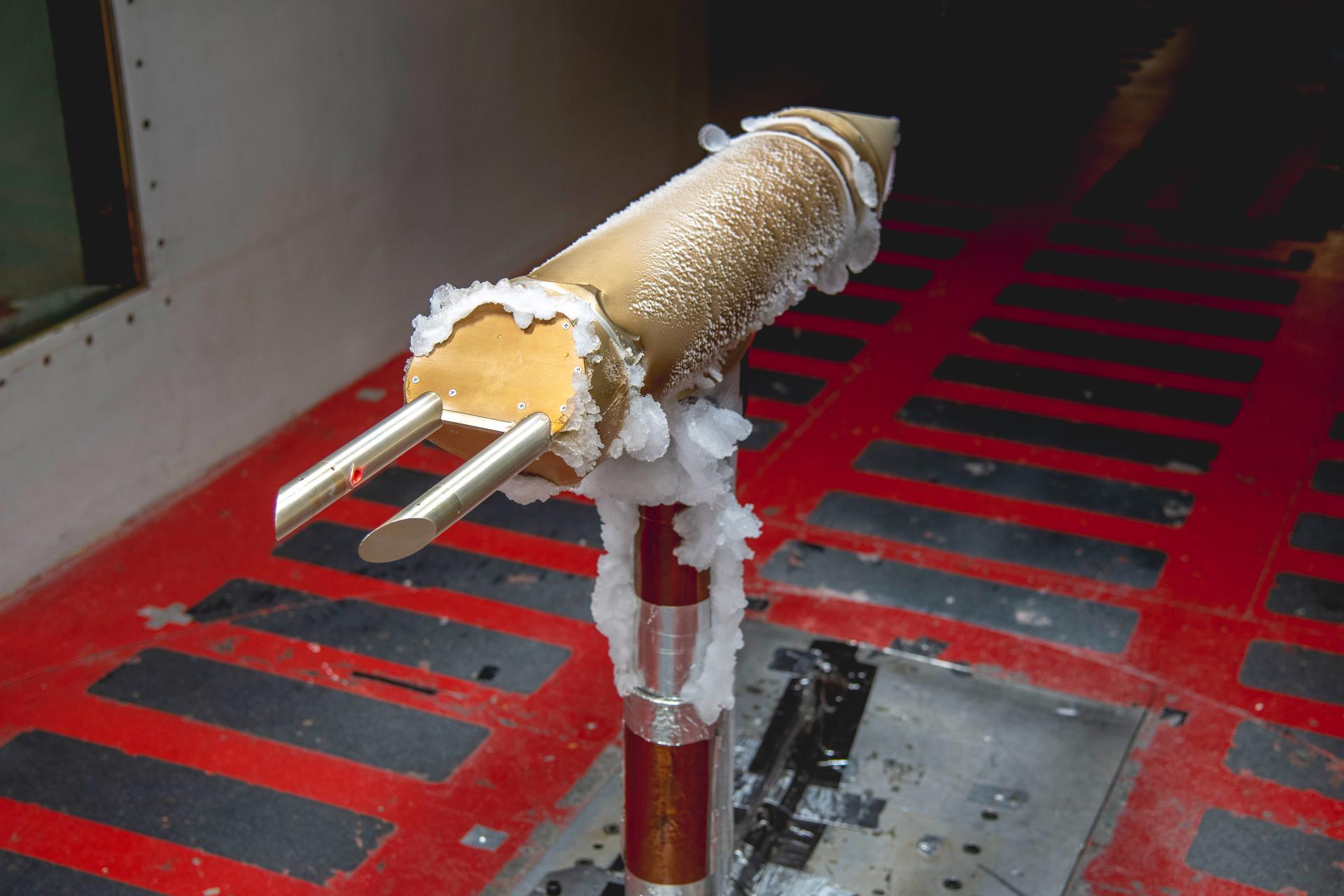
NASA researchers tested a new spacecraft designed to help calibrate the size of cloud droplets produced in research tunnels. The probe can detect droplets larger than 45 microns and analyze their size in real time.
NASA plans to compare those measurements with results from a detailed post-processing analysis of droplet images collected in the tunnel. Researchers will also compare the data with measurements from another probe that detects droplets smaller than 45 microns.
Together, these measurements provide a complete picture of the cloud’s droplet size spectrum, helping researchers better understand conditions associated with supercooled large droplet icing.
Research Supports NASA’s Subsonic Flight Demonstrator Project
The test campaign is an important milestone for NASA’s Subsonic Flight Demonstrator project, part of the agency’s Research and Technology Mission Directorate.
Detailed analysis of the data is ongoing. Once the work is complete, NASA’s project team plans to share the results with the broader aerospace community.
Source: www.nasa.gov