


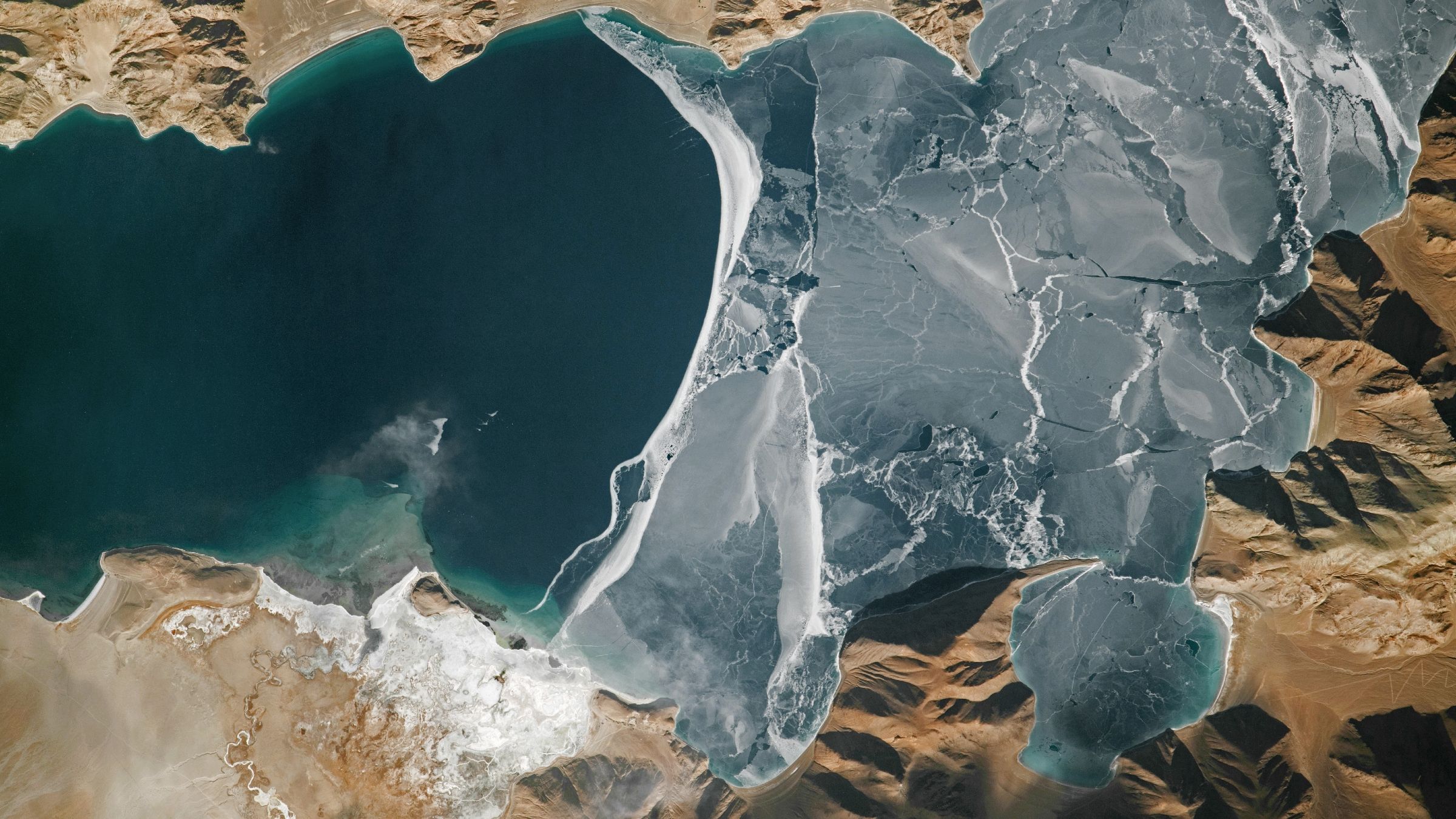
Pangong Lake Ice Fractures Along the Disputed China-India Border in Astronaut Photo
QUICK FACTS
Where is it? Pangong Lake, Tibetan Plateau [33.75582309, 78.69202953]
What is shown? Fractured ice on Pangong Lake near the disputed border between China and India
Who took the photo? An unnamed astronaut aboard the International Space Station
When was it taken? Jan. 25, 2024
An astronaut photograph of Pangong Lake reveals a striking fracture across the surface of one of the world’s highest lakes. The bright white boundary between the frozen water and open water appears to follow a disputed section of the border between China and India.
Also known as Pangong Tso, the long, narrow lake sits high in the Tibetan Plateau at approximately 13,862 feet (4,225 meters) above sea level, according to NASA’s Earth Observatory. Pangong Lake stretches for about 83 miles (134 kilometers) across Ladakh, a region administered by India, and Tibet, an autonomous region of China.
The image covers an approximately 9.5-mile (15-kilometer) section of Pangong Lake, positioned about one-third of the way from west to east. In this area, the most widely accepted location of the boundary places Ladakh on the left side of the image and Tibet on the right.
However, the precise location of the divide — commonly called the Line of Actual Control — remains disputed and is not clearly marked on the ground. Its position has shifted over time, according to The New York Times.
Pangong Lake is an endorheic lake, meaning it has no outlet. Water leaves the basin almost entirely through evaporation, allowing salt to accumulate over thousands of years. Despite its high salinity, the lake can freeze during the harsh Himalayan winter, when temperatures may fall to around minus 13 degrees Fahrenheit (minus 25 degrees Celsius), according to a local travel site.
The exact cause of the dramatic ice fracture in the astronaut photo is uncertain. Pangong Lake is typically frozen across much of its surface in January, the month when the image was captured in 2024. Changes in temperature, wind, water movement or differences in ice thickness may all contribute to cracking.
Pangong Lake usually freezes between December and February. This image, captured in April 2025, shows winter ice melting across another section of the lake.
(Image credit: Matt Hunt/Anadolu via Getty Images)
Although Pangong Lake has no major outflow, several rivers feed into it. One of these streams enters near the lower-left portion of the image. Its delta has largely frozen into a broad white patch, while a small plume of water can still be seen flowing into the lake.
Across the delta, parallel lines visible along the beach mark ancient shorelines. These features formed when Pangong Lake held more water and its shoreline reached farther inland, according to NASA’s Earth Observatory.
Scientists believe Pangong Lake may once have been connected to the Indus River, which travels nearly 2,000 miles (3,200 kilometers) through South and Central Asia. The lake was likely separated from the river system millions of years ago as the Indian and Eurasian tectonic plates collided, raising the Tibetan Plateau and forming the Himalayas.
Pangong Lake and the disputed border
The Line of Actual Control was first established in 1959 and took much of its current form after the Sino-Indian War in 1962. Although China and India have avoided a formal war since then, military confrontations and sometimes deadly clashes have continued along the border, including near Pangong Lake, according to the BBC.

Pangong Lake extends 83 miles (134 kilometers) across Ladakh and Tibet. The orange box marks the approximate location shown in the close-up astronaut photograph.
(Image credit: NASA)
Despite its remote location and politically sensitive setting, Pangong Lake attracts visitors from both India and China. Bird-watchers are drawn to the lake to observe breeding populations of bar-headed geese (Anser indicus) and Brahminy ducks (Tadorna ferruginea), also known as ruddy shelducks.
The frozen lake has also attracted extreme-sports events. On the Ladakh side, runners crossed the ice during a half-marathon in February 2023. The event was recognized by Guinness World Records as the highest-altitude frozen-lake half-marathon ever held.
Source: www.livescience.com