


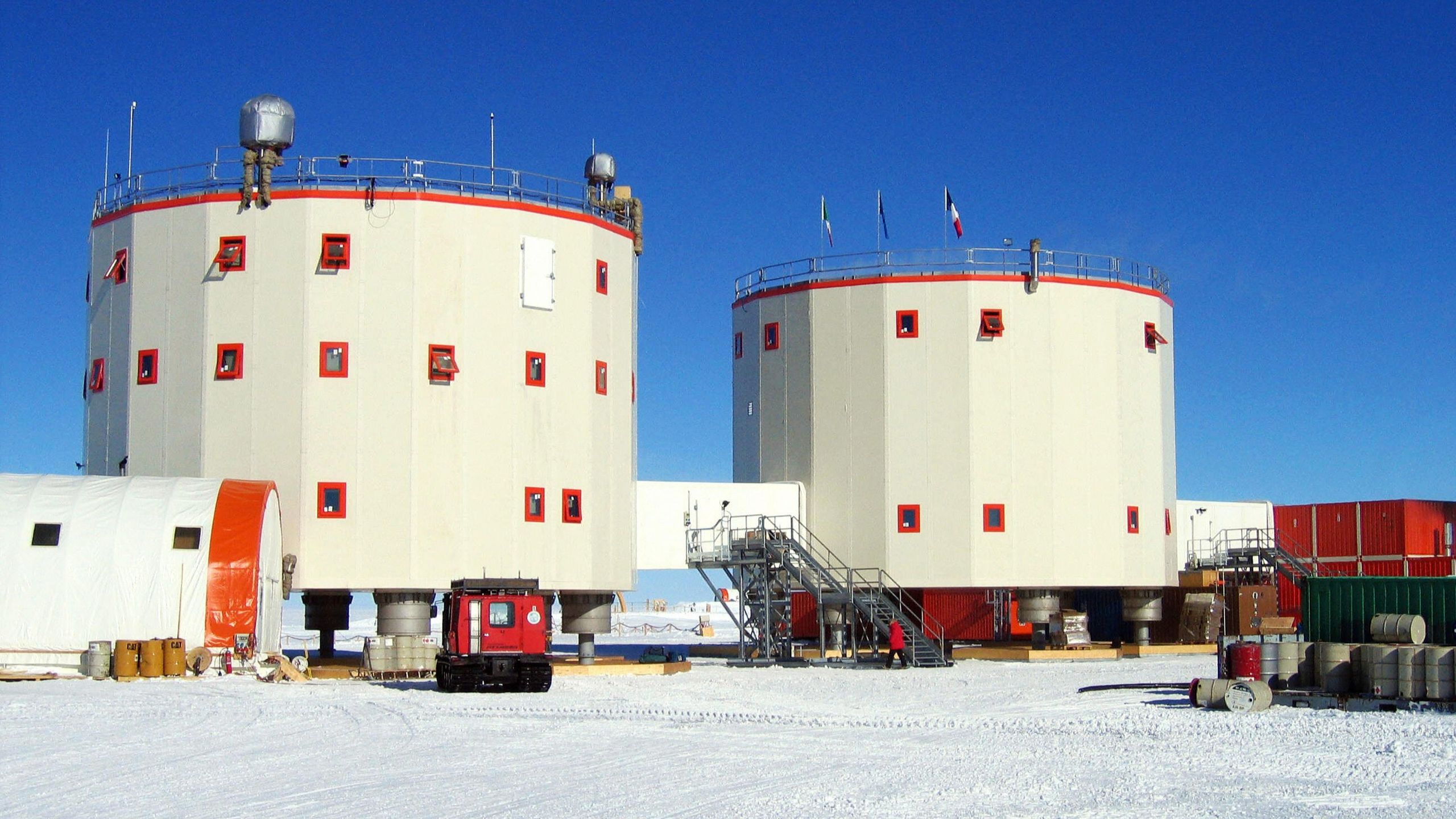
While millions of people around the world faced extreme heat this month, Concordia Research Station in Antarctica recorded its coldest temperature since 2012.
The high-altitude Antarctic research station recorded a temperature of minus 119.4 degrees Fahrenheit (minus 84.1 degrees Celsius) on July 18, according to station data.
Concordia is located deep inside Antarctica, which is currently experiencing the darkest and coldest part of winter. The station regularly records temperatures below minus 112 F (minus 80 C) during this season, so the latest reading is not unprecedented—but it remains an impressive example of Antarctica’s extreme climate.
“Even here, where extreme cold is expected, temperatures below minus 84 C are remarkable and highlight how variable Antarctic weather can still be,” Gabriele Carugati, the Italian National Antarctic Research Program (PNRA) station leader at Concordia, told Live Science during a video call from Antarctica.
The French Polar Institute Paul-Émile Victor, which operates Concordia with the PNRA, provided raw data showing that the temperature fell to minus 84.1 C twice on July 18—at 6:25 a.m. and 6:34 a.m. local time.
The freezing conditions at Concordia are a stark contrast to the dangerous heat affecting many parts of the Northern Hemisphere. North America and Europe have experienced intense summer heat, while Western Europe recorded its hottest June on record. At the same time, wildfires have spread across Canada, the United States, France and Spain.
Although average global temperatures are rising as human activities increase the concentration of heat-trapping greenhouse gases in the atmosphere, climate change does not mean every location becomes warmer all the time. Earth’s weather systems remain complex, and short-term weather patterns can still produce exceptional cold in some regions.
“Climate change describes long-term global trends, while individual weather events can still bring exceptional cold,” Carugati said. “Antarctica is influenced by complex atmospheric processes, so an extreme low temperature at one location does not contradict the broader pattern of global warming.”
Why Concordia is known as the ‘astronauts of ice’ station
Concordia is widely regarded as one of the most remote and extreme research stations on Earth. Built on an ice cap approximately 10,800 feet (3,300 meters) thick, the station supports research into seismic activity, astronomy and Earth’s past climate, according to the French Polar Institute Paul-Émile Victor.
“Concordia is a special place because it sits more than 3,200 meters [10,500 feet] above sea level on the Antarctic Plateau and more than 1,000 kilometers [600 miles] from the coast,” Carugati said. “During winter, there is no sunlight for months. The atmosphere is extremely dry and stable, and under clear skies, heat continuously escapes into space because there are no clouds. This allows temperatures to fall to extraordinary levels.”
Concordia’s isolated and hostile environment also makes it valuable for studying the physical, psychological and social challenges that astronauts may face during long-duration space missions. The European Space Agency maintains a biomedical doctor at the station to study the researchers who live and work there. These crews are often nicknamed the “astronauts of ice.”
Once the Antarctic winter begins, aircraft cannot reach Concordia. The station is also approximately 370 miles (600 kilometers) from the nearest research station. In practical terms, this makes Concordia’s winter crews even more isolated than astronauts aboard the International Space Station, which orbits roughly 250 miles (400 km) above Earth, according to the European Space Agency.
What is the coldest temperature ever recorded in Antarctica?
Concordia’s lowest recorded temperature was minus 120.5 F (minus 84.7 C), measured during the winter of 2010, according to Italy’s Antarctic Meteo-Climatological Observatory.
The official record for the coldest temperature ever recorded on Earth belongs to Vostok Station, another high-altitude research facility in East Antarctica. In July 1983, the Russian station recorded minus 128.6 F (minus 89.2 C), according to the World Meteorological Organization.
Satellite observations suggest that some areas of East Antarctica may reach temperatures as low as minus 144 F (minus 98 C). However, those satellite estimates are not considered the same as an official surface weather-station record. The findings were reported in a 2018 study published in Geophysical Research Letters.
Antarctica remains the coldest and driest continent on Earth, but it is still being affected by global warming. Major glaciers and the ice sheet in West Antarctica face serious risks, while the Antarctic Peninsula is experiencing some of the continent’s most rapid warming.
A study published in Frontiers in Environmental Science found that decisions about greenhouse gas emissions made today could determine how dramatically the Antarctic Peninsula changes over the coming centuries. Sea ice, ice shelves, glaciers and the penguins that depend on them could all be affected.
Concordia stands on the massive East Antarctic Ice Sheet. That ice sheet is generally considered more stable than the smaller West Antarctic Ice Sheet, but it remains vulnerable to a warming climate. During an unprecedented Antarctic winter heat wave in March 2024, temperatures near Concordia reached 15.1 F (minus 9.4 C)—around 32 F (18 C) warmer than the previous March record. Research published in npj Climate and Atmospheric Science concluded that global warming amplified the event.
Earth has also recently entered an El Niño phase, the warmer phase of a naturally occurring climate pattern. El Niño could contribute to additional temperature extremes in an already warming world. Climate publication Carbon Brief has predicted that 2026 could become the second-warmest year on record, behind 2024, while a strengthening El Niño may increase the chance that 2027 becomes the warmest year ever measured.
At Concordia, researchers will continue working through the severe Antarctic winter. The latest extreme cold measurements will help improve weather forecasts, climate models and long-term monitoring of Earth’s atmosphere.
“Extreme observations like this help scientists better understand atmospheric processes and improve climate models,” Carugati said.
Source: www.livescience.com