


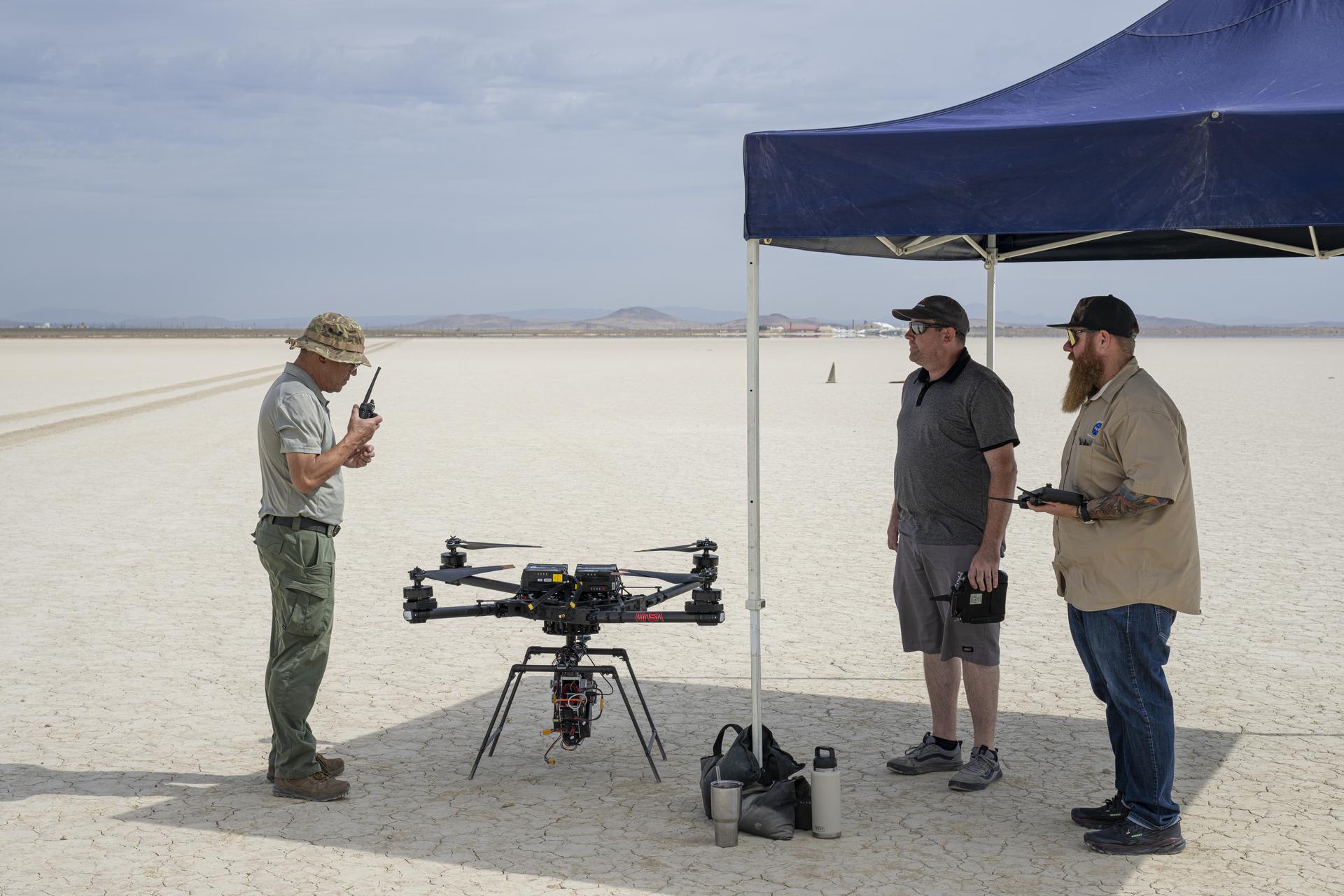
Meet the NASA Team Turning Radio-Controlled Airplanes Into Aerospace Innovation
Long before they helped advance NASA aerospace research, Derek Abramson, Justin Hall, and Justin Link were building radio-controlled airplanes in their garages and homes, testing new ideas, and flying their creations at hobby events. Today, that lifelong passion fuels research at NASA’s Dale Reed Subscale Flight Research Laboratory at NASA Armstrong Flight Research Center in Edwards, California.
NASA’s Subscale Flight Lab Tests the Future of Aviation
At NASA Armstrong’s Subscale Flight Research Laboratory, the team transforms a passion for flight into mission-focused innovation. The lab supports research ranging from advanced navigation systems for future landings on the Moon and Mars to aviation concepts that require rapid, low-cost evaluation.
NASA’s remotely piloted and autonomous small aircraft allow engineers to explore ideas that could be difficult, risky, or expensive to test at full scale. The team integrates emerging aerospace technologies with the lab’s subscale aircraft fleet and conducts aircraft design, manufacturing, and flight experiments to evaluate new concepts.
Three Experts, One Passion for Flight
Abramson, Hall, and Link each play a key role in the laboratory’s work. Abramson is the lab’s chief engineer, Hall is the lead pilot, and Link is a drone pilot.
Abramson brings experience from the U.S. Navy and the aerospace industry, with expertise in technical oversight, management, and systems design. Hall is known for his creative approach to problem-solving, using practical methods to address technical challenges while maintaining flight safety. Link specializes in designing and manufacturing research vehicles and draws on extensive practical experience to understand what works—and what does not—in flight.
Outside work, the team spends weekends in garages and hangars building radio-controlled airplanes, researching hobby trends, and exploring new technology. They also attend hobby events and exhibitions, where they may be found flying their creations. Their shared passion for flight brought them together years before they each joined NASA more than a decade ago, although each discovered that passion in a different way.
Derek Abramson: From Model Aircraft to NASA Flight Testing
Abramson’s interest in aviation began during childhood with rubber-band-stick aircraft, tissue airplanes, and radio-controlled models. His early pursuits led to his first solo flight in high school and eventually helped him earn his pilot’s license.
While serving in the Navy, Abramson worked as an avionics technician on several aircraft, including the EA-6B and F-18. As an engineer, he supported flight testing of B-1 and CV-22 Osprey aircraft. As a NASA Armstrong intern, he leveraged his experience in remotely piloted and autonomous aircraft operations and engineering.
Justin Hall: Inspired by the SR-71 and Space Shuttle
Hall’s interest in aviation grew after he watched historic aircraft, including the Mach 3 SR-71, fly over his elementary school playground. He also watched Space Shuttle Challenger land from atop his father’s shoulders.
Since he was young, Hall has built and remotely flown model airplanes. His reputation for flying radio-controlled aircraft at fly-ins and trade events eventually led to an opportunity to fly subscale aircraft for NASA.
Justin Link: Building Aircraft From Balsa Wood to Large Drones
When Link was five years old, he and his father built an airplane from balsa wood and flew it in a field near their home. As he grew older, his hobbies expanded to include radio-controlled cars, boats, helicopters, and airplanes.
Aviation runs deep in Link’s family. His great-grandfather served in the U.S. Army Air Corps, his grandfather served in the U.S. Air Force, and his father was an Air Force avionics engineer. Link later raced sailplanes and scaled-up Warbird aircraft, while family and friends encouraged him to pursue a career in aviation.
Link has worked on large drones for more than 11 years, focusing on research and development, composite materials, and specialized manufacturing methods.
From Hobby Aircraft to NASA Missions
Together, Abramson, Hall, and Link bring new ideas to life through rapid design, manufacturing, integration, and flight testing. Their hands-on experience with radio-controlled aircraft and advanced research vehicles continues to support NASA missions in aeronautics, science, and exploration.
Source: www.nasa.gov