


Scientists Confirm a Carnivorous Flowering Plant in China
Scientists have confirmed that Saxifraga candelabrum, a flowering plant native to the mountains of southwest China, is carnivorous. The discovery supports a prediction Charles Darwin made more than 150 years ago about closely related saxifrage plants.
Saxifraga candelabrum grows at elevations above 8,200 feet (2,500 meters) in the Hengduan Mountains. This mountain range connects the southeastern Tibetan Plateau with the Yunnan-Guizhou Plateau.
How Saxifraga candelabrum traps insects
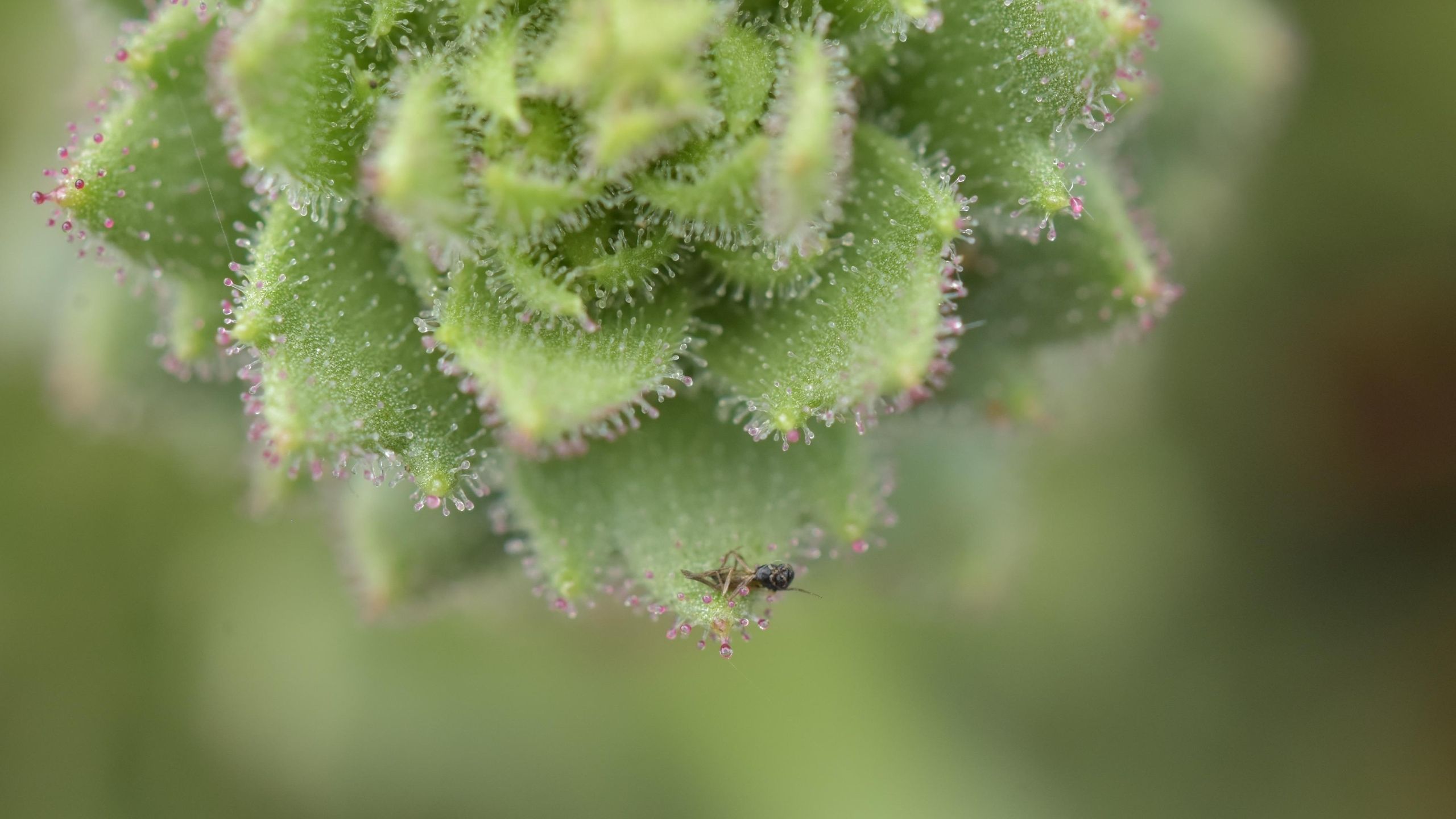
The plant’s stems and branches are covered with sticky hairs that trap small insects, especially nonbiting midges. Until now, however, researchers did not know whether the plant simply caught insects or could digest and absorb nutrients from them.
In a new study, scientists demonstrated that S. candelabrum can digest captured insects and absorb nutrients from their bodies, confirming that it is a true carnivorous plant. The findings were published Tuesday, Aug. 4, in the journal Nature Communications.
This is the first confirmed example of carnivory in the saxifrage plant group, said study co-author Douglas Soltis, a distinguished professor of biology at the Florida Museum of Natural History.
Most carnivorous plants grow in wet, boggy environments. By contrast, S. candelabrum lives in dry alpine habitats. These high-elevation soils are low in nitrates, so carnivory may help the plant obtain essential nutrients that are scarce in its environment.
Darwin predicted these plants could be carnivorous
In 1875, Darwin proposed that two species closely related to S. candelabrum — Saxifraga rotundifolia and Saxifraga umbrosa — might be carnivorous because they possessed sticky hairs capable of catching insects.
Darwin could not prove that the plants digested their prey or absorbed nutrients from insect tissues. Those two processes are essential for confirming true carnivory. Plants that trap and kill insects without digesting or absorbing them are generally described as “protocarnivorous.”
“Although untested at the time, Darwin’s hypothesis provided an important inspiration for our study,” study co-author Hang Sun, a researcher at the Chinese Academy of Sciences’ Kunming Institute of Botany, said in an email.
Evidence that the Chinese mountain plant is carnivorous
Researchers combined field observations, herbarium research, biochemical tests and genetic analysis to investigate S. candelabrum.
Field observations showed that mature plants with more branches and longer stems held an average of 71 trapped insects. Herbarium surveys produced similar evidence: 43 of 45 preserved specimens contained insects. This suggests that insect trapping is common throughout the species.
The scientists also found that S. candelabrum produces phosphatase, a digestive enzyme commonly associated with carnivorous plants. They used fluorescent markers to identify the enzyme under a specialized microscope.
S. candelabrum produces a sticky substance that coats its hairs, causing insects to become trapped when they land on the plant’s stems or branches.
Image credit: Xin-Jian Zhang
To test whether the plant absorbs nutrients from insects, the researchers fed it fruit flies marked with a stable form of nitrogen. Afterward, nitrogen levels increased significantly in S. candelabrum and in a known carnivorous plant used as a control.
A noncarnivorous plant used as a second control did not show an increase in stable nitrogen. The results indicate that S. candelabrum not only catches insects but also digests them and absorbs their nutrients.
Evolution helped the plant balance carnivory and pollination
Genetic analysis revealed that S. candelabrum shares genes with established carnivorous plants. These genes are associated with attracting prey, digesting insects and absorbing nutrients.
According to the study, the plant likely evolved carnivorous traits as an adaptation to its nutrient-poor alpine habitat. Its sticky hairs may originally have helped defend the plant against herbivores before becoming effective insect traps.
Interestingly, larger insects rarely become stuck to the plant’s hairs. The researchers suggest this may help preserve the insects that S. candelabrum needs for pollination, creating an evolutionary balance between feeding and reproduction.
Other Saxifraga species and plants from the same lineage may also prove to be carnivorous.
“Many members of the Saxifragaceae, which includes genera other than Saxifraga, have sticky glandular hairs and are often covered with insects,” Soltis said. “I would not be surprised if other members of the family are also carnivorous — as Darwin predicted.”
The discovery expands scientists’ understanding of carnivorous plants and suggests that carnivory may be more widespread among flowering plants than previously thought, Sun said.
Zhang, X.-J., Deng, T., Lin, N., Wang, H.-C., Song, B., Xun, E.-N., Huang, X.-H., Fu, Q.-S., Chen, J.-T., Luo, P.-R., Soltis, D. E. and Sun, H. (2026). Identification of carnivory in the flowering plant Saxifraga via multidisciplinary evidence. Nature Communications.
Charles Darwin quiz: Test your knowledge of the “father of evolution.”
Source: www.livescience.com