


Pluto’s atmosphere may be shrinking after remaining stable for several years, according to a new study published in the Planetary Science Journal.
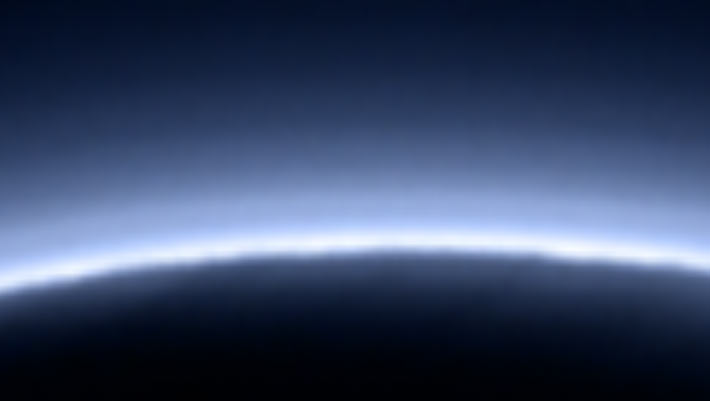
Complex chemical compounds called tholins create Pluto’s distinctive blue haze. Image credit: NASA / Johns Hopkins University Applied Physics Laboratory / Southwest Research Institute.
Pluto’s atmosphere consists primarily of nitrogen, along with smaller amounts of methane and carbon monoxide.
First detected through stellar occultations in the 1980s, Pluto’s atmosphere is maintained by a delicate balance between atmospheric gases and surface ices.
Pluto follows a highly elliptical orbit and has an extreme axial tilt. As a result, the amount of sunlight reaching different regions of its surface changes dramatically during its 248-year orbit around the Sun. These seasonal variations influence how much nitrogen ice and other frozen materials sublimate into the atmosphere.
Planetary scientists have long debated whether Pluto’s seasonal cycle could eventually cause its atmosphere to collapse as the dwarf planet moves farther from the Sun. Another possibility is that nitrogen-ice reservoirs, especially those in Sputnik Planitia — the large, heart-shaped basin visible on Pluto’s surface — could continue supplying enough gas to maintain the atmosphere.
“There are no spacecraft near enough to Pluto to see its atmosphere, and from Earth, Pluto appears to be nothing more than a tiny blob to even the best space telescopes,” said lead author Dr. Amanda Sickafoose of the Planetary Science Institute and her colleagues.
“Luckily, as Pluto, Earth and even the stars slowly move through the sky, chance alignments, called occultations, cause Pluto to pass in front of some stars.”
“By observing how starlight changes as a star passes behind Pluto during these occultations, we can characterize Pluto’s atmosphere.”
The new study analyzes data from 10 stellar occultations observed between 2017 and 2023.
The results indicate that Pluto’s atmospheric pressure remained stable for several years. After decades of gradual increases, the atmosphere reached a plateau around the time of NASA’s New Horizons flyby in 2015 and stayed relatively steady through approximately 2021.
However, more recent observations suggest that Pluto’s atmospheric pressure has begun to fall. When the researchers compared observations from 2015–2021 with measurements collected in 2022, they calculated a pressure decrease of approximately 7% in the clear upper atmosphere. When haze in the lower atmosphere was included, the estimated decline increased to about 16%.
“We’re at a particularly interesting point for Pluto,” Dr. Sickafoose said.
“Our work suggests that the atmosphere has recently started decreasing in pressure.”
“I am hopeful that we’ll be able to get more data in the next years to decades to specifically confirm or refute this trend.”
The researchers also found that Pluto’s upper-atmosphere structure has remained broadly consistent since 2017. The lower atmosphere, however, appears to be changing, as indicated by a shallower light-curve slope in the most recent observations.
The team attributes this change to haze particles settling through the atmosphere, a process that can occur over periods ranging from several weeks to roughly one year.
One observation made in 2018 also recorded brief spikes in the light curve. The researchers interpret these features as possible evidence of vertically propagating buoyancy waves in Pluto’s atmosphere.
The scientists emphasize that the apparent decline in atmospheric pressure requires confirmation through additional stellar occultation observations. The quality of the available data varied considerably, and some events were too noisy to support firm conclusions.
“I’m constantly amazed at how the simple technique of watching starlight dim and reappear allows us to study a thin atmosphere — a few millionths of the Earth’s — on a world two-thirds the size of our Moon and 30 times farther from the Sun,” Dr. Sickafoose said.
_____
Amanda A. Sickafoose et al. 2026. Changes in Pluto’s Atmosphere Based on Stellar Occultation Data from 2017 to 2023. Planet. Sci. J 7, 180; doi: 10.3847/PSJ/ae6cdd
Source: www.sci.news