


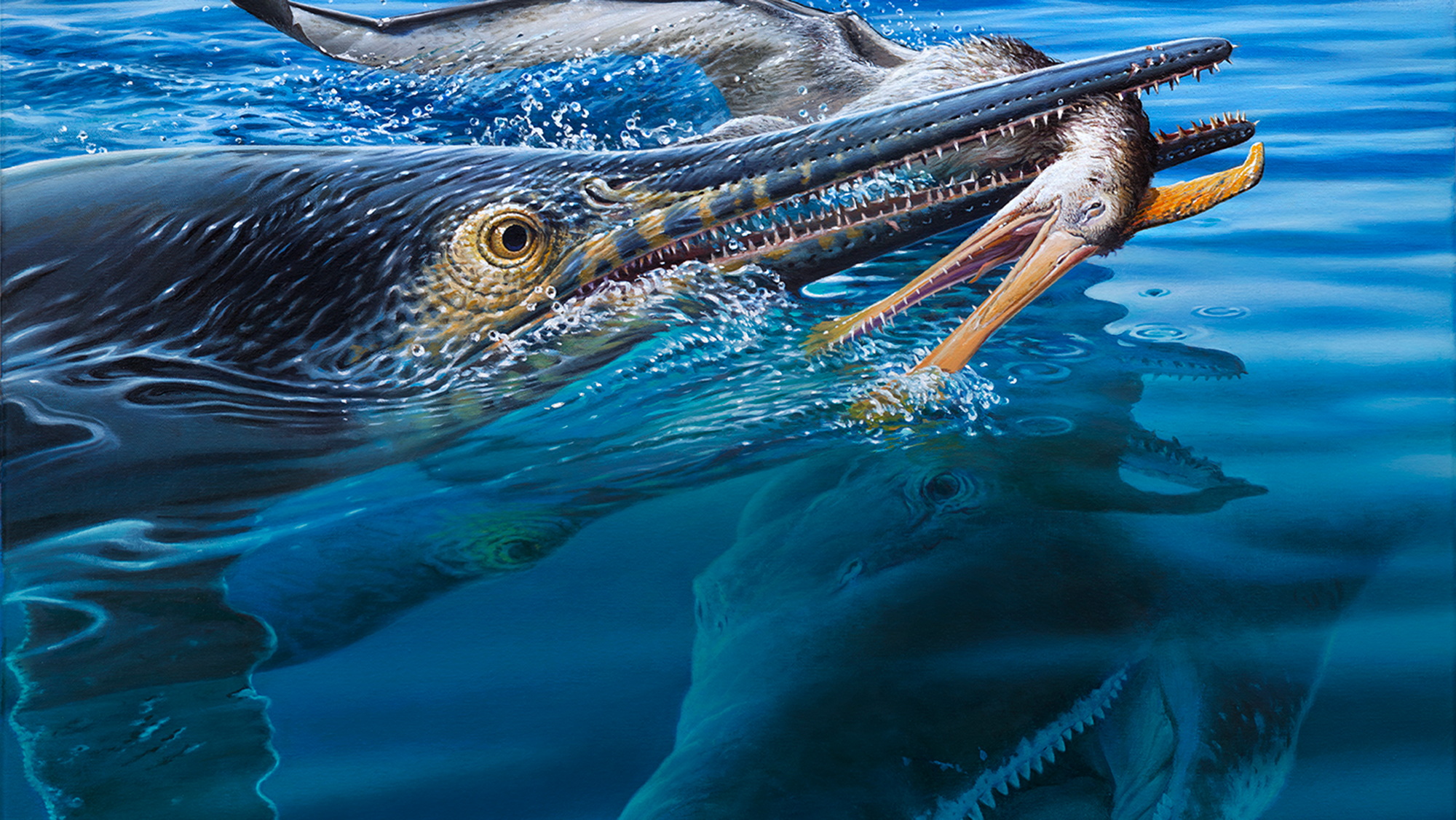
An ichthyosaur attacks a pterosaur while a giant pliosaur swims below.
(Image credit: Peter Trusler)
A fossil discovered in the Australian outback may capture an extraordinary prehistoric food chain. Roughly 100 million years ago, a giant marine reptile appears to have eaten a flying pterosaur before dying in an attack by an even larger ocean predator.
The fossil collection, known as “BOB,” or “Bag of Bones,” belonged to a 20- to 23-foot-long (6 to 7 meters) ichthyosaur. These dolphin-shaped marine reptiles lived alongside dinosaurs during the Mesozoic Era, approximately 250 million to 90 million years ago.
Inside the animal’s body cavity, researchers found fragments of a pterosaur jaw, as well as the remains of fish and cephalopods. The discovery provides the first confirmed evidence that ichthyosaurs consumed pterosaurs, an extinct group of flying reptiles that dominated the prehistoric skies.
The research, published July 28 in Gondwana Research, also offers clues about how the ichthyosaur died and how its remains were preserved.
Latest Videos FromLive Science
The ichthyosaur’s skeleton was discovered in Queensland in 2019. It contains broken bones, missing ribs and substantial crushing injuries. Scientists believe the damage may have been caused by Kronosaurus queenslandicus, a crocodile-like apex predator that lived between 120 million and 100 million years ago in Australia’s ancient Eromanga Sea.
Ichthyosaur fossil preserves a rare prehistoric meal
Fossilized stomach contents are exceptionally rare because they require rapid burial and very specific conditions to survive for millions of years.
“Rapid burial after death is essential to prevent decay and scattering of remains,” study co-author Matt White, a research associate at the University of New England in Australia, told Live Science in an email. “The animal must have died soon after its last meal so stomach acids did not completely digest the prey.”

Researchers scan the BOB ichthyosaur fossil to investigate its internal contents.
(Image credit: Kronosaurus Korner Museum Queensland Australia)
To investigate the fossil without damaging it, researchers used advanced neutron imaging. The scans revealed bones hidden inside the fossil and helped confirm that the remains were located within the ichthyosaur’s digestive system.
According to White, modern imaging technology is allowing paleontologists to examine fossil interiors and identify evidence that could not previously be seen.
“Scanning techniques have improved, enabling us to see inside specimens and determine what they potentially ate,” White said. The technology can also reveal “the shape of various organs” and internal bone structures.
The pterosaur bones were found near the front of the ichthyosaur’s body cavity rather than in the position expected for digested food. Researchers believe the remains may have shifted when the animal struck the seafloor headfirst after death.
“We believe the animal died in the water column—perhaps because of a pliosaur, such as Kronosaurus, attack or natural causes—and then sank,” White said. “It struck the seafloor with its snout, while connected soft tissues helped keep much of the skeleton in place.”

Graphic showing the complex marine food web of Cretaceous Australia.
(Image credit: White et al. (2026))
What the fossil reveals about an ancient ecosystem
The fossil provides a rare view of the food web in the ancient Eromanga Sea, which covered large areas of central Australia during the Early Cretaceous Period, approximately 145 million to 100 million years ago.
Ichthyosaurs are widely known to have hunted fish and squidlike animals, but direct evidence that they ate pterosaurs has been difficult to find. The BOB fossil suggests that some ichthyosaurs may have captured flying reptiles when they landed on the water—or scavenged pterosaurs that had died and floated on the surface.
“These discoveries provide valuable evidence of ancient predator-prey relationships and help scientists reconstruct prehistoric ecosystems in greater detail,” White said.
White, M. A., Bevitt, J. J., Enchelmaier, M. J., Petersen, K. W., & Trusler, P. W. (2026). Beneath the waves: Extraordinary dietary insights from a dismembered ichthyosaur from the lower Cretaceous. Gondwana Research.
Source: www.livescience.com