


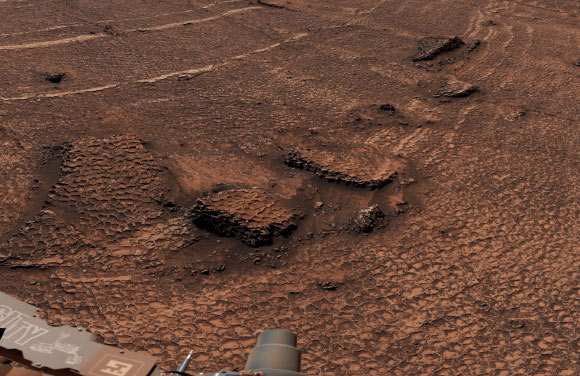
NASA’s Curiosity rover has discovered the largest field of polygon-shaped fractures ever observed on Mars, offering scientists new clues about the Red Planet’s ancient watery environment.
Polygon-shaped fractures discovered by NASA’s Curiosity rover in Gale crater on Mars. Image credit: NASA / JPL-Caltech / MSSS.
The unusual Martian terrain is located in Valle Grande, a valley on the lower slopes of Mount Sharp within Gale crater. Curiosity has been exploring and climbing the mountain since 2014.
A 360-degree panorama captured on June 19 and 20, 2026, reveals honeycomb-like polygons extending toward the horizon in every direction.
The individual fractures measure approximately 4 to 8 cm (1.5 to 3 inches) across. The polygon pattern also extends up the sides of a nearby sand-capped butte known as Miraflores, which rises about 6 m (20 feet) above the surrounding landscape.
NASA’s Curiosity rover has photographed smaller groups of geometric fractures on Mars before, but researchers say this newly discovered field is unprecedented in scale.
“We’ve seen a lot of fascinating landscapes through Curiosity’s eyes, but this sea of polygons took our breath away,” said Curiosity team member Dr. Ashwin Vasavada, a researcher at NASA’s Jet Propulsion Laboratory.
“We measured their shapes and chemistry carefully and are hopeful there are clues in the data as to how these features formed.”
Scientists say polygon-shaped features on Mars can form through several different geological processes, meaning the newly discovered fractures may not have the same origin as similar patterns found elsewhere on the planet.
Some polygon networks previously examined by Curiosity formed when ancient mud dried and cracked. Other patterns may have developed through repeated freeze-thaw cycles or compression that forced water out of buried sediments.
Researchers have not yet determined which process — or combination of processes — created the newly identified polygon field in Gale crater.
“Billions of years ago, lakes and streams dappled the lower foothills of Mount Sharp, a 5-km- (3-mile-) tall mountain that Curiosity has been ascending since 2014,” the research team said.
Curiosity has previously found chemical evidence of Mars’ wet past, including carbon-based organic molecules considered possible precursors to RNA and DNA, the nucleic acids that carry genetic information.
“We have no way of knowing whether these organic molecules were created by biologic or geologic processes — either path is possible — but their discovery reconfirmed that ancient Mars had the right chemistry to support life.”
Source: www.sci.news