


When Did Human Ancestors Stop Climbing Trees? Little Foot Reveals a Complex Transition
A new study led by paleoanthropologists from the University of the Witwatersrand and the University of Southern California provides fresh evidence about a major transition in human evolution: when our ancestors shifted from regularly climbing trees to relying primarily on upright, terrestrial walking.
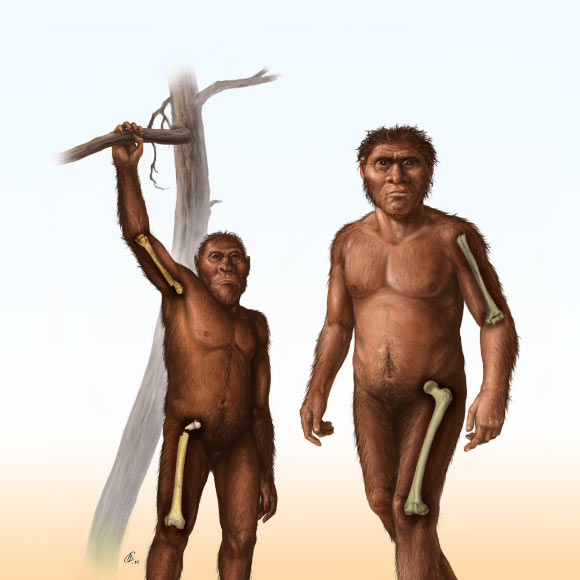
A depiction of Australopithecus (left), whose arm and thigh bones had more similar strength, and an early Homo individual (right), whose femur was relatively stronger than the humerus. Image credit: Karen Townsend.
Little Foot combined tree climbing with bipedal walking
“Since the days of Darwin and Huxley, terrestrial bipedalism has been a central tenet of humanity’s ecological niche,” said lead author Professor Christian J. Carlson and his colleagues.
Researchers have been examining how this form of locomotion changed throughout human evolution, beginning with the last common ancestor of humans and chimpanzees, which lived between approximately 9.3 and 6.5 million years ago.
Evidence accumulated over the years suggests that terrestrial bipedalism developed in stages, progressing from occasional or facultative behavior to habitual and eventually obligatory bipedalism.
For the new study, the researchers analyzed the internal strength of limb bones from two important fossils: the 3.67-million-year-old “Little Foot,” an individual of Australopithecus from Sterkfontein Cave in South Africa, and an early Homo individual dating to approximately 1.8 million years ago from Dmanisi, Georgia.
The team focused on the diaphysis, or shaft, of the long bones. Because this part of the skeleton responds to the physical demands placed on it during life, its relative strength can provide clues about how an individual actually moved—not simply about the shape of the skeleton.
The researchers compared the strength ratios of the arm and leg bones from the fossils with those of modern humans, chimpanzees, gorillas, and orangutans. These ratios are closely associated with the amount of time different species spend moving through trees.
Australopithecus retained an ape-like pattern
Little Foot’s limb proportions were similar to those of African great apes, suggesting that the individual regularly climbed trees despite being relatively large for an australopith.
At the same time, Little Foot’s lower-limb bones displayed more human-like proportions. Together, these findings point to a mixed locomotor repertoire that combined terrestrial bipedal walking with frequent arboreal activity.
“This is one of the most surprising results,” Professor Carlson said.
“This Australopithecus individual has signals similar to modern humans in its lower limbs, but the relationship between its arms and thighs is much more similar to African apes.”
The findings suggest that early human ancestors could have been well adapted to walking on the ground while still relying heavily on trees for climbing, shelter, or other activities.
Early Homo shows a major shift toward terrestrial life
In contrast, the early Homo individual from Dmanisi displayed limb-strength proportions within the range of modern humans on both measurements examined by the researchers. The results are also consistent with earlier evidence from African Homo erectus fossils.
These similarities indicate that arboreal behavior had been substantially reduced by approximately 1.8 million years ago. By that time, habitual, human-like terrestrial bipedalism appears to have become firmly established.
The transition occurred more than a million years after stone tool production began. This suggests that the shift away from frequent tree climbing may have been associated more closely with changes in foraging strategies and the expansion of ranging behavior than with tool use alone.
Why did human ancestors become more terrestrial?
The researchers describe the difference between Australopithecus and Homo as a possible threshold in human adaptation—one of several major changes used to distinguish stages of human evolution.
However, the cause of this transition remains unclear. Changes in ranging patterns, food gathering, and other ecological pressures may have favored stronger lower limbs and a greater reliance on terrestrial movement.
The shift also occurred during a broader period of increasing brain size in the human lineage. The researchers emphasize that this timing does not demonstrate that one change caused the other, but they believe the possible relationship warrants further investigation.
“We hope that the possible relationship between changes in limb use, ranging behavior, and brain size will stimulate further discussion,” the researchers said.
The study was published in the journal Science Advances.
_____
Christian J. Carlson et al. 2026. Proportional limb strength indicates an adaptive change in arboreal nature during early human evolution. Science Advances 12(38); doi: 10.1126/sciadv.aeh1752
Source: www.sci.news