


Fascinating Facts
Name: Elamite Helmet Featuring a Divine Image
What It Is: Bronze Helmet Adorned with Gold Decorations
Origin: Southwestern Iran
Date of Creation: 1500 to 1100 BC
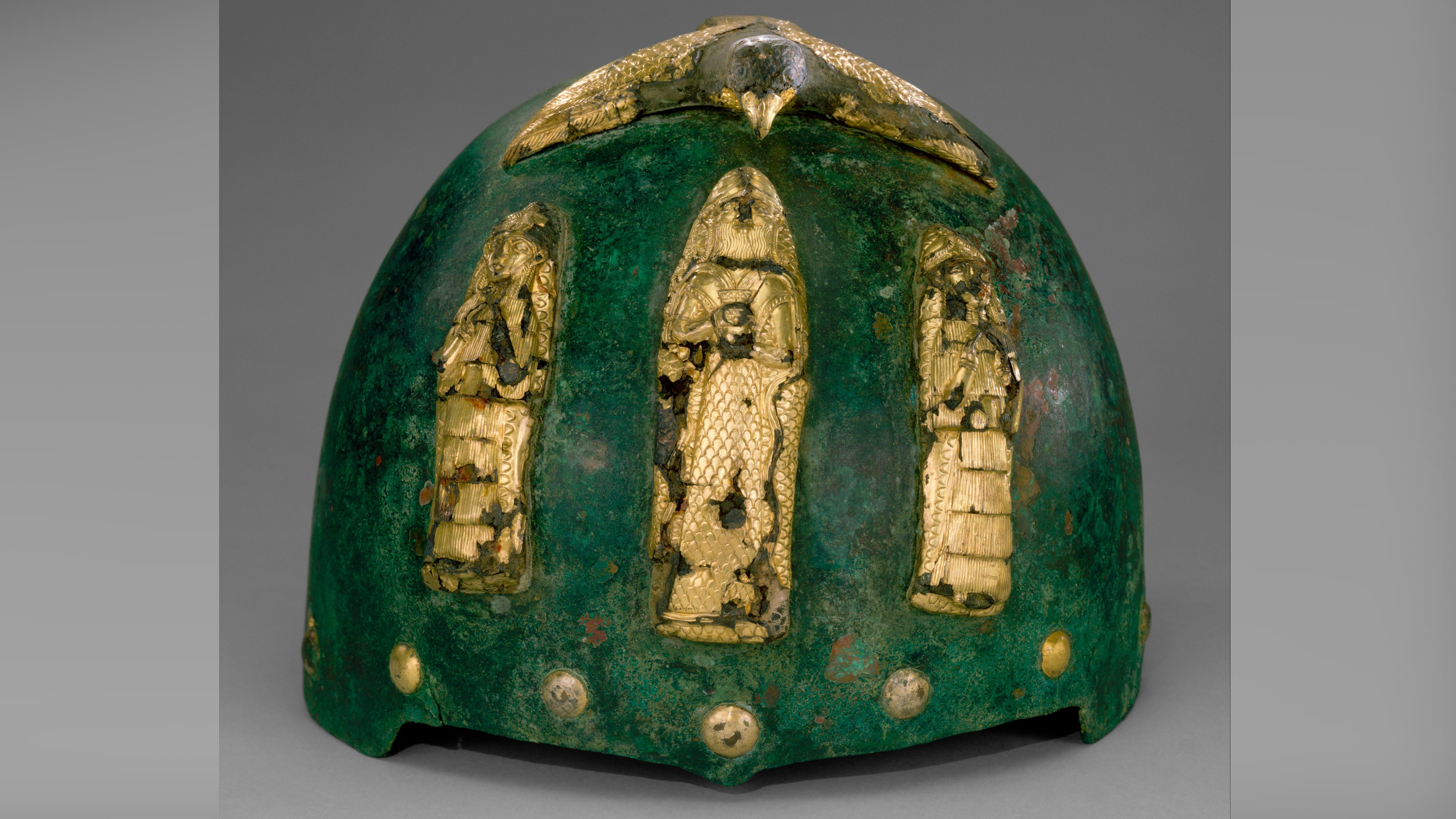
This remarkable helmet originates from the Elamite culture, an illustrious civilization that thrived for nearly 3,000 years in present-day Iran. Likely worn by a warrior king over 3,000 years ago, it is ornately decorated with a majestic bird of prey soaring over three sacred figures.
The helmet is domed, measuring approximately 8.5 inches (21.6 centimeters) in diameter and featuring a cutout area at the front, extending past the wearer’s eyebrows. Initially, small projections between the eyebrows helped shield the wearer’s nose. Gold-Covered silver studs trim the edge of the helmet, and a bronze tube at the back might have once held feathers or hair.
This helmet is part of the collection at the Metropolitan Museum of Art. Crafted by skilled artisans of the Elamite culture, one of the earliest civilizations in the ancient Near East, the Elamites inhabited what is now southwestern Iran and the eastern Persian Gulf from around 2700 BC until their conquest by the Persian Empire in 539 BC.
Historians consider this particular helmet a “masterpiece of ancient art,” noted as unparalleled by any other known artifact from the ancient Near East. Archaeologist Oscar White Muscarella discusses it in his 1988 publication on ancient Middle Eastern artifacts.
The front of the helmet portrays three gold deities: one male god—holding a vessel from which water flows, suggesting his role as an Elamite water god—and two identical goddesses wearing horned headdresses. The goddesses raise their hands in prayer. Above the water god, a bird of prey is depicted, perhaps symbolizing the birds awaiting the fallen in battle. Curator emeritus Charles K. Wilkinson notes in a 1965 study that the helmet’s unique design distinguishes it from other Elamite armor pieces.
This helmet would have been donned by a high-ranking individual in the Elamite civilization. Scholars Muscarella and Wilkinson suggest that its representations of deities were likely intended to protect against evil and chaos on historical battlefields.
For more captivating archaeological discoveries, visit our archive of amazing artifacts.
Check out last week’s interesting finds: Last week’s amazing artifacts?
Topics
Source: www.livescience.com