


New Omomyid Primate Species Discovered in Southern Wyoming
Paleontologists have identified a previously unknown species of omomyid primate in southern Wyoming, revealing new details about the evolution and geographic distribution of one of North America’s best-studied fossil primate lineages.
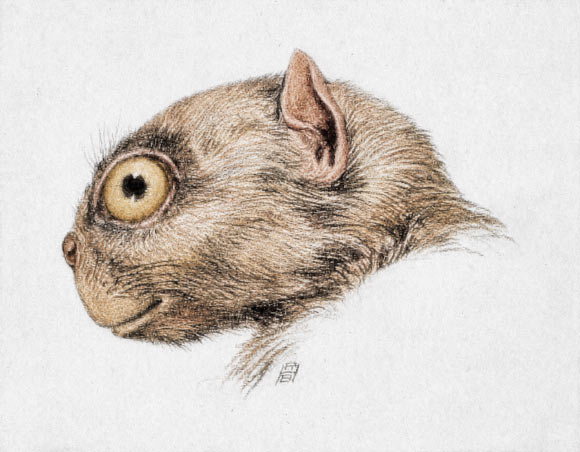
Tetonius homunculus (colorized) by R. Bruce Horsfall from W.B. Scott’s History of Land Mammals in the Western Hemisphere.
The new species, named Tetonius varleyorum, belonged to the omomyid family of small, large-eyed, tarsier-like primates. These extinct animals lived in the forests of North America approximately 50 million years ago during the Eocene Epoch.
About the size of a modern mouse lemur, Tetonius varleyorum is providing scientists with fresh evidence about early primate evolution.
“Our paper is about a new species of an omomyid primate, a primate family close to the top of the family tree of modern primates — with lemurs on one side and apes, humans and monkeys on the other,” said Parker Rhinehart, a doctoral student with the Biodiversity Institute and Natural History Museum at the University of Kansas.
“The branch point where they meet up at the top is where the omomyids fall.”
“They’re true primates, but they’re extinct. They appear about 55 or 56 million years ago across the Northern Hemisphere.”
Researchers discovered dozens of jaw and tooth fragments belonging to Tetonius varleyorum at a sandstone locality known as Tim’s Confession. The site is part of the Smiley Draw local fauna in Wyoming’s Great Divide Basin.
Tim’s Confession has already produced nearly 1,000 tooth-bearing jaw fragments from a broad range of ancient mammals, making it an important location for studying Eocene mammal diversity.
“Identifying ancient primate fossils in the field typically requires hunting tiny fossil jaws and teeth — the only body parts tough enough to withstand erosion over geologic time,” Rhinehart said.
“Our paper analyzes fossils from Smiley Draw, a different Wyoming locality outside of the better-sampled Bighorn Basin.”
“This is really important to the Tetonius story,” he added.
“Because so many scientific ideas only really consider the fossils from the Bighorn Basin, they just don’t take in the whole picture.”
“One of the things our paper points out is that when you start incorporating fossils from outside of the Bighorn Basin, this picture becomes a little bit more complicated.”
### A diverse community of Eocene primates
The discovery of Tetonius varleyorum is significant not only because it represents a new species, but also because of the other ancient primates found at the same site.
The Smiley Draw locality also yielded two rare omomyid primates, Arapahovius gazini and Anemorhysis savage. These finds represent only the second and third times that either species has been documented.
According to the paleontologists, three distinct species of these small Eocene primates have never previously been found together at a single early Eocene site. A fourth omomyid species, which has not yet been formally described, was also recovered from the locality.
“Our description of Tetonius varleyorum as a new fossil species gives fresh detail to the biogeographic and evolutionary history of primates,” Rhinehart said.
### New evidence challenges a classic evolutionary model
A landmark 1987 paper by paleontologists Thomas Bown and Kenneth Rose included a well-known figure illustrating the evolution of fossil Tetonius jaws discovered in Wyoming’s Bighorn Basin.
The figure has long been regarded as a strong example of evolutionary transition in the fossil record. It suggested that one intermediate Tetonius species gradually transformed into the next without branching speciation events, a pattern known as anagenesis.
However, the new fossils from Smiley Draw complicate that interpretation.
“While the earlier paper and figure have been vital to the Tetonius story, fossils from Smiley Draw would challenge some of its conclusions,” Rhinehart said.
“The 1987 paper claims that there is no branching of the tree, going from one intermediate species of Tetonius to the next with no branching speciation events. Evolutionary biologists call this anagenesis.”
“Our analysis reveals that the new fossils of Tetonius varleyorum interrupt the purported anagenetic lineage from the Bighorn Basin.”
The team’s study was published in the Journal of Human Evolution.
_____
Parker D. Rhinehart et al. 2026. A diverse new omomyid primate fauna from the early Eocene of southern Wyoming with implications for interpreting macroevolutionary patterns among anaptomorphines. Journal of Human Evolution 218, 103867; doi: 10.1016/j.jhevol.2026.103867
Source: www.sci.news