


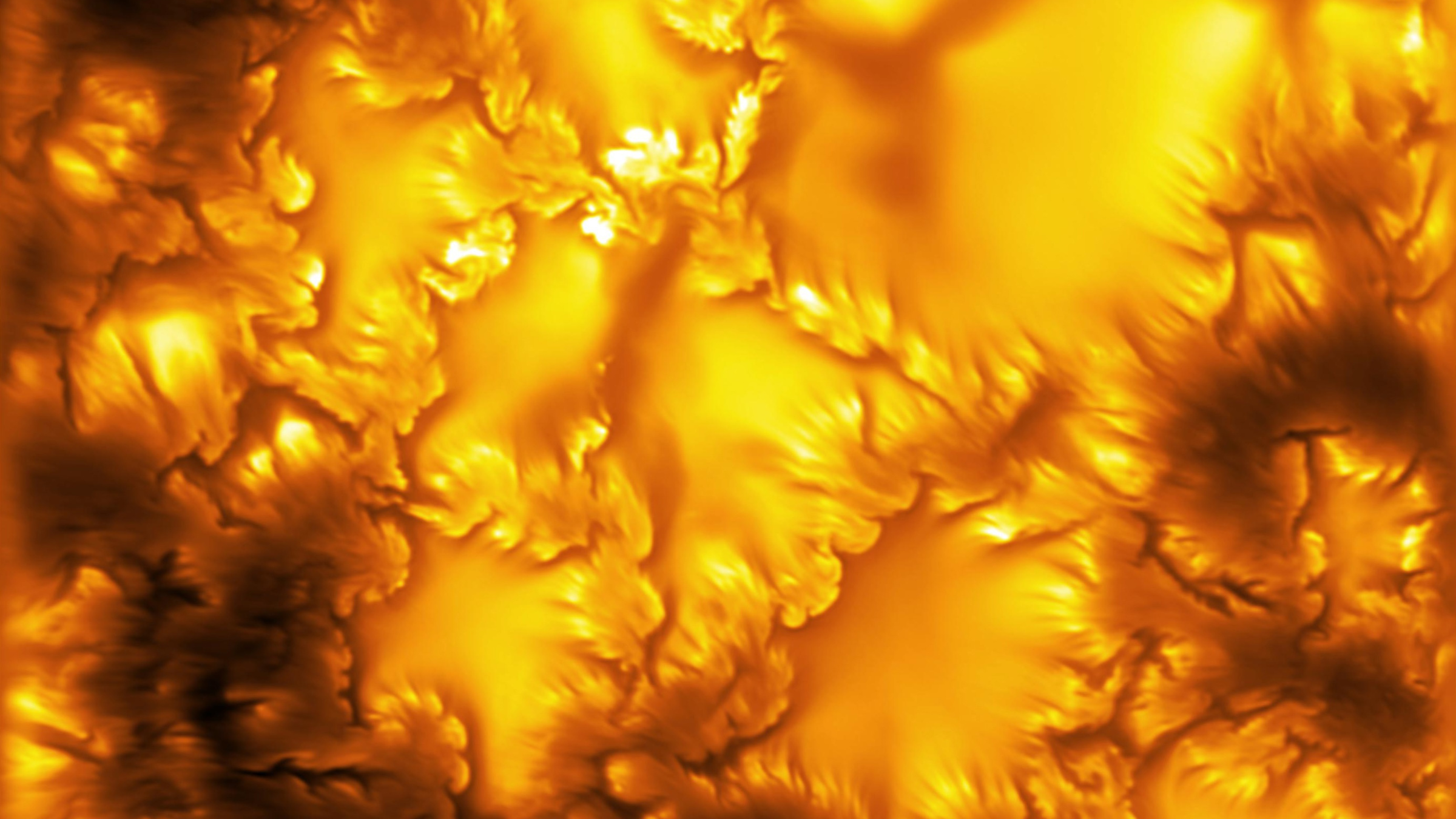
New images from the world’s most powerful solar telescope have revealed thousands of tiny whirlpools swirling across the sun’s surface — a hidden phenomenon that has eluded scientists for more than 150 years. The highly detailed observations could help explain the sun’s most violent eruptions and provide important clues about one of solar physics’ biggest mysteries.
The time-lapse footage provides the first direct evidence of a long-predicted process known as Kelvin-Helmholtz instability. The phenomenon is named after physicists Lord Kelvin and Hermann von Helmholtz, who described it in the 19th century. When two fluids or gases flow past one another at different speeds, friction between the layers creates shear that can roll into spiraling waves and vortices. Scientists had observed this instability in other settings, but this is the first time it has been directly seen on the sun, where the motion occurs between neighboring streams of superheated solar plasma.
Researchers detected the solar vortices with the U.S. National Science Foundation’s Daniel K. Inouye Solar Telescope in Hawaii. They then compared the observations with computer simulations of the sun’s visible surface, known as the photosphere. The findings were published Aug. 5 in the journal Nature.
Latest Videos FromLive Science
Time-lapse observations of the sun captured by the Inouye Solar Telescope.
(Image credit: NSF/NSO/AURA/MPS)
The footage shows dozens of tiny vortices clustered along the edges of magnetically active regions. Some of the whirlpools are accompanied by thin, dark stripes known as striations, according to a statement from the National Science Foundation. The Inouye telescope can resolve structures only tens of miles across, allowing scientists to see details that had remained hidden until now.
When the researchers compared the telescope images with their computer simulations, the results closely matched — including the average distance between the vortices. This agreement confirmed that the team had captured Kelvin-Helmholtz instability occurring on the sun in real time.
The discovery may have implications beyond the striking visuals. By twisting and mixing the sun’s magnetic-field lines, the vortices could help store and release the energy that powers solar flares and coronal mass ejections.
The phenomenon could also help solve the long-standing mystery of why the sun’s outer atmosphere, or corona, reaches temperatures of around 2 million degrees Fahrenheit (about 1 million degrees Celsius), even though the sun’s visible surface is hundreds of thousands of degrees cooler. The vortices may transport energy upward from the photosphere into the corona, Thomas Rimmele, chief technologist at the National Solar Observatory, said in the statement.
Get the world’s most fascinating discoveries delivered straight to your inbox.
The research team plans to use computer algorithms to automatically identify and track these solar vortices in future observations. This could help scientists determine how much energy the whirlpools contribute to heating the corona and driving explosive space weather — events that can disrupt satellites, communications systems and power grids on Earth.
Test your knowledge of the sun with our sun quiz!
Source: www.livescience.com