


NASA Perseverance Captures Rare View of Earth Disappearing Behind Mars’ Moon Phobos
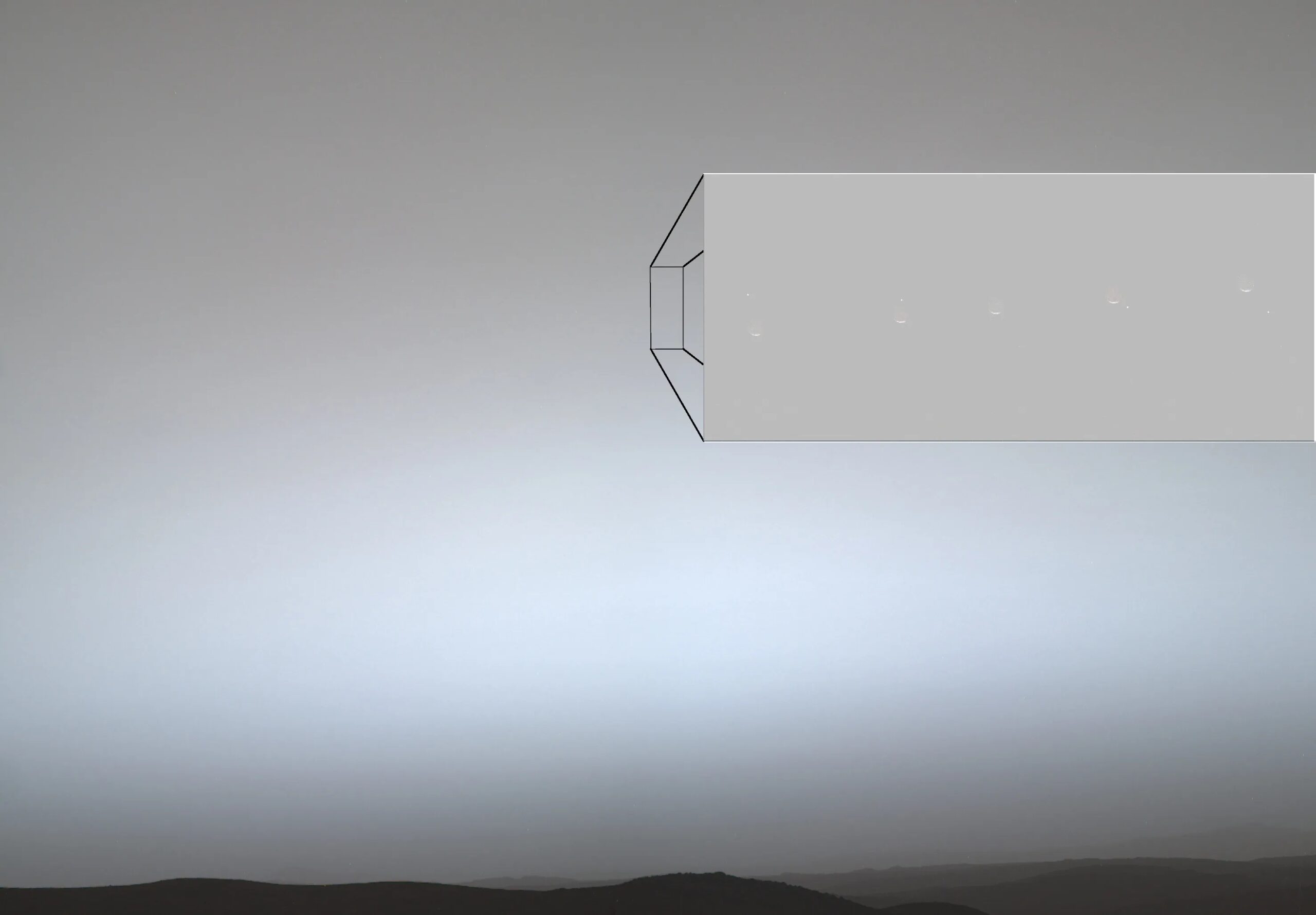
NASA’s Perseverance Mars rover has captured a rare sequence showing Earth disappearing behind Phobos, the larger of Mars’ two moons. In the images, Earth appears as a tiny point of light in the Martian sky before passing behind the crescent-shaped silhouette of Phobos.
The observation marks the first time humanity has recorded Earth disappearing behind another celestial object from the surface of a different planet.
Perseverance Records Earth and Phobos in Motion
The image sequence was captured by Perseverance’s Mastcam-Z instrument at approximately 7 p.m. local solar time on July 2, the mission’s 1,907th Martian day, or sol.
In the composite image, Earth moves from the upper-left toward the lower-right of the frame, while Phobos travels from the lower-left toward the upper-right. In the third image, the two objects align, and Earth disappears behind the shadowed edge of the Martian moon.
“The composite image makes for a unique Earth self-portrait, taken from the surface of another planet, with a Phobos photobomb,” said Justin Maki, Mastcam-Z deputy principal investigator and imaging scientist for Perseverance at NASA’s Jet Propulsion Laboratory in Southern California.
A Rare Occultation Seen From Mars
From Perseverance’s location on the rim of Mars’ Jezero Crater, Earth and Phobos appear dramatically different. Phobos is a lumpy, potato-shaped moon measuring about 17 miles (27 kilometers) across at its widest point. It orbits Mars at a distance of roughly 4,850 miles (7,800 kilometers).
When the images were taken, Phobos appeared to be about one-third the apparent width of Earth’s Moon as viewed from Earth. Earth, located approximately 195 million miles (314 million kilometers) away, appeared as a single pixel of light.
“Phobos crosses the Martian sky three times a day, and Earth is visible for months at a stretch, but catching one directly behind the other takes planning and a little luck,” said Mark Lemmon, a Mastcam-Z co-investigator at the Space Science Institute in Boulder, Colorado. Lemmon planned the observation and assembled the composite image.
Astronomers call this type of event an occultation. An occultation occurs when one celestial body completely blocks another body from an observer’s perspective.
An eclipse is different: It happens when one object passes into the shadow of another. For example, when the Moon moves through Earth’s shadow, the event is called a lunar eclipse. When the Moon passes in front of the Sun as seen from Earth, it is known as a solar eclipse.
When a smaller-looking object crosses in front of a larger-looking object, astronomers refer to the event as a transit. Perseverance has also observed Phobos and Deimos transiting the Sun as seen from Mars. These events are sometimes informally called “Martian solar eclipses.”
About NASA’s Perseverance Rover and Mastcam-Z
NASA’s Jet Propulsion Laboratory in Southern California, managed by Caltech, built the Perseverance rover and manages its operations for NASA’s Science Mission Directorate in Washington. The rover is part of NASA’s Mars Exploration Program.
Arizona State University leads operations for Perseverance’s Mastcam-Z instrument in collaboration with Malin Space Science Systems in San Diego, which contributed to the cameras’ design, fabrication, testing, and operation.
For more information about NASA’s Perseverance Mars rover and its latest discoveries, visit NASA’s official Mars exploration resources.
News Media Contacts
DC Agle
Jet Propulsion Laboratory, Pasadena, Calif.
818-393-9011
[email protected]
Karen Fox / Alana Johnson
NASA Headquarters, Washington
240-285-5155 / 202-672-4780
[email protected] /
[email protected]
2026-054
Source: www.nasa.gov