


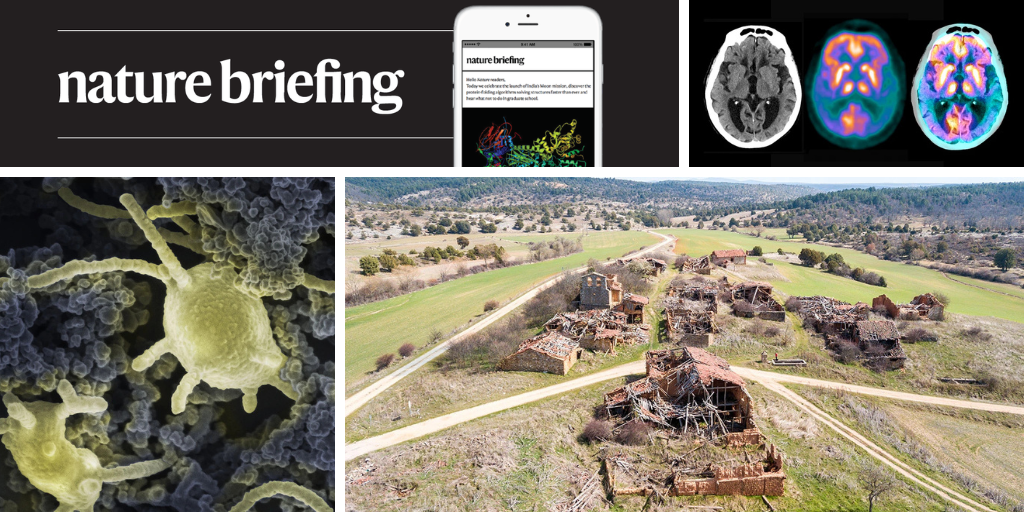
Nature Briefing: Alzheimer’s Microproteins, Gut–Brain Immunity and the Future of AI Agents
Hello Nature readers. Would you like to receive this briefing free in your inbox every day? Sign up here.
More than 1,000 overlooked microproteins found in Alzheimer’s brain tissue
Mapping tiny proteins in the brain could help researchers understand and treat Alzheimer’s disease. Credit: Zephyr/SPL
Researchers have discovered more than 1,000 previously overlooked “microproteins” in human brain tissue samples from people with and without Alzheimer’s disease. Dozens of these microproteins show altered expression in people with Alzheimer’s, potentially opening new avenues for understanding the mechanisms of ageing and neurodegeneration.
Nature | 5-minute read
Reference: Natural Aging paper
Gut-trained immune cells can migrate to the brain in mice
Studies in mice show that immune cells that fight stomach worms can migrate from the gut to the brain, where they establish a lasting “memory” of previous infections. After infection, T cells trained in the intestine travel to the meninges, the protective membrane surrounding the brain.
Once there, the cells become resident immune cells capable of responding to later infections. The findings could shed light on how intestinal infections affect neurological disorders and may help researchers develop treatments that harness the relationship between the gut and the central nervous system.
Nature | 5-minute read
Reference: Nature Neuroscience paper
This week’s image: abnormal airway cilia in motion

Advanced-imaging researcher Ning Xu used a diffractive super-resolution microscope to record the abnormal beating of airway cilia in a child with primary ciliary dyskinesia, a rare genetic disorder that affects respiratory function.
“To understand this disease, we need to look at cilia over dozens of beat cycles, not just static images,” says Xu. The image won the 2026 Small World in Motion Competition. (Xu Ning/Nikon Small World)
Features and impressions
Asgardian archaea may reveal the origins of complex life
Asgardian archaea, microorganisms that may be the ancestors of all complex life, were discovered in 2015 in DNA from sediment collected on the floor of the North Atlantic Ocean. Since then, researchers have painstakingly cultivated these unusual organisms and made many surprising discoveries.
Nature | 11-minute read

Why healthy rural regions matter to resilient cities
“Urbanization is usually judged by what is built, but it should also be measured by what is hollowed out,” argue geographers Yansui Liu and Xinxing Fan.
As more people move to cities, those who remain in rural areas may lose infrastructure and services, undermining the ability of these regions to perform important roles such as food production. “The beginning of the urban era should not be mistaken for a post-rural era,” the authors write. “The resilience of modern cities still depends on the health of the countryside.”
Nature | 9-minute read
Self-driving cars could transform crash-test standards
Driverless cars could allow unusual seating arrangements, with passengers reclining or lying down. Vehicles that are not designed with seat belts or airbags are prompting the development of new types of crash-test dummies.
The rise of self-driving cars could finally persuade regulators to address outdated safety standards, says automotive safety engineer Becky Mueller. “It’s a good time to make fundamental changes.”
Source: www.nature.com