


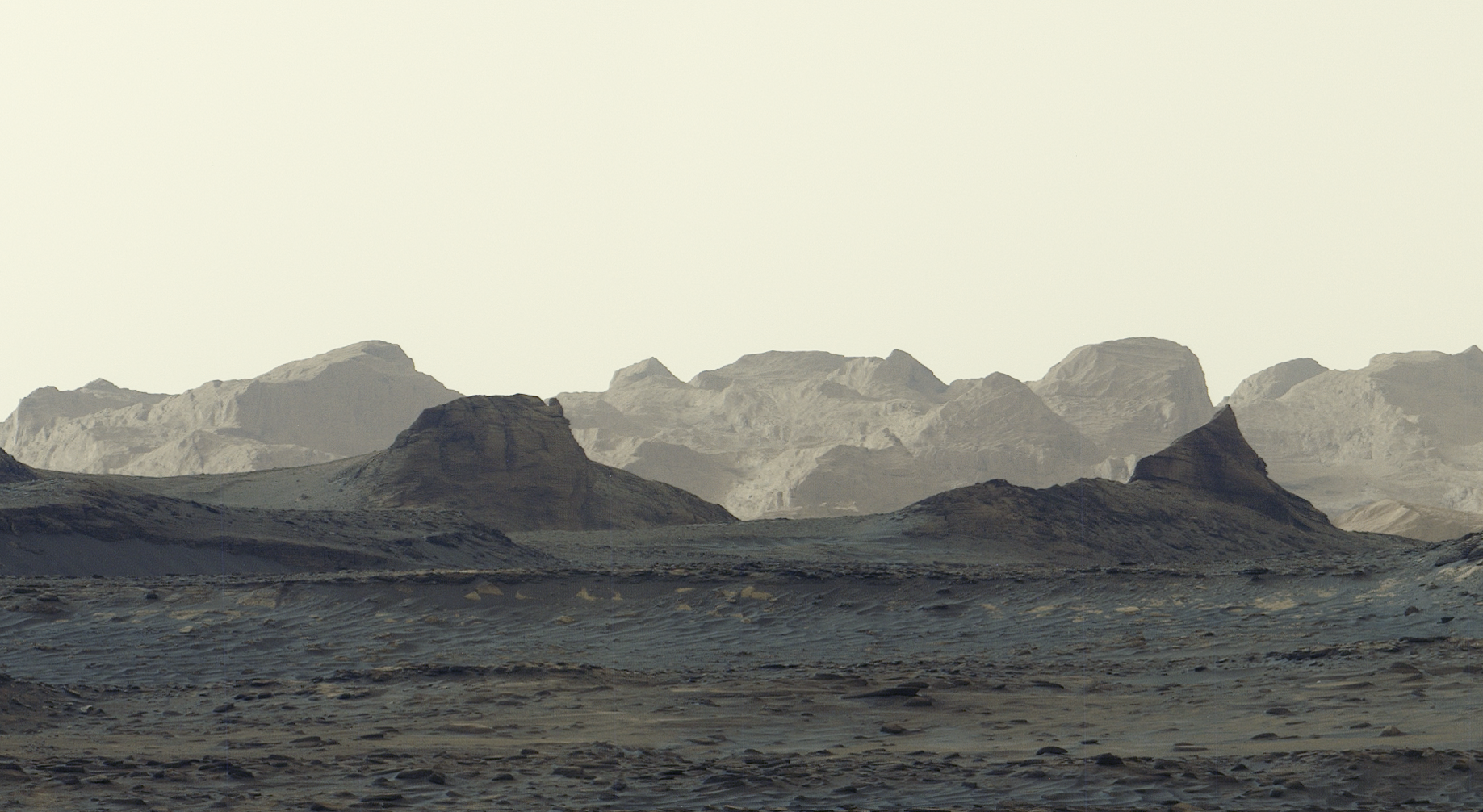
NASA’s Curiosity Rover Captures Its Most Detailed View Yet of Mars’ Wind-Carved Yardangs
A newly released panorama from NASA’s Curiosity rover offers the most detailed view yet of distant wind-carved cliffs on Mars. The image highlights the rocky formations known as yardangs, features mission scientists have been waiting to study up close.
Captured at 8:30 a.m. local Mars time, the panorama shows a striking blue hue in the foreground as bright morning light illuminates the mountains on the horizon. Curiosity’s Mastcam took the image on August 11, the mission’s 4,982nd Martian day, or sol.
The panorama combines six individual images that were stitched together after being transmitted to Earth. Unlike most Curiosity Mastcam images, it was processed without white-balance adjustments to preserve the scene’s early-morning appearance.
Curiosity’s view of the Yardang Formation
The Yardang Formation stretches approximately 10 miles (16 kilometers) across the northwest tip of Mount Sharp, a 5-kilometer-high mountain that Curiosity has been climbing since 2014. The rover recently reached a new 1-kilometer (0.6-mile) elevation-gain milestone during its ascent.
As Curiosity moves closer to the yardangs, mission scientists expect to capture even more detailed images and investigate how the unusual cliffs formed. Sometime in 2027, the rover is expected to reach the base of the Yardang Formation, where its robotic arm could collect unique data about these mysterious features.
What Mars’ layered rocks reveal about its past
Mount Sharp is made up of multiple layers, each recording a different period in Mars’ history. By studying these layers, scientists have found evidence that lakes and streams once covered this part of the Red Planet billions of years ago.
Eventually, the water dried out, leaving behind salty minerals. After new material stopped settling on the mountain, some of it may have been stripped away by wind, creating the yardangs.
“The Yardang layer looks out of place. The color is wrong, the layer is tilted at an odd angle, and it almost looks filled in,” says Ashwin Vasavada, Curiosity project scientist at NASA’s Jet Propulsion Laboratory in Southern California. “But that’s what makes it exciting to get there. No one knows what exactly formed this layer, but one idea is that it could be ash deposited by an ancient volcanic eruption.”
Curiosity’s next mission milestone
Curiosity is in the second year of its fifth extended mission, which began with an exploration of the spiderweb-like boxwork ridge. Over the next year or so, the rover will traverse geological formations rich in sulfates and carbonates, minerals linked to ancient Martian aridity.
Reaching the Yardang Formation will give Curiosity an opportunity to examine a distinctive part of Mount Sharp that may preserve clues about how Mars’ climate and landscape changed over time.
Learn more about NASA’s Curiosity rover
Curiosity was built by NASA’s Jet Propulsion Laboratory and is managed by the California Institute of Technology in Pasadena, California. NASA JPL leads the mission on behalf of NASA’s Science Mission Directorate in Washington as part of NASA’s Mars Exploration Program portfolio. Malin Space Science Systems in San Diego built and operates Mastcam.
News media contacts
Andrew Good
Jet Propulsion Laboratory, Pasadena, California
818-393-2433
[email protected]
Karen Fox / Alana Johnson
NASA Headquarters, Washington
240-285-5155 / 202-672-4780
[email protected] / [email protected]
2026-067
Source: www.nasa.gov