


Public funding for science is built on a social contract: in exchange for financial support, researchers must demonstrate how science benefits society. Historically, the scientific community has had substantial autonomy to determine research priorities. However, some governments are increasingly influencing how science budgets are allocated, redirecting funding away from politically contested fields such as the social sciences and climate change research.
Governments have a legitimate role in setting broad science-policy priorities and public expectations. However, excessive political control over research can restrict innovation and threaten long-term societal progress. Maintaining the right balance requires scientists to communicate the public value of research more effectively, build compelling evidence-based narratives and develop strong partnerships with business, policymakers and civil society.
Scientists should recognize their own political biases to build public trust
Supporting researchers in these efforts is a key priority for the International Science Council (ISC), a non-governmental organization representing more than 250 international scientific unions, academies and research councils. During my five-year presidency, the ISC has strengthened its focus on helping scientists serve society and communicate the value of research.
The organization supports training that helps researchers communicate effectively with policymakers and is examining the wider ethical responsibilities of science. Its work also addresses major challenges involving artificial intelligence, transdisciplinary research, data governance and open data sharing.
Public trust in science is under increasing pressure in a rapidly changing world. Science remains highly trusted overall, and scientists are generally viewed as members of a respected profession. Yet in politically polarized countries, extreme voices can dominate public debate and weaponize disinformation. Surveys indicate a strong connection between political identity and attitudes towards science. Some extreme populist groups reject science outright, while others dismiss evidence in areas such as vaccines when it conflicts with their values, interests or political beliefs.
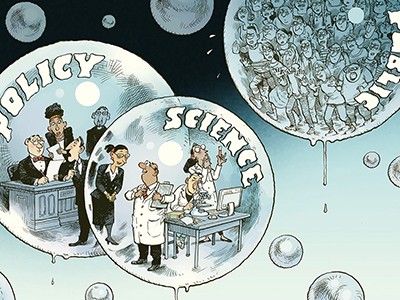
Six ways to put the public at the heart of science and policy
Researchers must manage these tensions without allowing science to become politicized. Too often, however, scientists can appear entitled or focused primarily on securing research funding rather than explaining how their work benefits society. Uncertainty is frequently overlooked, while exaggerated claims can increase public skepticism. Being transparent about what science does not yet know — and recognizing that many people also rely on other knowledge systems, including religion and Indigenous knowledge — can help rebuild public confidence.
Artificial intelligence is creating both opportunities and risks for scientific credibility. Generative AI has contributed to a surge in grant applications and an increase in research papers of questionable quality. Concerns are also growing about how AI-generated content could affect research integrity and the reliability of the scientific record, potentially weakening trust in science.
More effective measures are needed to address paper mills, symbolic or non-existent peer review and fraudulent research content. The ISC and academic publishers have launched a project to explore trust markers that could identify journals with reliable editorial and peer-review practices. Strengthening transparency, accountability and research integrity will be essential to protecting public trust in science.
Source: www.nature.com