


‘Upside-down’ exoplanet GJ 3090 b orbits its red dwarf star backward
Astronomers have discovered a rare retrograde exoplanet circling a small red dwarf star in the opposite direction from the star’s rotation. The finding could offer new clues about how planets form around the most common stars in the Milky Way.
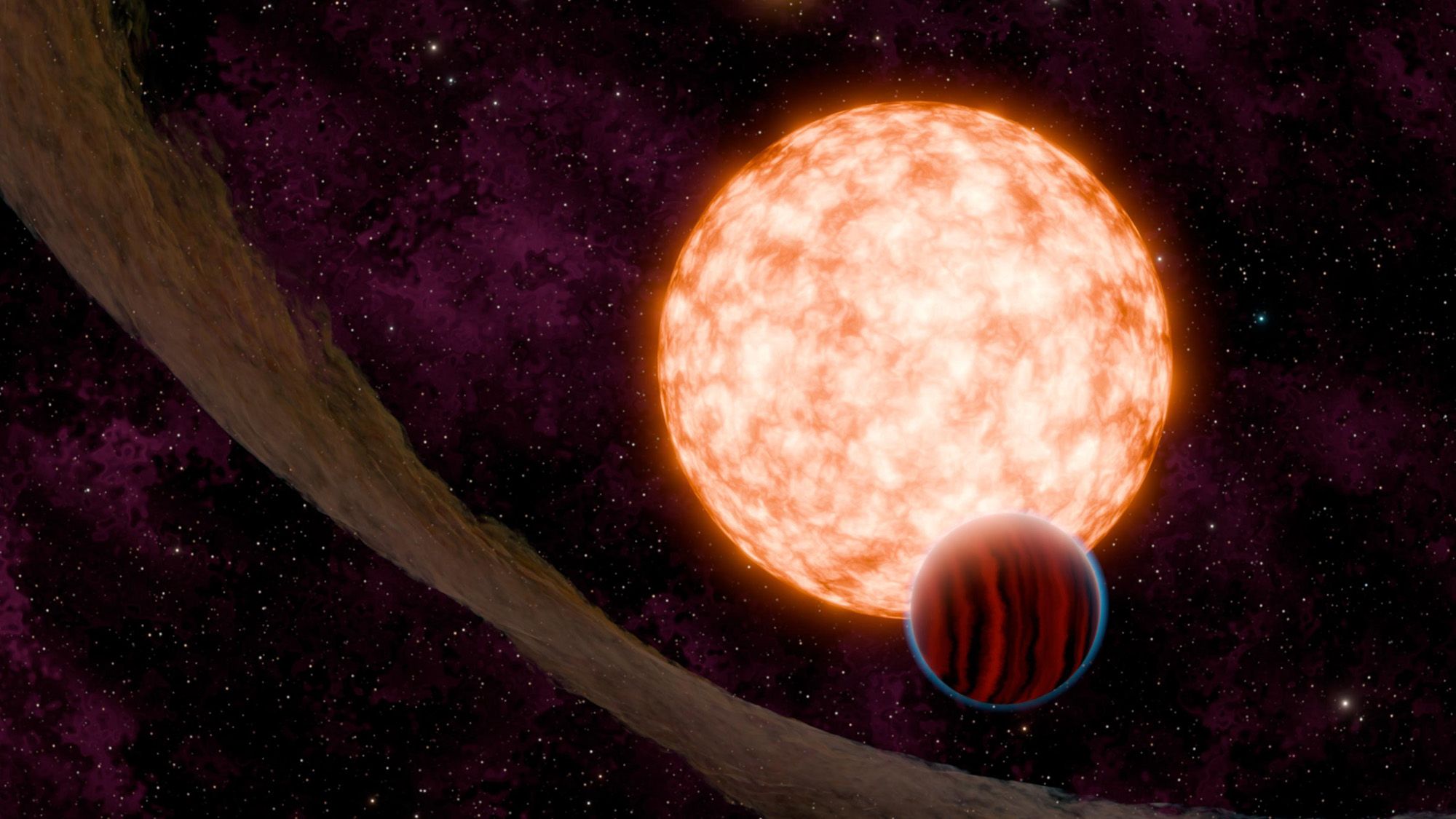
The exoplanet, called GJ 3090 b, follows a highly unusual orbit tilted by 136 degrees relative to its star’s rotation. In effect, the planet travels almost upside down around the star.
Why is GJ 3090 b orbiting backward?
Stars and planets typically form from the same rotating disk of gas and dust, known as a protoplanetary disk. Because the material in that disk is already moving in a particular direction, newly formed planets generally orbit their stars in the same direction.
Changing a planet’s orbital direction requires a substantial transfer of energy. Astronomers have previously discovered exoplanets with retrograde orbits, but those unusual paths are often caused by gravitational disturbances from other massive objects in the same star system.
However, the system containing GJ 3090 b does not appear to have a large companion star or massive planet capable of forcing the planet into its backward orbit. The researchers reported their findings in a study published in Astronomy & Astrophysics.
“We looked for massive companion stars of the kind that could have driven the planet into such an extreme orbit. We may need to think differently about how this system acquired its unusual architecture,” the researchers said.
How astronomers detected the retrograde exoplanet
Researchers analyzed 23 hours of observations collected with two exoplanet instruments mounted on the 12-foot-wide (3.6-meter) telescope at the European Southern Observatory’s La Silla Observatory in Chile.
During the observations, GJ 3090 b passed in front of its star 10 times. Each transit caused the star’s light to become slightly dimmer. By measuring the depth and duration of those dips in brightness, astronomers were able to determine the planet’s size and orbital characteristics.
Image credit: NASA/JPL-Caltech
GJ 3090 b is one of several planets in the system
The planetary system contains two, or possibly three, planets smaller than Neptune. Each one completes an orbit around the star in fewer than 16 days.
GJ 3090 b is the innermost planet and circles its star once every 2.9 days. Its orbit is unusually eccentric and is tilted 136 degrees from the star’s rotation, making it one of the most extreme planetary orbits discovered.
The other planets in the system do not appear to share GJ 3090 b’s retrograde motion. Because they are farther from the star, they would likely be more vulnerable to large gravitational disturbances than the innermost planet.
A rare planet around a common type of star
The discovery was particularly difficult because GJ 3090 is an M dwarf, also known as a red dwarf. These stars are small, relatively cool and so faint that even the closest M dwarfs to Earth cannot be seen with the naked eye.
Despite their faintness, M dwarfs are extremely important to exoplanet research. Approximately three-quarters of the stars in the Milky Way are M dwarfs, making them the most common type of star in our galaxy.
Studying planets around these stars can help astronomers understand how planetary systems form and evolve throughout the Milky Way.
Could GJ 3090 b have formed backward?
Because GJ 3090 b is the closest planet to its star, the researchers say it is unlikely that a massive planet or hidden binary companion pushed it into its current orbit. The system also lacks an obvious large object that could explain the planet’s extreme tilt.
One possibility is that GJ 3090 b formed from a second disk of gas and dust that entered the young star system at a different angle from the original protoplanetary disk.
If large amounts of material were drawn into the system from outside, the new material could have created a second disk with a different orientation. A planet forming from that disk might then have developed a retrograde orbit.
The material in the inner planets may not contain enough mass to alter the star’s rotation, allowing the system to retain its unusual misalignment.
“The idea that a planetary system could be reconstructed from a second disk with a different orientation is particularly exciting,” the researchers said. “This suggests that the environment around a young star may play a much larger role than we expected in determining the structure of its planets.”
The discovery of GJ 3090 b suggests that a planet’s unusual orbit may not always be caused by later gravitational disruption. In some cases, the architecture of a planetary system could be shaped by the chaotic environment in which its star and planets were born.
Study: Carteret, Y., Bourrier, V., Parc, L., Winter, A., Allart, R., De Castro Leão, I., Bousy, F., Passegger, V. M., Cadieux, C., Lamontagne, P., Artigau, É., Baron, F., Barros, S. C. C., Benneke, B., Bonfils, X., Bryan, M., Martins, B. L. C., Cloutier, R., Cristo, E., and Weisserman, D. (2026). “Upside down: GJ 3090 b is the first retrograde exoplanet around an M dwarf star detected by NIRPS.” Astronomy & Astrophysics, 713, L15.
Source: www.livescience.com