


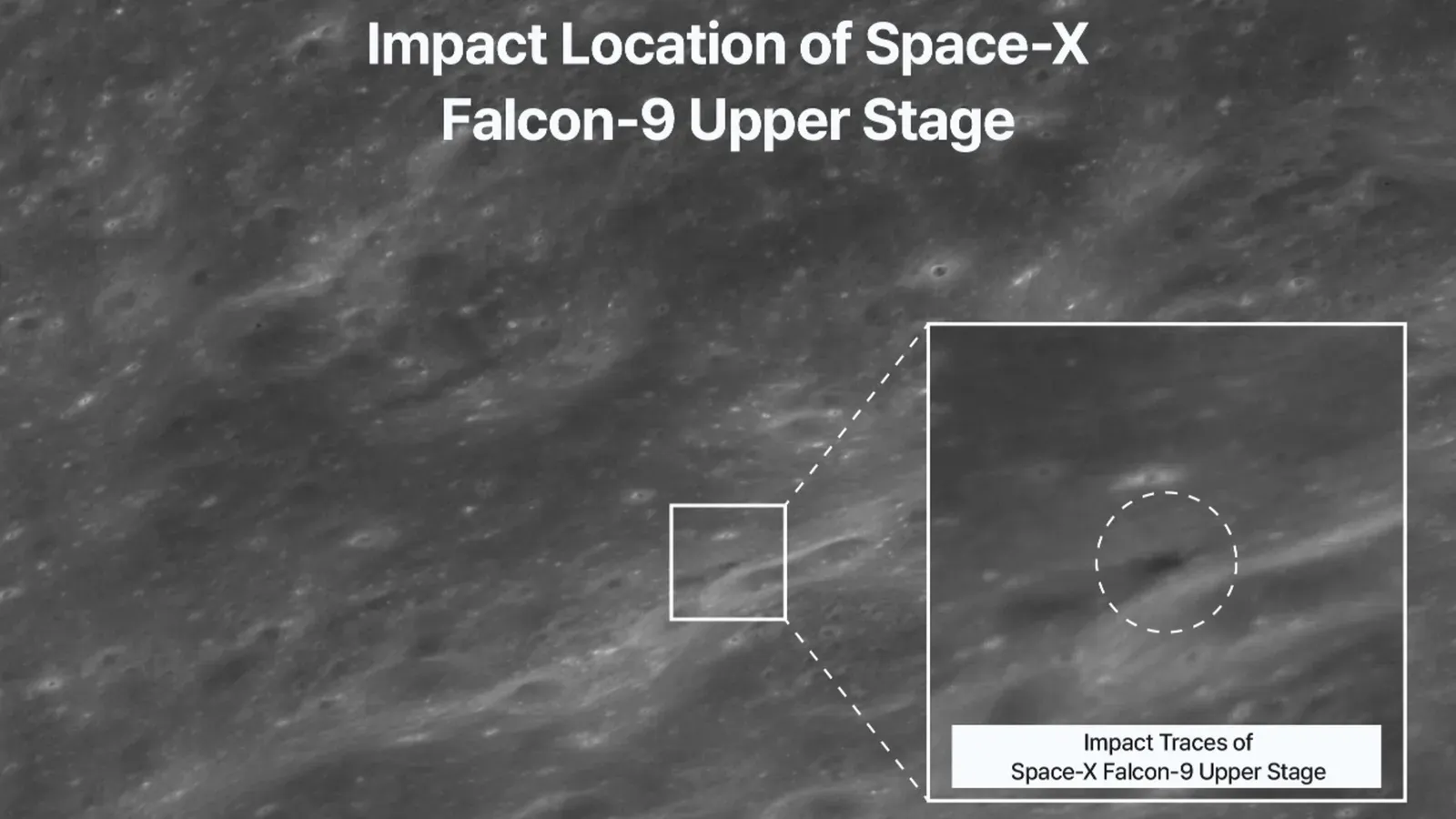
A discarded SpaceX Falcon 9 rocket stage crashed into the moon at more than 5,000 mph (8,000 km/h) on Wednesday, Aug. 5. South Korea’s Danuri lunar orbiter has now captured the first images of the impact site and the newly formed lunar crater.
Images taken by the Korean lunar satellite show a small, darkened crater near the suspected impact location. The Falcon 9 upper stage struck the lunar surface at approximately 2:35 a.m. ET near Einstein crater, along the moon’s northwestern limb and close to the terminator — the boundary between lunar day and night. The Korea AeroSpace Administration released the images on social media Thursday, Aug. 6.
Because the impact occurred on the sunlit side of the moon, the flash from the collision was not visible from Earth. However, researchers using the European Southern Observatory’s Very Large Telescope in Chile reported detecting signs of a debris plume rising from the lunar surface shortly after the impact, according to CBC. No images of the debris plume have been released yet.
Latest Videos FromLive Science
A preprint study published earlier this week predicted that the SpaceX rocket impact would create a crater about 90 feet (27 meters) wide and up to 16 feet (5 meters) deep. The crater is too small to be seen from Earth, even with a powerful telescope.
Scientists have not yet released precise measurements of the new crater. Additional observations from lunar spacecraft, including NASA’s Lunar Reconnaissance Orbiter, and Earth-based telescopes could provide more details in the coming days.
What caused the SpaceX rocket to crash into the moon?
Before-and-after images from South Korea’s Danuri orbiter show the lunar impact site.
Image credit: KASA
The object that hit the moon was the second stage of a SpaceX Falcon 9 rocket launched on Jan. 15, 2025. The mission carried two lunar landers: Firefly Aerospace’s Blue Ghost lander, which successfully landed on the moon in March 2025, and Japan’s Hakuto-R lander from ispace, which lost contact with Earth and crash-landed on the moon in June 2025.
Unlike the reusable first stage of a Falcon 9, the rocket’s upper stage is normally discarded after launch. This particular stage spent almost a year in an elongated orbit around Earth before solar radiation and the moon’s gravity altered its trajectory and sent it toward the lunar surface, according to Space.com.
Independent astronomer Bill Gray first predicted the rocket’s lunar impact in May, including the approximate timing and location of the collision. Other researchers later confirmed his calculations.
The 4.4-ton (4 metric ton) rocket stage is estimated to have struck the moon at about 5,400 mph (8,700 km/h). Although that speed is more than seven times faster than the speed of sound, it is slower than the average speed of a meteoroid hitting the moon, making the event especially difficult to observe.
Why lunar impacts matter
This is not the first human-made object to strike the moon, and it will not be the last. Studying artificial impacts helps scientists understand the moon’s surface, subsurface composition and the behavior of debris released during high-speed collisions.
In 2009, NASA deliberately crashed a Centaur rocket upper stage near the lunar south pole as part of the Lunar Crater Observation and Sensing Satellite mission. Analysis of the resulting plume revealed evidence of water ice beneath the surface, helping make the lunar south pole a leading target for future exploration and permanent human settlements.
Monitoring rocket impacts will also be important as more spacecraft and astronauts return to the moon. These events could pose risks to future lunar missions, including the permanent moon base NASA hopes to build.
“Now that we’re in an era where we’re going to have more and more astronauts going back to the moon, perhaps permanently, we also want to understand how much of a risk these artificial impacts pose,” Benjamin Fernando, a postdoctoral researcher at Los Alamos National Laboratory and co-author of a recent study on the impact, told CBC.
“It presents a different set of hazards than the average meteoroids that strike the moon every day. What we want to understand from this event is both the direct and indirect hazards posed by artificial impacts.”
Source: www.livescience.com