


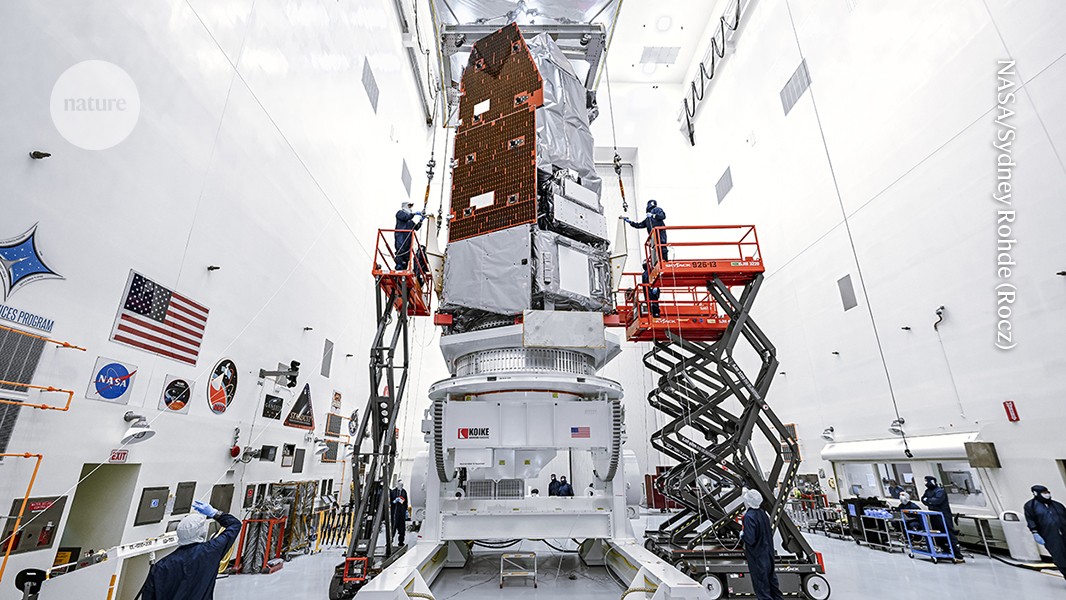
The Nancy Grace Roman Space Telescope will test leading theories about dark matter, dark energy and the nature of gravity.
Credit: NASA/Sidney Rohde (Rocz)
On 30 August, a remarkable space observatory left Earth. Encased inside a SpaceX rocket, it will travel approximately 1.5 million kilometres before beginning its mission to study the universe.
The Nancy Grace Roman Space Telescope has an unusual history. Its 2.4-metre primary mirror was originally built for ground-based surveillance, transferred to NASA in 2012 and later redesigned for astronomical research. Today, the observatory is equipped to investigate some of the biggest questions in modern cosmology, including the nature of dark matter, dark energy, distant exoplanets and the hidden structure of the universe.
Lift off! NASA launches Roman Space Telescope to investigate the mysteries of dark energy
The telescope’s resourceful development is more than an intriguing origin story. It demonstrates how scientific progress often depends on adapting existing tools, ideas and technologies for new purposes. Researchers frequently describe discovery as a neat sequence: ask a question, develop an experiment, collect evidence and reach a conclusion. In practice, however, science is rarely so straightforward.
Instruments can outlive their original missions. Technologies developed to solve one problem can become essential for another. New theoretical questions can also give fresh meaning to old observations, while advances in different fields can eventually converge in unexpected ways. The Nancy Grace Roman Space Telescope embodies this productive intersection of ideas and engineering.
Its primary mirror is similar in size to Hubble’s, but Roman has a much wider field of view. Its wide-field instrument contains a 300-megapixel infrared camera capable of capturing an area of sky roughly 100 times larger than Hubble can record in a single exposure. Hubble transformed astronomy through deep, high-resolution observations. Roman will complement that approach by combining detailed imaging with panoramic surveys of the cosmos.
Stars, planets, galaxies and all other visible objects make up only a small fraction of the universe. Most matter appears to be dark matter, which can be detected only through its gravitational effects. Dark energy is even more mysterious: it is associated with the accelerating expansion of the universe.
One of the Roman Space Telescope’s central goals is to map this invisible universe. By measuring how dark matter bends and distorts light from distant galaxies, astronomers can reconstruct the underlying distribution of matter. Roman will carry out this work on an unprecedented scale, potentially transforming — or even overturning — current theories of dark matter, dark energy and gravity.
Countdown to Artemis: Will NASA’s moon mission usher in a new era of space exploration?
Yet the telescope’s most important discoveries may come from observations that fall outside its primary scientific objectives. The greatest breakthroughs often begin with a residual — an unexpected result or anomaly that does not fit existing theories. Such findings force researchers to refine established models or, more excitingly, develop entirely new ones.
Unusual statistical patterns, unexplained transient events, galaxies that appear to have formed too early and previously overlooked populations may initially seem like complications. But astronomy’s history is filled with puzzling observations that eventually opened the door to major discoveries. Because Roman will conduct wide, deep and repeated surveys, it will be especially well suited to finding these unexpected phenomena.
That discovery potential will be strengthened by another important feature of the mission: Roman’s data will be released to the public immediately. There will be no exclusive period reserved only for the scientists who designed or built the survey. Graduate students, small research groups and theoretical scientists who were not involved in constructing the spacecraft will all be able to study the same view of the universe.
Source: www.nature.com