


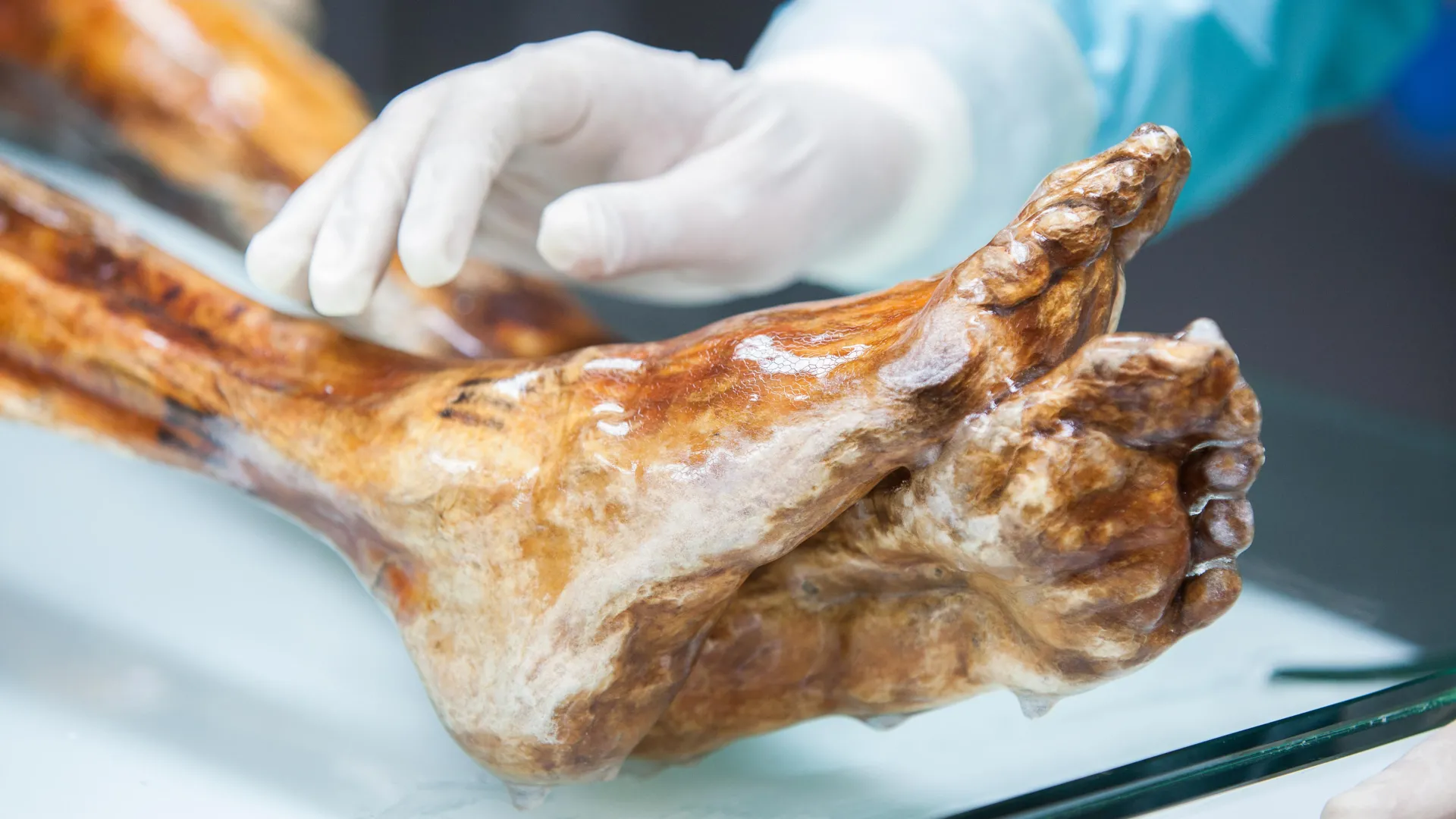
Researchers have used multiple sampling methods to identify which microorganisms belonged to Ötzi the Iceman during his lifetime and which arrived after his death. Some microbes may have colonized the body while it was preserved in the glacier, while others may have been introduced during more than 30 years of modern conservation.
Genetic material recovered from Ötzi’s internal tissues included bacteria that formed part of his original gut microbiome. Researchers also made an unexpected discovery: cold-adapted yeast species likely originating from the glacier. These yeasts have remained associated with the mummy to the present day and could eventually have applications in industrial biotechnology.
The findings were published in the journal Microbiome.
Tracing Ötzi’s Ancient and Modern Microbiome
The study analyzed a broad range of samples, including ice from the mummy’s surface, meltwater collected from inside the body, and material gathered with numerous swabs. The researchers also examined previously available data from Ötzi’s intestinal tissue and stomach contents.
To investigate potential environmental sources, the team analyzed a soil sample collected at the discovery site during Ötzi’s recovery in 1991. The sample had remained frozen since it was collected.
Genetic evidence of Ötzi’s original gut microbiome was detected in both his intestinal tract and stomach contents. This microbial community was first documented in a 2019 study conducted in collaboration with Eurac Research.
Ötzi’s gut flora closely resembles the limited number of microbiomes identified in early human populations. Many of the bacteria found in his digestive system are uncommon in people living in modern industrialized societies. As a result, the mummy offers a rare glimpse into the microorganisms that once lived inside ancient humans.
Cold-Adapted Yeasts Linked to the Glacier
The newly identified yeasts were found in skin samples, meltwater from inside the mummy, and stomach-content samples. These specialized microorganisms are adapted to survive in extremely cold environments.
Genetic analysis showed that the yeasts are related to strains found in other frigid environments, including Antarctica. This relationship supports the theory that they originated in the glacier and may have remained associated with Ötzi for thousands of years.
Researchers detected both severely degraded ancient DNA and well-preserved modern DNA. This combination indicates that the microorganisms are not merely remnants from the distant past. Some remain capable of surviving under the mummy’s current storage conditions, which include a temperature of minus six degrees Celsius and high humidity. They may persist in a dormant state.
“We see continuity here,” explains Frank Maixner, director of the Institute for Mummy Studies at Eurac Research: “These yeasts have accompanied Ötzi on his long journey through the millennia.”
According to Maixner, the findings demonstrate that the mummy is “not a static relic, but a dynamic biological system.”
Earlier Conservation Treatments May Have Supported Yeast Growth
Previous preservation treatments may have unintentionally created favorable conditions for some microorganisms. Three of the four yeast species possess genes that enable them to break down phenol.
Phenol was used after Ötzi’s discovery to remove fungal growth from the mummy’s surface. The yeasts may have been able to use this chemical as a food source.
“A mummy’s microbiome is unique because we are dealing with microbes that are over 5,000 years old and, at the same time, with modern microbes that have been introduced since the discovery,” says microbiologist and lead author Mohamed S. Sarhan.
Preserving Ötzi for Future Generations
The South Tyrol Museum of Archaeology is responsible for preserving Ötzi’s mummy and continuously monitoring its condition.
“The mummy’s conservation conditions are very stable today,” comments Elisabeth Vallazza, director of the South Tyrol Museum of Archaeology that oversees the mummy’s conservation, “close microbiological monitoring ensures that the mummy suffers no damage. But further research and full conservation efforts are certainly needed to preserve it for many more generations.”
Scientists still do not fully understand how glacial mummies remain preserved for thousands of years.
Conservation expert and co-author Marco Samadelli emphasizes: “The conditions under which glacial mummies are preserved are not yet fully understood. This study expands our knowledge in this area.”
Cold-Adapted Microbes Could Support Low-Temperature Industries
The research may help scientists develop improved strategies for preserving Ötzi and other ancient human remains. It could also lead to applications beyond archaeology.
Cold-adapted microorganisms can remain active at temperatures that slow or stop many other species. They may therefore support industrial processes that use less energy, including fermentation carried out at low temperatures.
Source: www.sciencedaily.com