


I recently rewatched Armageddon, complete with Bruce Willis, oil drillers launched into space, and an asteroid the size of Texas heading toward Earth. Beneath the Hollywood spectacle lies a more practical question: What could humanity actually do with an asteroid if we could reach, mine, and use one?
The most valuable answer may have nothing to do with destroying it. Sorry, Bruce. Instead, asteroid mining could help humanity build a sustainable new world beyond Earth.
The Supply Challenge of Building a Mars Colony
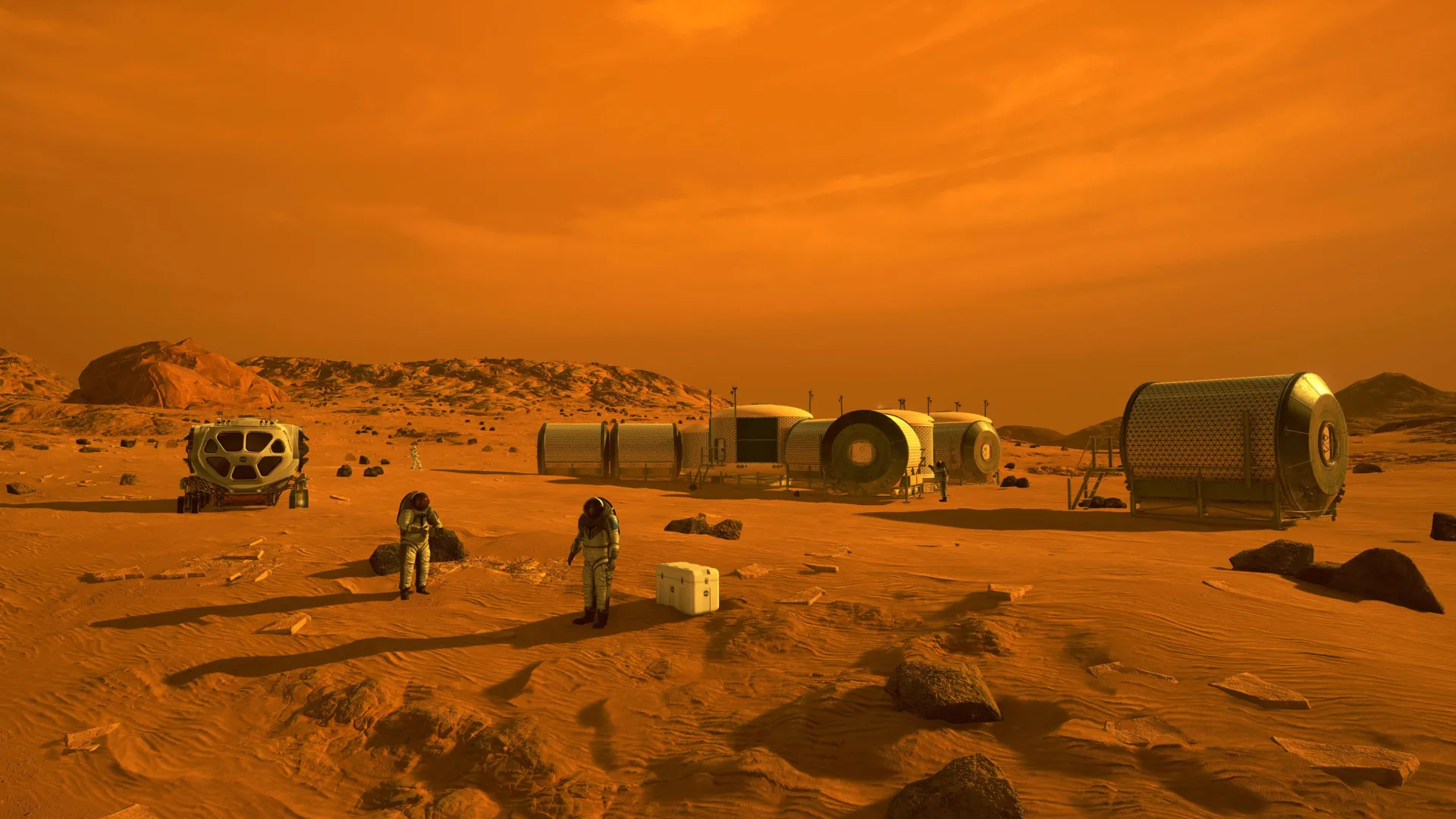
Establishing a permanent human settlement on Mars would involve much more than solving complex engineering and survival challenges. It would also require a reliable supply chain capable of transporting food, equipment, construction materials, and raw resources across the Solar System.
Although logistics may not sound as exciting as rockets or space habitats, they could determine whether humans become a multiplanetary species or remain permanently dependent on Earth.
A Mars colony would need more than food, water, and oxygen. It would require vast quantities of metal, including steel for habitat structures, aluminum for machinery, and iron for tools and replacement parts. Equipment would inevitably wear out, malfunction, and need to be repaired or replaced.
Transporting all of these supplies from Earth would not be a practical long-term strategy. Launching a single tonne of cargo can cost tens of millions of pounds, while a journey to Mars typically takes six to nine months, depending on the orbital positions of Earth and Mars. That makes Earth-to-Mars shipping too slow and expensive to serve as a dependable source of construction materials.
Using Asteroid Mining to Supply Metals to Mars
Researchers at EPFL in Switzerland have investigated whether asteroid mining could provide metals directly to Mars.
Millions of asteroids orbit the Sun, and some—known as M-type asteroids—contain significant amounts of iron, nickel, and other valuable metals. In practical terms, these objects are enormous mineral deposits traveling through space.
The key question is whether spacecraft could reach suitable asteroids, extract their resources, and deliver the metals to Mars without using so much energy and fuel that the mission became economically or technically unworkable.
The study’s findings are cautiously optimistic, although the success of such a system would depend on several important conditions.
Identifying Efficient Asteroid Supply Routes
The researchers used computer modeling to examine thousands of potential mission combinations and supply chains. Their calculations considered the energy required to travel between Mars and different asteroids, the quantity of metal that could realistically be extracted, and the fuel needed to complete each stage of the journey.
Fuel for the return journey is especially important, and this is where asteroid resources could make the concept more efficient.
Some asteroids are carbonaceous, which means they contain carbon-rich materials and water ice. With suitable processing technology, these resources could be converted into rocket propellant in space. Spacecraft would then need to carry less return fuel from Earth, reducing launch mass and mission costs.
The researchers included this in-space fuel production option in their asteroid mining and Mars supply-chain models.
The Right Asteroids Could Make Mars Resupply Possible
The results identified specific asteroids that could potentially be reached using current spacecraft technology. For some of these targets, the energy required for the complete mission may be low enough to make asteroid mining and metal delivery to Mars worthwhile.
However, selecting the right asteroid would be essential. An unsuitable target could require so much fuel and energy that the value of the recovered metals would not justify the mission.
The study does not mean that commercial asteroid mining or Mars construction will begin soon. Humanity remains a long way from operating its first industrial mine in space.
Its importance is that it demonstrates how the logistics challenge might eventually be addressed. A future space-based supply network could transport metals from asteroids to Mars while using propellant produced from asteroid-derived resources.
A Mars colony would need people capable of building and maintaining it. Just as importantly, it would need a reliable way to deliver the materials those workers require. This research suggests that asteroid mining could one day play a central role in making a self-sustaining human settlement on Mars possible.
Source: www.sciencedaily.com