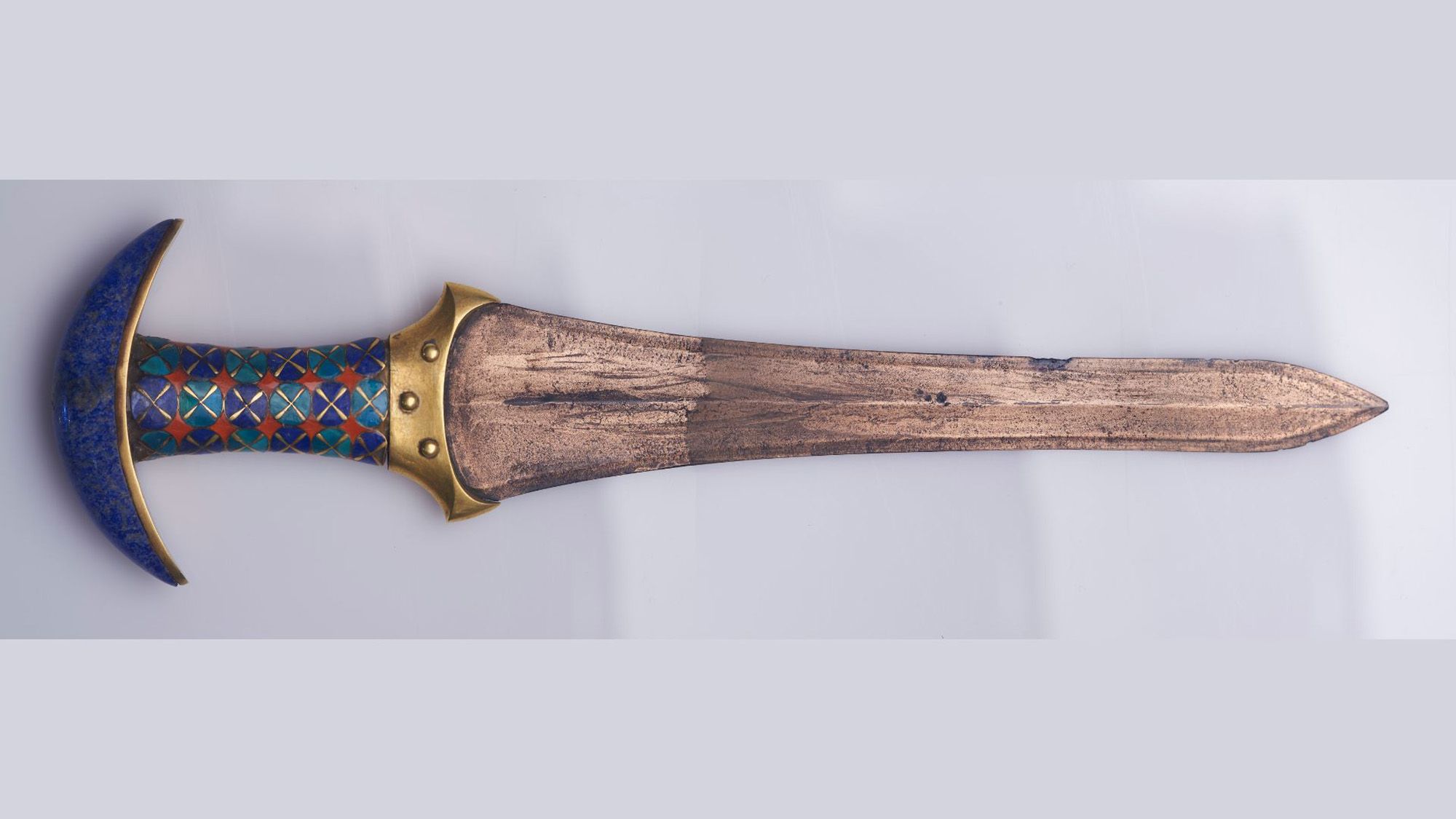
A groundbreaking study suggests that several ancient Egyptian princesses, interred with bows, arrows, and daggers, underwent training in archery and weapon handling during their lives. This research raises intriguing questions about their roles in activities such as hunting and combat.
Researchers delved into the remains of six royal family members from Egypt’s Middle Kingdom, around 4,000 years ago. By analyzing muscle attachment sites on these skeletal remains, the team theorized that specific areas indicated repetitive actions, such as archery and weapon manipulation.
According to lead author Zeynab Hashesh, an archaeologist at Beni Suef University, “Members of the royal family, particularly women, engaged in skilled and physically demanding activities such as archery and hunting,” as noted in her statement.
Latest videos from
This significant finding was published in the Frontiers of Environmental Archaeology, which challenges the conventional view that weapons found in women’s graves served solely ceremonial purposes. It also offers fresh insights into the health and active lifestyles of royal women.
However, a bioarchaeologist, who was not part of the study, expressed caution, stating that skeletal alterations cannot precisely indicate specific activities. Factors such as age, body size, and genetics could also produce similar changes.
Royal Family Rediscovered in Museum Basement
In the 1890s, French archaeologist Jacques de Morgan uncovered ruins near the tombs of Pharaohs Amenemhat II and III, where multiple royal figures’ remains were later stored in the Egyptian Museum in Cairo.
French archaeologist Jacques de Morgan discovered royal burial sites in the 1890s.
(Image credit: Gallica Digital Library (via Wikimedia Commons))
The remains remained forgotten for decades, until museum personnel rediscovered them in 2020 during a curation project. The collection includes notable items related to King Hor, Princess Ita, Kenmet, Itaweret, Noob Hotep, and an unidentified female, presumed to be Princess Satasolmerit. Four of these women are thought to be daughters of Pharaoh Amenemhat II.
Get the world’s most fascinating discoveries delivered straight to your inbox.
The skeleton’s identity is primarily based on 19th-century labels, raising questions about their reliability. Sonia Zakrushevsky, a bioarchaeologist from the University of Southampton, highlighted that most skulls were missing, with only about 22% to 58% of the skeletons remaining intact. Most of their soft tissues had decomposed, but the surviving bones still provided insights into age, injury, illness, and physical activities.
Evidence of Weapons Training?
Using advanced techniques like X-ray scanning and infrared spectroscopy, researchers identified materials where muscles, tendons, and ligaments attach to bones. Repeated muscle use can lead to enlargement of attachment sites, albeit several factors can also lead to similar changes.
For instance, Princess Ita, who lived between 28 to 34 years, exhibited lesions on her right shoulder and arm, suggesting frequent gripping of weapons, likely connected to the ornate dagger found in her burial site.
Similarly, Princess Noob Hotep, who passed away in her early 40s, exhibited pronounced attachment sites on her forearm and right hand. Notably, a magazine from 1896 highlighted the discovery of “an arrow with fletching in an astonishing state of preservation” in her tomb, as recorded by an American anthropologist.
Princess Itauellet also displayed developed attachment sites around her shoulders, and Kenmet exhibited prominent features on her arms. King Hor showed asymmetric muscle attachment differences across his body.
The researchers argue that these patterns align with actions associated with drawing a bowstring, resulting in muscle asymmetry between the left and right upper body. They proposed that these muscle traits could reflect gripping actions relevant to handling daggers, implying that the weapons buried with these royals were functional rather than merely symbolic.
Experts Remain Skeptical
Despite the pronounced muscle attachment sites in these individuals, the question remains whether the royal family members were indeed engaged primarily in archery, as Zakrushevsky remarked.
She noted that while certain muscle groups were evidently used repeatedly, the actual cause of such usage remains unknown. “We can’t definitively link these skeletal changes to weaponry,” she emphasized, especially since no comparison groups from the Nile Valley or nearby areas were examined.
Furthermore, Zakruzhevsky queried the purpose of including arrows and other armaments in graves, suggesting that they might have been intended for use by individuals connected to the deceased.
Scott Haddow, a bioarchaeologist at the University of Turin, remarked that some skeletal changes were bilateral, casting doubt on the conclusions that these changes stemmed from archery or similar activities.
“Archery is a highly asymmetric activity, and finding bilateral robustness in some bones does not strongly indicate that individuals practiced archery,” he explained via email.
Factors like aging might also account for the differences observed. For example, Kenmet was between 35 and 45 years at her death, while Noubhotep was approximately 40 to 44 years old. As Haddow mentioned, variations also depend on body size and genetic background.
Old photo of the Pyramid of Dashur, where the royal family was found.
(Image credit: Rijksmuseum, via Wikimedia Commons)
Princess Versus Pauper
A significant limitation of the study is the absence of a comparison group to illustrate how the skeletal changes compare to those of other Egyptians from the same period.
“It would be beneficial to understand the differences among contemporary Egyptians, irrespective of their social standing,” Zakrushevsky pointed out.
Moreover, several experts believe that the researchers might be over-interpreting the significance of the weapons discovered in royal tombs.
“While the presence of grave goods suggests participation in such activities, the authors provide insufficient biomechanical or biomedical evidence to substantiate their claims,” remarked Sebastien Vilot, an anthropologist at France’s National Center for Scientific Research.
He continued, “A more thorough approach would entail comparing these individuals with non-elite members in the region to identify whether the observed degenerative changes are common across the broader population or indicative of elite-specific activities.”
Despite the uncertainties this study might present, its value in revealing more about these individuals’ lives should not be discounted, Zakrushevsky concluded. “This research enables us to flesh out their stories and gain insights into their experiences,” she expressed.
Hashesh, Z., Gabr, A., and Walker, R. (2026). Bioarchaeological reassessment of the royal remains of Dahshur from the late Middle Kingdom (c. 1850 BC to ca. 1700 BC). Frontiers of Environmental Archaeology.
Think you can identify these historical war objects? Put your knowledge to the test with our World Weapons Quiz!
This rewrite optimizes the content for search engines while preserving the original HTML structure and tags. Key terms such as “ancient Egyptian princesses,” “archery training,” and “royal burial sites” are included for SEO enhancement.