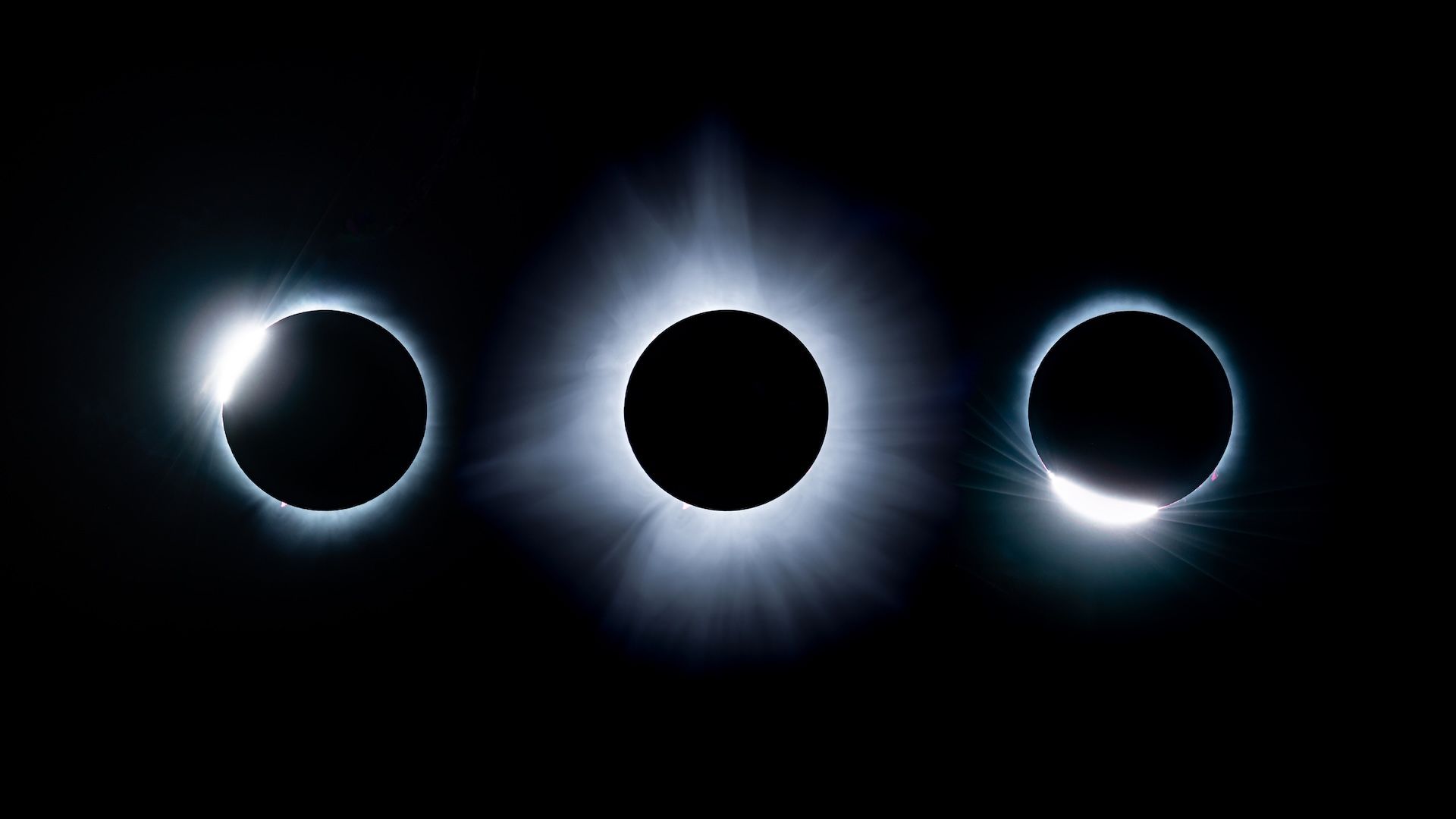
Millions of people across Europe, North America and parts of North Africa will be able to watch the Aug. 12, 2026 solar eclipse. The view will depend on your location: a narrow path from Greenland through Iceland and northeastern Spain will experience a total solar eclipse, much of Europe will see a dramatic deep partial eclipse, and parts of North America will witness a smaller partial eclipse.
Wondering what the August 12 solar eclipse will look like from your location? This guide explains where to see totality, how much of the sun will be covered and the expected viewing times for cities across Europe, North Africa and North America.
Always wear certified solar eclipse glasses during every partial phase of the eclipse. The only time it is safe to remove your eclipse glasses is during totality, when the moon completely covers the sun. If you do not already have a pair, it may still be possible to order last-minute eclipse glasses before eclipse day.
Latest Videos FromLive Science
Where to see totality during the August 12 solar eclipse
The red line marks the path of totality for the Aug. 12, 2026 solar eclipse.
Observers inside the roughly 180-mile-wide (290 kilometers) path of totality — the region crossed by the moon’s darkest shadow — will see the moon completely cover the sun. The path crosses eastern Greenland, western Iceland and northeastern Spain. Totality will last for up to 2 minutes, 18 seconds, depending on your exact location. During this brief period, the sky will darken like twilight, bright stars and planets may become visible, and the sun’s glowing corona will appear around the moon. A handy guide to eclipse-viewing equipment can help you prepare for the experience.
The closer you are to the centerline, the longer totality will last. However, the most important factor is staying inside the path of totality, which has a definite boundary. Madrid, for example, lies just outside the path and will experience a 99.99% partial eclipse — but no totality. The partial phases will last approximately one hour before and after totality.
The following locations are expected to experience totality during the Aug. 12, 2026 total solar eclipse:
Scoresby Sund, Greenland: 4:35 p.m. WGST — up to 2 minutes, 17 seconds
Reykjavik, Iceland: 5:48 p.m. GMT — approximately 60 seconds
León, Spain: 8:28 p.m. CEST — 1 minute, 45 seconds
Soria, Spain: 8:29 p.m. CEST — 1 minute, 43 seconds
North America will see a partial solar eclipse rather than totality. The deepest eclipse will be visible across northern and eastern Canada, Alaska and the northeastern United States. Locations farther northeast will see a greater percentage of the sun covered. The event will last about two hours, and eclipse glasses are required throughout because the moon will never completely block the sun.
Get the world’s most fascinating discoveries delivered straight to your inbox.
Iqaluit, Nunavut: 1:24 p.m. EDT — 61% of the sun covered
St. John’s, Newfoundland and Labrador: 3:00 p.m. NDT — 53%
Fairbanks, Alaska: 8:27 a.m. AKDT — 37%
Anchorage, Alaska: 8:21 a.m. AKDT — 28%
Bangor, Maine: 1:53 p.m. EDT — 23%
Quebec City: 1:46 p.m. EDT — 24%
Montreal: 1:45 p.m. EDT — 18%
Boston: 1:55 p.m. EDT — 16%
New York: 1:54 p.m. EDT — 9%
If you are outside the path of totality, you can still watch the eclipse online. Planned livestreams are expected from NASA and the European Space Agency.
Europe will see a deep partial solar eclipse, while North America will experience a smaller partial eclipse.
(Image credit: GAGAN NAYAR via Getty Images)
Solar eclipse viewing times in Europe and North Africa
Most of Europe and northwestern Africa will experience a spectacular deep partial solar eclipse. In many western European cities, more than 90% of the sun will be covered. Although the eclipse will not reach totality in these locations, the event should still be highly impressive. Certified solar eclipse glasses are necessary throughout the entire eclipse.
The expected maximum eclipse times and coverage for several major cities are listed below:
Madrid: 8:32 p.m. CEST — 99.9%
Barcelona: 8:29 p.m. CEST — 99.8%
Algiers, Algeria: 7:33 p.m. CET — 96%
Nice, France: 8:24 p.m. CEST — 95%
Lisbon, Portugal: 7:36 p.m. WEST — 94%
Dublin, Ireland: 7:10 p.m. BST — 94%
Cardiff, Wales: 7:13 p.m. BST — 93%
Belfast, Northern Ireland: 7:08 p.m. BST — 93%
Paris: 8:17 p.m. CEST — 92%
Tangier, Morocco: 7:40 p.m. WEST — 92%
London: 7:13 p.m. BST — 91%
Edinburgh, Scotland: 7:05 p.m. BST — 91%
For the most accurate local forecast, enter your location into an interactive August 12, 2026 eclipse map. It will show when the eclipse begins, reaches maximum coverage and ends where you are.