


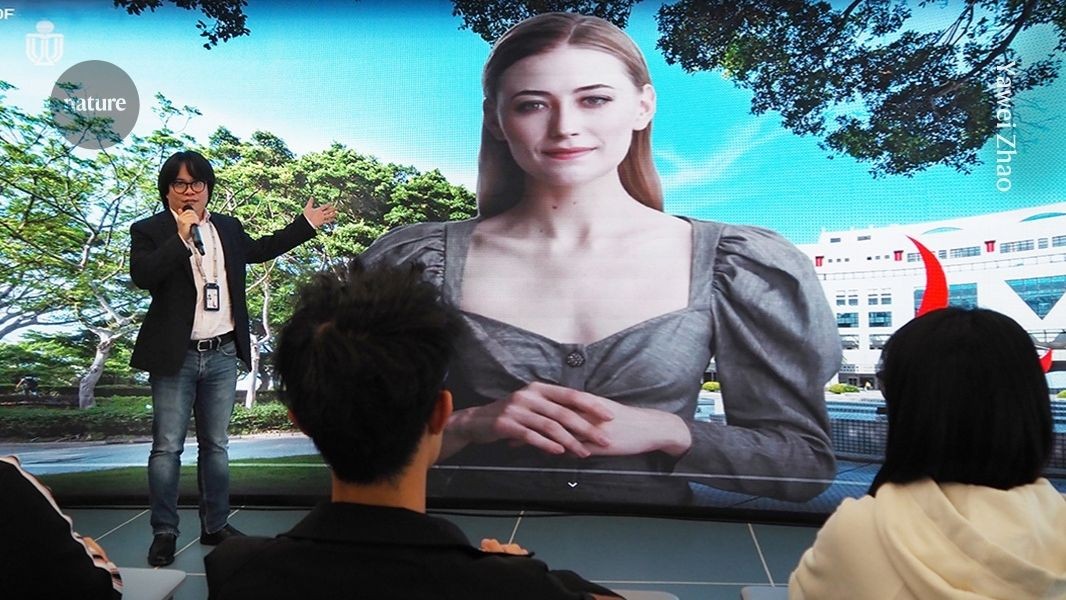
Computer scientist Pan Hui alongside a digital educational avatar from the Hong Kong University of Science and Technology in Guangzhou.
Credit: Zhao Yawei
At the Hong Kong University of Science and Technology, located in Guangzhou, students have the unique opportunity to attend lectures delivered by AI avatars resembling prominent figures such as Albert Einstein and mathematician John Nash. These avatars not only present information but also respond to student inquiries.
The incorporation of virtual avatars is rapidly expanding across various educational settings in China. These advanced computer-generated entities are developed using artificial intelligence tools, including video generation and large-scale language models (LLMs), enabling them to engage in conversation and provide information. Early implementations of this technology included digital sales representatives on platforms like Taobao and China’s Douyin, a counterpart to TikTok.
A recent 2024 report from the Chinese government highlighted that over 1.3 million companies in China offer digital avatar services. Mengjiao Ying, a researcher at Wuxi Taihu University specializing in AI and digital humans, noted their applications in fields like medicine, education, and even as social companions at home. While Yi believes that the use of AI avatars in laboratory settings is on the horizon, it’s not yet a reality.
According to Yang Liu, a computer scientist at Tsinghua University in Beijing, AI avatars, or digital humans, are poised to “significantly transform” our daily lives, reshaping numerous aspects of society. “They will serve as our agents and assistants, managing a range of tasks and enhancing productivity,” he emphasized. However, Liu also pointed out that the technology underpinning these digital entities requires further refinement, along with the establishment of ethical standards governing their operation.
In light of the widespread adoption of AI, the Chinese government is taking proactive measures. The Cyberspace Administration of China has recently introduced a regulation aimed at overseeing the development and application of virtual digital humans, effective today. This regulation is intended to promote the effective use of AI avatars throughout China and to encourage collaboration between academic institutions and digital human technology developers. The integration of AI into everyday life remains a key focus for China, as it is a fundamental element of the nation’s five-year plan for social and economic advancement released this year.
Transforming Medical Care
Yang Liu is part of a dedicated team at Tsinghua University that has developed an innovative virtual hospital simulation called Agent Hospital. This simulation features AI-driven doctors, nurses, and patients, designed specifically to train virtual physicians on disease management, from diagnosis to treatment.1
The Agent Hospital initiative commenced in November 2025 across eight hospitals in China. Within these facilities, human physicians are equipped with personal digital avatars that assist with various tasks, such as managing medical records, recommending tests, and formulating treatment plans. Nevertheless, human doctors maintain ultimate authority over patient care decisions, according to Liu.
Furthermore, Hangzhou’s Ant Group launched an AI-driven health application last June. This app features digital representations of over 1,000 real-life doctors capable of addressing patient inquiries. As of January, the app has garnered 30 million monthly active users, according to company reports.
Enhancing Education
In 2024, computer scientist Pan Hui and his team at the Hong Kong University of Science and Technology began employing AI avatars in educational settings. They have developed 10 digital instructors for various social media subjects, including avatars modeled after Einstein, Nash, and Hui himself, along with fictional characters of varying ages and backgrounds.
Hui’s initiative was sparked by students’ requests for more guest instructors for course content. Their current approach blends conversational AI with recorded video instruction, both of which require substantial computational resources. As advancements continue in the realm of AI avatars, Hui envisions a future where these digital entities serve as always-available personal tutors.
Digital Companions
Furthermore, virtual human services are facilitating social interaction. For example, the networking platform Elys allows users to create AI clones of themselves, enabling interaction with other avatars through comments and likes, even when the human users are offline. Yin noted that some individuals are utilizing this service as a unique way to engage in dating.
Source: www.nature.com