


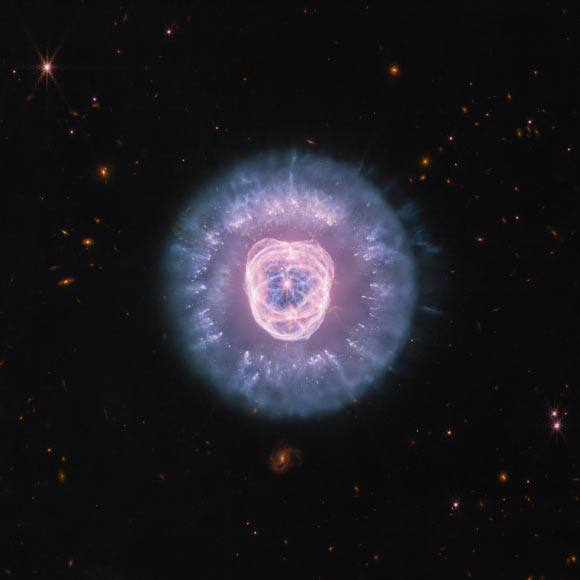
New James Webb Space Telescope infrared observations of the Eskimo Nebula, also known as NGC 2392, reveal intricate clumps of dust, ionized gas and expanding shells surrounding its dying central star.
This Webb/NIRCam/MIRI image shows the Eskimo Nebula, a bipolar planetary nebula about 4,200 light-years away in the constellation of Gemini. Image credit: NASA / ESA / CSA / Webb / STScI / Alyssa Pagan, STScI.
The Eskimo Nebula lies approximately 4,200 light-years from Earth in the constellation of Gemini.
Also called NGC 2392, the Clownface Nebula and the Lion Nebula, this striking planetary nebula was discovered by German-British astronomer William Herschel on January 17, 1787.
“Webb’s infrared vision highlights features such as compact dust clumps and a diffuse haze of ionized gas,” the Webb astronomers said in a statement.
“It has taken several thousand years for this combination of gas and dust to form its present-day structure, and the nebula continues to evolve.”
“The source of these ongoing changes, as well as the Eskimo Nebula’s distinctive appearance, is the dying star at its center.”
“This oxygen-rich central star has left behind a white dwarf that is heating its surroundings from within and creating a bubble of ionized gas.”
“As the gas bubble expands, it destroys dust along its path and reshapes the surrounding material.”
“Explaining why the swept-up gas forms such a complex arrangement of rings and shells, a feature commonly seen in planetary nebulae, remains an active area of research.”
The new infrared image of the Eskimo Nebula was obtained with the NIRCam and MIRI instruments aboard the NASA/ESA/CSA James Webb Space Telescope.
“The Eskimo Nebula will continue changing as its gas and dust move away from the stellar core,” the astronomers said.
“The nebula is expected to disperse in approximately 10,000 years, an extremely brief interval on astronomical timescales.”
Source: www.sci.news