


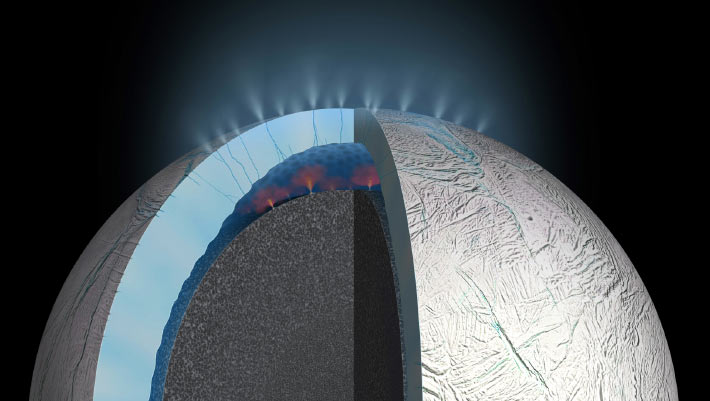
Enceladus’ Salty Ocean Freezes in Complex Ways, Revealing New Clues About Its Hidden Ocean
An analysis of 961 ice grains from Saturn’s E ring shows that spray from Enceladus’ salty subsurface ocean freezes and fragments in a more complex way than planetary scientists previously thought.
Type 3 ice particles are a major constituent group within Enceladus’ plumes and Saturn’s E ring. They are believed to represent frozen, micrometer-sized droplets from Enceladus’ salty subsurface ocean. Image credit: NASA/JPL-Caltech.
Ice grains from Enceladus’ ocean
“Enceladus’ global ocean is thought to lie beneath its icy crust and above its rocky core, where tidal dissipation is thought to drive hydrothermal activity,” said Dr. Frank Postberg of Freie Universität Berlin and colleagues.
Enceladus releases ice particles into Saturn’s E ring through polar volcanic activity. The ring is therefore composed of micrometer- and submicrometer-sized ice dust particles sourced from the moon’s underground ocean.
From 2004 to 2017, the Cosmic Dust Analyzer (CDA) aboard the NASA/ESA Cassini-Huygens spacecraft recorded the composition of individual ice grains using impact ionization mass spectrometry.
“CDA’s analysis of E-ring particles provides important insights into the composition of the subsurface ocean, with much better statistics compared with the rare and short-term data from Cassini’s crossings of the plume,” the researchers said.
Earlier analyses of CDA spectra classified Enceladus’ ice grains into three basic compositional groups. Type 1 grains are nearly pure water ice, with spectral features corresponding to water and sub-parts-per-million amounts of sodium salts. Type 2 grains contain spectral features associated with organic matter. Type 3 grains are salt-rich and indicate a significant increase in salinity.
Five chemical types of salty ice
For the new study, the researchers examined CDA data from 961 Type 3 ice grains.
Rather than finding a uniform salt composition, they identified at least five chemical subtypes. The particles were variously dominated by sodium chloride, sodium carbonate or bicarbonate, sodium phosphate, sodium hydroxide, or potassium salts.
“Enceladus actually does a lot of the work for us in preparing samples for analysis, which normally takes a lot of effort in chemical laboratories on Earth,” Postberg said.
“Ocean components are separated from each other and simultaneously concentrated into individual ice particles.”

Saturn’s moon Enceladus with plumes. Image credit: NASA / JPL-Caltech / SSI / Kevin M. Gill.
How Enceladus’ ocean spray freezes
To explain how the salts separate, the scientists created simulated Enceladus ocean-water droplets in the laboratory. They froze the droplets at a controlled rate and mapped the distribution of salts in the resulting ice.
When relatively large droplets, tens to hundreds of micrometers in diameter, were frozen slowly—at less than about 20 K per minute—different salts crystallized separately. These droplets are much larger than the approximately 1–2 micrometer ice grains detected in Enceladus’ plumes.
Thermodynamic models of the freezing process supported the laboratory results, showing that phosphates, carbonates, and chlorides precipitate at significantly different temperatures.
The findings suggest that Enceladus’ plume particles may form through a two-step process. First, large, salt-laden droplets slowly freeze in icy vents beneath the moon’s surface, separating their mineral contents. The droplets then fragment into the smaller, chemically distinct particles observed by Cassini.
Implications for the search for life
The discovery suggests that analyzing individual ice grains, rather than large amounts of plume material, will be essential for future missions investigating the chemistry and potential habitability of Enceladus’ hidden ocean.
“This is great news in the search for life,” Postberg said.
“Future spacecraft will need to analyze many individual ice particles within the plume.”
“However, if we come across a particle that contains microbial material, it would be relatively easy to identify the biosignature within the particle using the technologies already available.”
The study was published in Science Advances.
_____
Frank Postberg et al. 2026. Cassini CDA observed compositional separation of Enceladus’ ice grains due to slow freezing and fragmentation of ocean spray. Science Advances 12(39). DOI: 10.1126/sciadv.aee7256
Source: www.sci.news