


Bottlenose Dolphins Use Giant Seashells to Hunt Fish in Queensland
Marine biologists have documented Indo-Pacific bottlenose dolphins (Tursiops aduncus) using large seashells to hunt fish off the coast of Queensland, Australia. Known as shelling or bombardment, this rare tool-use behavior has been recorded in only one other location worldwide.
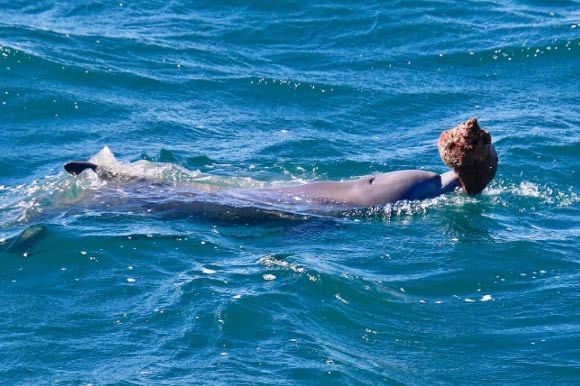
A bottlenose dolphin uses a large shell during a shelling incident recorded on January 4, 2019. Image credit: Levengood et al., doi: 10.1111/mms.70252.
During shelling, a dolphin lifts a large, empty gastropod shell—often a bailer shell (Melo amphora)—to the surface. These shells can grow to about the size of a soccer ball. The dolphin then tilts or shakes the shell, causing a fish hiding inside to slide into the animal’s mouth.
This behavior is considered a form of animal tool use. It is exceptionally rare among wild animals and offers scientists valuable insights into dolphin intelligence, problem-solving abilities, social learning, and culture.
The latest observations were made in Hervey Bay, within the Great Sandy Marine Park in Queensland. This is far from Shark Bay in Western Australia, the only other location where dolphins have previously been observed using shells to capture fish.
“When we were on a research vessel off Hervey Bay, we saw a dolphin raise something large out of the water. We realized it was shelling,” said researcher Dr. Alexis Levengood of the University of the Sunshine Coast.
“Shelling is a hunting behavior in which a dolphin chases a fish into a large, empty shell, lifts the shell to the surface, and shakes it to flush the fish into its mouth.”
“We were able to record and photograph a dolphin using a shell in the Great Sandy Marine Park, providing the first publicly available record of this behavior on Australia’s east coast.”
Researchers documented two shelling incidents in 2025. They also reviewed older photographs dating back to 2013 that were provided by local whale-watching companies.
During the first recent sighting, on July 6, 2025, an adult female dolphin nicknamed Stevie Nicks was observed alone carrying a bailer shell at the water’s surface before eventually dropping it.
The second sighting, recorded on October 1, 2025, provided more evidence of how this behavior may be learned. A mother dolphin named Maserati surfaced with a shell containing a fish. She then dropped the shell and pursued the escaping prey.
A few minutes later, Maserati’s calf, Bentley, was seen in the same area picking up a shell and imitating the behavior. The observation provides the first potential evidence that dolphins in this region learn shelling directly from their mothers through vertical social transmission.
“We saw the mother come to the surface holding the shell, with the fish inside attempting to escape. The dolphin dropped the shell and chased the fish,” Dr. Levengood said.
“After a few minutes, the calf picked up the shell and held it in a similar way to its mother.”
“Our footage provides the first potential evidence of maternal social transmission—the process through which offspring learn behaviors by observing their mothers.”
The findings challenge the idea that dolphins learn shelling primarily from peers and suggest that mothers may play an important role in passing this specialized hunting technique to their calves.
These observations further highlight the intelligence, flexibility, and innovation of bottlenose dolphins. Additional research is needed to understand how shelling relates to dolphin ecology, cognition, culture, and evolution.
The study was published on August 8, 2026, in the journal Marine Mammal Science.
_____
Alexis L. Levengood et al. 2026. Observations of shelling behavior and potential evidence of vertical social learning by bottlenose dolphins in Great Sandy Marine Park, Queensland, Australia. Marine Mammal Science 42 (4): e70252; doi: 10.1111/mms.70252.
Source: www.sci.news