


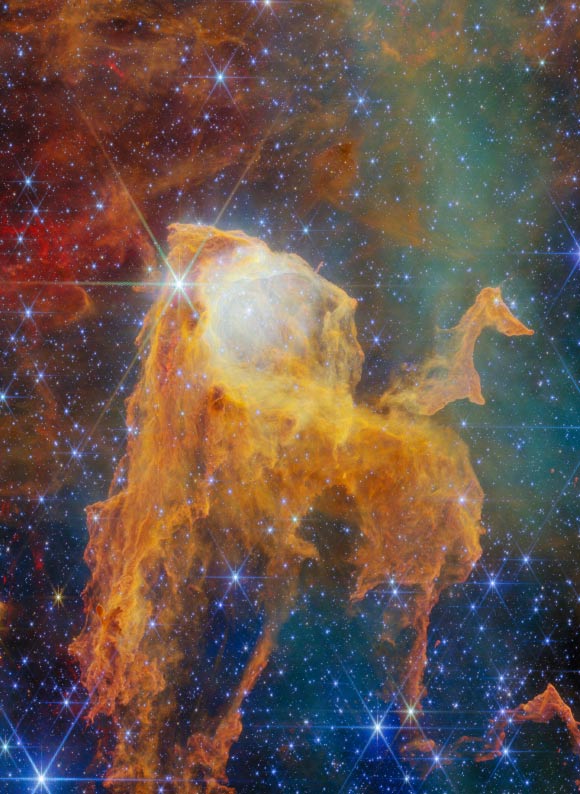
NASA’s James Webb Space Telescope has captured a spectacular view of the “Treasure Chest,” a comet-shaped cloud in the Carina Nebula that conceals a cluster of approximately 70 young stars—including a rare O-type star nearly 19 times more massive than the Sun.
This Webb image shows the Treasure Chest, a cometary globule located within the famous Carina Nebula. Image credit: NASA / ESA / CSA / Webb / M. Reiter / M.H. Özsaraç.
The Carina Nebula, also known as NGC 3372 and Caldwell 92, is located approximately 7,500 light-years from Earth in the constellation Carina.
French astronomer Nicolas Louis de Lacaille discovered the immense nebula during the 1750s.
The Carina Nebula is a dynamic, evolving region filled with thinly distributed interstellar gas and dust. Stretching across roughly 260 light-years, it ranks among the largest star-forming regions in the Milky Way and can be seen with the unaided eye under dark skies.
“The Carina Nebula houses some of the most massive stars in our Galaxy as well as tens of thousands of protostars, offering a valuable opportunity to understand how stars shape their neighborhoods,” the Webb astronomers said in a statement.
“The feature highlighted in the new image, aptly called the Treasure Chest, looks right at home in this celestial sculpture garden.”
The Treasure Chest is a type of cometary globule—an isolated cloud of gas and dust characterized by a dense, dark head and an elongated tail.
Inside the cloud lies a compact cluster of young stars that produces the object’s remarkable glow.
Astronomers observed the Treasure Chest using the James Webb Space Telescope’s Near-Infrared Camera (NIRCam), an instrument designed to study some of the most distant and obscured objects in the Universe.
“The Treasure Chest’s cluster contains about 70 stars, the most massive of which is a rare O-type star roughly 19 times as massive as the Sun,” the researchers said.
The stellar cluster is estimated to be approximately 1.3 million years old. However, earlier studies suggested that it could be as young as 100,000 years.
Because of its extreme youth, the cluster remains deeply embedded within the dusty clouds of the Treasure Chest. The individual stars are also surrounded by dust, and astronomers have found evidence that many of them possess circumstellar disks—the material that can eventually contribute to the formation of planets.
Over millions of years, powerful radiation from the young stars will gradually erode and disperse the surrounding cloud, revealing the full star cluster.
The Treasure Chest’s distinctive comet-like shape is influenced by powerful radiation from outside the Webb image. Approximately 39 light-years to the northwest, as seen from Earth, lies Eta Carinae—the most luminous object in the Carina Nebula.
Eta Carinae is a stellar system containing at least two stars. One of its stars is approximately 100 times more massive than the Sun and shines with a luminosity roughly 5 million times greater than that of our star.
The Treasure Chest is also exposed to intense radiation from the nearby Trumpler 16 star cluster, which contains several extremely hot and massive stars. Together, these powerful stellar sources help shape the cometary globule and illuminate the young stars forming within it.
Source: www.sci.news